
Similar Right Triangles
Similar right triangles form when you draw the altitude from the right angle of a right triangle to its hypotenuse. The altitude splits the triangle into two smaller triangles, and all three triangles are similar. This gives the geometric mean rules for finding the altitude, the legs and the parts of the hypotenuse.
Before this lesson: You should know AA Similarity, Proportions and Simplifying Square Roots.
What Happens When You Draw the Altitude
Start with a right triangle ABC with the right angle at C. Draw a segment from C to the hypotenuse AB so that it meets AB at a right angle. This segment is the altitude to the hypotenuse (see medians and altitudes of triangles). It meets AB at point D.
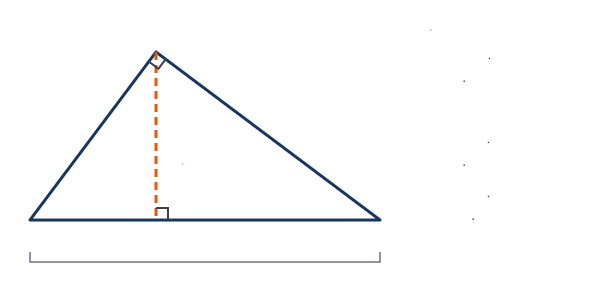
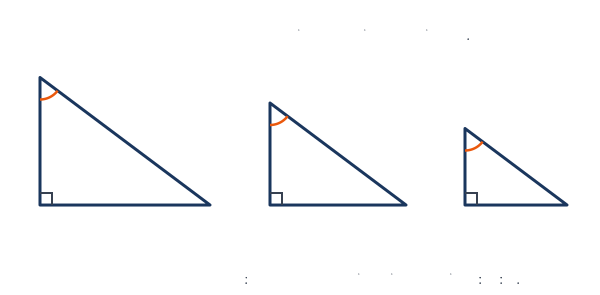
Now there are three right triangles: the big one, △ACB, and two smaller ones, △ADC and △CDB. Each small triangle shares one acute angle with the big triangle. So by AA similarity, each small triangle is similar to the big one. That makes all three triangles similar to each other.
The Geometric Mean
The geometric mean of two positive numbers a and b is the positive number x that makes \frac{a}{x} = \frac{x}{b} true. Cross multiply to get x^2 = ab. Then take the square root.
x = \sqrt{ab}For example, the geometric mean of 4 and 9 is \sqrt{36} = 6, because \frac{4}{6} = \frac{6}{9}. The number 6 sits between 4 and 9, so it is a kind of middle value. You also see this idea in geometric sequences: 4, 6, 9 is one.
The Similar Right Triangles Rules
Use the triangle in the first diagram. The right angle is at C, CD is the altitude, and D is on the hypotenuse AB.
Right triangle similarity theorem: The altitude to the hypotenuse makes two triangles. Both are similar to the original triangle and to each other.
\triangle ACB \sim \triangle CDB \sim \triangle ADC
Altitude rule (geometric mean altitude theorem): The altitude is the geometric mean of the two parts of the hypotenuse.
CD^2 = AD \cdot DB \quad \text{so} \quad CD = \sqrt{AD \cdot DB}Leg rule (geometric mean leg theorem): Each leg is the geometric mean of the whole hypotenuse and the part of the hypotenuse next to that leg.
AC^2 = AD \cdot AB \qquad BC^2 = DB \cdot AB
A quick way to remember the leg rule: a leg squared equals the part next to it times the whole.
Why the Rules Work
The rules come from the side ratios in the similar triangles. Similar triangles have equal side ratios (see similar polygons). In △ADC, the legs are AD and CD. In △CDB, the matching legs are CD and DB. So the ratios match:
\frac{AD}{CD} = \frac{CD}{DB}Cross multiply to get CD^2 = AD \cdot DB. That is the altitude rule.
For the leg rule, compare △ADC with △ACB. Divide the short leg by the hypotenuse in each one:
\frac{AD}{AC} = \frac{AC}{AB}Cross multiply to get AC^2 = AD \cdot AB. The same steps with △CDB and △ACB give BC^2 = DB \cdot AB.
How to Use Similar Right Triangles
- Find the right angle, the altitude and the hypotenuse.
- Label the two parts of the hypotenuse and the whole hypotenuse.
- Choose a rule. Use the altitude rule when the altitude is involved. Use the leg rule when a leg is involved.
- Put in the numbers and solve.
- Take the positive square root, and simplify it.
Worked Examples
Example 1: Find the geometric mean
Find the geometric mean of (a) 5 and 20 and (b) 6 and 8.
- Part (a). Write the rule: x = \sqrt{5 \cdot 20}
- Multiply: x = \sqrt{100}
- Take the square root: x = 10
- Part (b). Write the rule: x = \sqrt{6 \cdot 8}
- Multiply: x = \sqrt{48}
- Write 48 with a perfect square factor: x = \sqrt{16 \cdot 3}
- Take the square root of 16 (see simplifying square roots): x = 4\sqrt{3}
- Use a calculator and round: 4\sqrt{3} \approx 6.93
Answer: (a) 10 (b) 4\sqrt{3} \approx 6.93
Example 2: Find the altitude
In right △ABC, CD is the altitude to the hypotenuse. AD = 4 and DB = 16. Find CD.
- Write the altitude rule: CD^2 = AD \cdot DB
- Substitute the parts: CD^2 = 4 \cdot 16
- Multiply: CD^2 = 64
- Take the positive square root: CD = 8
Answer: CD = 8
Example 3: Find both legs
In right △ABC, CD is the altitude to the hypotenuse. AD = 5 and DB = 15. Find AC and BC.
- Write the whole hypotenuse as a sum: AB = 5 + 15
- Add: AB = 20
- Write the leg rule for AC: AC^2 = AD \cdot AB
- Substitute: AC^2 = 5 \cdot 20
- Multiply: AC^2 = 100
- Take the positive square root: AC = 10
- Write the leg rule for BC: BC^2 = DB \cdot AB
- Substitute: BC^2 = 15 \cdot 20
- Multiply: BC^2 = 300
- Take the positive square root: BC = \sqrt{300}
- Write 300 with a perfect square factor: BC = \sqrt{100 \cdot 3}
- Take the square root of 100: BC = 10\sqrt{3}
Answer: AC = 10 and BC = 10\sqrt{3} \approx 17.32. Check with the Pythagorean theorem: 10^2 + (10\sqrt{3})^2 = 100 + 300 = 400 = 20^2. The hypotenuse is twice the short leg, so this is a 30-60-90 triangle, one of the special right triangles.
Example 4: Find the hypotenuse from a leg
In right △ABC, CD is the altitude to the hypotenuse. AC = 12 and AD = 8. Find AB, DB and CD.
- Write the leg rule: AC^2 = AD \cdot AB
- Substitute: 12^2 = 8 \cdot AB
- Square 12: 144 = 8 \cdot AB
- Divide both sides by 8: 18 = AB
- Write DB as a difference: DB = 18 - 8
- Subtract: DB = 10
- Write the altitude rule: CD^2 = AD \cdot DB
- Substitute: CD^2 = 8 \cdot 10
- Multiply: CD^2 = 80
- Take the positive square root: CD = \sqrt{80}
- Write 80 with a perfect square factor: CD = \sqrt{16 \cdot 5}
- Take the square root of 16: CD = 4\sqrt{5}
- Use a calculator and round: 4\sqrt{5} \approx 8.94
Answer: AB = 18, DB = 10 and CD = 4\sqrt{5} \approx 8.94
Example 5: Word problem with a garden path
A garden bed is shaped like a right triangle. A straight path runs from the right-angle corner to the longest side and meets it at a right angle. The path meets the longest side 9 m from one corner and 16 m from the other. How long is the path? How long are the two shorter sides of the garden?
- The path is the altitude to the hypotenuse, so write the altitude rule: h^2 = 9 \cdot 16
- Multiply: h^2 = 144
- Take the positive square root: h = 12
- Write the hypotenuse as a sum: c = 9 + 16
- Add: c = 25
- Write the leg rule for the side next to the 9 m part: a^2 = 9 \cdot 25
- Multiply: a^2 = 225
- Take the positive square root: a = 15
- Write the leg rule for the side next to the 16 m part: b^2 = 16 \cdot 25
- Multiply: b^2 = 400
- Take the positive square root: b = 20
Answer: The path is 12 m long. The shorter sides are 15 m and 20 m. This is the triangle in the first diagram.
Common Mistakes
| Mistake | Example of the error | Fix |
|---|---|---|
| Using the far part of the hypotenuse for a leg | AC^2 = DB \cdot AB | Use the part next to the leg: AC^2 = AD \cdot AB. |
| Using the whole hypotenuse for the altitude | CD^2 = AD \cdot AB | The altitude uses only the two parts: CD^2 = AD \cdot DB. |
| Using the average instead of the geometric mean | Mean of 4 and 9 is \frac{4 + 9}{2} = 6.5 | Multiply, then take the square root: \sqrt{4 \cdot 9} = 6. |
| Forgetting the square root | CD = 4 \cdot 16 = 64 | That is CD^2. Take the square root: CD = 8. |
| Matching vertices in the wrong order | \triangle ACB \sim \triangle DCA | Match the right angles and the shared angle: \triangle ACB \sim \triangle ADC. |
Another Way to Find the Altitude
If you know both legs and the hypotenuse, use area. The area of △ABC is half of one leg times the other. It is also half of the hypotenuse times the altitude (see area of triangles). Set the two areas equal:
\tfrac{1}{2} \cdot AC \cdot BC = \tfrac{1}{2} \cdot AB \cdot CD \quad \text{so} \quad CD = \frac{AC \cdot BC}{AB}For the garden in Example 5, CD = \frac{15 \cdot 20}{25} = \frac{300}{25} = 12, the same answer.
| What you know | What you want | Rule to use |
|---|---|---|
| Both parts of the hypotenuse | The altitude | CD^2 = AD \cdot DB |
| The altitude and one part | The other part | CD^2 = AD \cdot DB, then divide |
| One part and the whole hypotenuse | The leg next to that part | AC^2 = AD \cdot AB |
| A leg and the part next to it | The whole hypotenuse | AC^2 = AD \cdot AB, then divide |
| Both legs and the hypotenuse | The altitude | CD = \frac{AC \cdot BC}{AB} |
Practice Problems
In problems 3–8, △ABC has a right angle at C, and CD is the altitude to the hypotenuse AB.
- Find the geometric mean of 2 and 18.
- Find the geometric mean of 5 and 10. Give the exact answer, then round to the nearest hundredth.
- AD = 3 and DB = 12. Find CD.
- AD = 6 and DB = 10. Find CD in simplest radical form.
- CD = 10 and AD = 5. Find DB and AB.
- AD = 4 and DB = 5. Find AC and BC.
- AC = 6 and AD = 3. Find AB, DB and CD.
- CD = 12, AD = x and DB = x + 7. Find x and AB.
- A roof truss is a right triangle with the right angle at the peak. A post runs from the peak to the base and meets it at a right angle. It meets the base 4.5 ft from one end and 8 ft from the other. How tall is the post? How long is the longer sloped side?
- Complete the proof in the table below. Given: △ABC has a right angle at C, and CD is the altitude to AB. Prove: AC^2 = AD \cdot AB.
| Statement | Reason |
|---|---|
| 1. \angle ACB and \angle ADC are right angles | ? |
| 2. \angle ACB \cong \angle ADC | ? |
| 3. \angle A \cong \angle A | ? |
| 4. \triangle ACB \sim \triangle ADC | ? |
| 5. \frac{AD}{AC} = \frac{AC}{AB} | ? |
| 6. AC^2 = AD \cdot AB | ? |
Show answers
- Write the rule: x = \sqrt{2 \cdot 18}
Multiply: x = \sqrt{36}
Take the square root: x = 6 - Write the rule: x = \sqrt{5 \cdot 10}
Multiply: x = \sqrt{50}
Write 50 with a perfect square factor: x = \sqrt{25 \cdot 2}
Take the square root of 25: x = 5\sqrt{2}
Use a calculator and round: 5\sqrt{2} \approx 7.07 - Write the altitude rule: CD^2 = 3 \cdot 12
Multiply: CD^2 = 36
Take the positive square root: CD = 6 - Write the altitude rule: CD^2 = 6 \cdot 10
Multiply: CD^2 = 60
Take the positive square root: CD = \sqrt{60}
Write 60 with a perfect square factor: CD = \sqrt{4 \cdot 15}
Take the square root of 4: CD = 2\sqrt{15} \approx 7.75 - Write the altitude rule: 10^2 = 5 \cdot DB
Square 10: 100 = 5 \cdot DB
Divide both sides by 5: 20 = DB
Write AB as a sum: AB = 5 + 20
Add: AB = 25 - Write AB as a sum: AB = 4 + 5
Add: AB = 9
Write the leg rule for AC: AC^2 = 4 \cdot 9
Multiply: AC^2 = 36
Take the positive square root: AC = 6
Write the leg rule for BC: BC^2 = 5 \cdot 9
Multiply: BC^2 = 45
Take the positive square root: BC = \sqrt{45}
Write 45 with a perfect square factor: BC = \sqrt{9 \cdot 5}
Take the square root of 9: BC = 3\sqrt{5} \approx 6.71 - Write the leg rule: 6^2 = 3 \cdot AB
Square 6: 36 = 3 \cdot AB
Divide both sides by 3: 12 = AB
Write DB as a difference: DB = 12 - 3
Subtract: DB = 9
Write the altitude rule: CD^2 = 3 \cdot 9
Multiply: CD^2 = 27
Take the positive square root: CD = \sqrt{27}
Write 27 with a perfect square factor: CD = \sqrt{9 \cdot 3}
Take the square root of 9: CD = 3\sqrt{3} \approx 5.20 - Write the altitude rule: 12^2 = x(x + 7)
Square 12: 144 = x(x + 7)
Use the distributive property: 144 = x^2 + 7x
Subtract 144 from both sides: 0 = x^2 + 7x - 144
Factor (see factoring trinomials): 0 = (x + 16)(x - 9)
Set each factor equal to zero (see solving quadratic equations by factoring): x + 16 = 0 or x - 9 = 0
Solve each equation: x = -16 or x = 9
A length can’t be negative, so x = 9
Write DB as a sum: DB = 9 + 7
Add: DB = 16
Write AB as a sum: AB = 9 + 16
Add: AB = 25 - The post is the altitude, so write the altitude rule: h^2 = 4.5 \cdot 8
Multiply: h^2 = 36
Take the positive square root: h = 6 ft
Write the base as a sum: c = 4.5 + 8
Add: c = 12.5
The longer sloped side is next to the 8 ft part, so write the leg rule: s^2 = 8 \cdot 12.5
Multiply: s^2 = 100
Take the positive square root: s = 10 ft - 1. Given and the definition of an altitude
2. All right angles are congruent
3. Reflexive property of congruence
4. AA similarity
5. Corresponding sides of similar triangles are proportional
6. Cross multiply (cross products property)
FAQ
What is the geometric mean in a right triangle?
The altitude to the hypotenuse is the geometric mean of the two parts of the hypotenuse. Each leg is the geometric mean of the whole hypotenuse and the part next to that leg.
What is the geometric mean theorem?
It is another name for the rules in this lesson. The altitude version says CD^2 = AD \cdot DB. The leg version says a leg squared equals the whole hypotenuse times the part next to that leg.
How do you find the altitude to the hypotenuse?
If you know the two parts of the hypotenuse, multiply them and take the square root. If you know the legs, multiply them and divide by the hypotenuse. For legs 15 and 20 with hypotenuse 25, the altitude is \frac{300}{25} = 12.
Why are the triangles formed by the altitude similar?
Each smaller triangle has a right angle and shares an acute angle with the big triangle. Two pairs of matching angles make the triangles similar by AA.
Summary
- The altitude to the hypotenuse splits a right triangle into two triangles. All three triangles are similar.
- The geometric mean of a and b is \sqrt{ab}.
- Altitude rule: CD^2 = AD \cdot DB.
- Leg rule: AC^2 = AD \cdot AB and BC^2 = DB \cdot AB. Use the part next to the leg.
- Always take the positive square root, and simplify it.
Previous lesson: Special Right Triangles
Next lesson: Trigonometric Ratios
Back to the Geometry Index