
Medians and Altitudes of Triangles
A median of a triangle is a segment from a vertex to the midpoint of the opposite side. An altitude is a segment from a vertex that is perpendicular to the line containing the opposite side. The three medians meet at the centroid, two-thirds of the way along each median. The three altitudes meet at the orthocenter.
Before this lesson: You should know the Midpoint Formula, Circumcenter and Incenter and Parallel and Perpendicular Lines.
Medians, Altitudes and Their Meeting Points
Every triangle has three medians, one from each vertex. They always meet at one point inside the triangle, called the centroid. If you cut a triangle out of cardboard, it balances on the tip of a pencil at the centroid. That is why the centroid is also called the center of gravity.
Every triangle also has three altitudes. An altitude is the height of the triangle when the opposite side is the base. The lines containing the altitudes meet at one point, called the orthocenter.
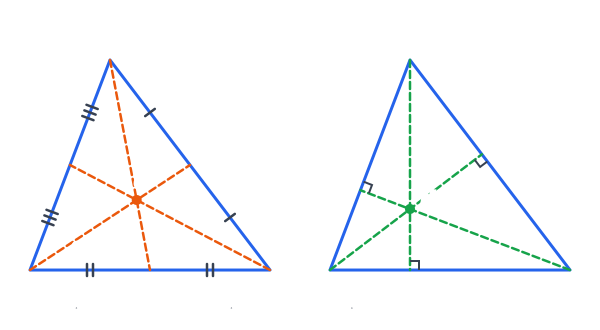
The Centroid Theorem
The centroid of a triangle is two-thirds of the way from each vertex to the midpoint of the opposite side. For median AD with centroid G:
AG = \tfrac{2}{3}AD \qquad GD = \tfrac{1}{3}AD \qquad AG = 2 \cdot GDOn a coordinate plane, the centroid is the average of the three vertices:
G = \left(\frac{x_1 + x_2 + x_3}{3}, \frac{y_1 + y_2 + y_3}{3}\right)| Point | Lines that meet there | Where it lies |
|---|---|---|
| Centroid | Medians | Always inside the triangle |
| Orthocenter | Altitudes (or the lines containing them) | Inside an acute triangle, at the right-angle vertex of a right triangle, outside an obtuse triangle |
How to Work with Medians and Altitudes
- For a median, find the midpoint of the side across from the vertex.
- For an altitude, draw a segment from the vertex that meets the opposite side (or its extension) at a right angle.
- Use the 2-to-1 rule on a median: the vertex-to-centroid piece is twice the centroid-to-midpoint piece.
- On a grid, average the vertices to find the centroid.
- To find the orthocenter on a grid, write equations for two altitudes and find where they cross.
Worked Examples
Example 1: Use the centroid theorem
G is the centroid of \triangle ABC, and median AD is 18 units long. Find AG and GD.
- The centroid is two-thirds of the way from A to D: AG = \tfrac{2}{3}(18)
- Multiply: \tfrac{2}{3}(18) = 12, so AG = 12.
- The rest of the median is GD: GD = 18 - 12 = 6
- Check the 2-to-1 rule: 12 = 2 \times 6
Answer: AG = 12 and GD = 6.
Example 2: Solve for x on a median
G is the centroid of \triangle ABC, and BE is a median. BG = 3x + 4 and GE = 2x - 3. Find x, BG, GE and BE.
- The vertex-to-centroid piece is twice the other piece: 3x + 4 = 2(2x - 3)
- Distribute (see distributive property): 3x + 4 = 4x - 6
- Subtract 3x from both sides (see equations with variables on both sides): 4 = x - 6
- Add 6 to both sides: 10 = x
- Find BG: 3(10) + 4 = 30 + 4 = 34
- Find GE: 2(10) - 3 = 20 - 3 = 17
- Add the pieces: BE = 34 + 17 = 51
Answer: x = 10, BG = 34, GE = 17 and BE = 51. Check: 34 is twice 17.
Example 3: Find the centroid on a grid
Find the centroid of the triangle with vertices A(1, 2), B(7, 4) and C(4, 9). Then check it with median AD.
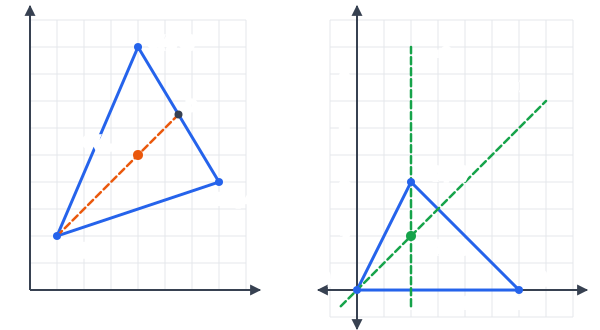
- Add the x-coordinates: 1 + 7 + 4 = 12
- Divide by 3: 12 \div 3 = 4
- Add the y-coordinates: 2 + 4 + 9 = 15
- Divide by 3: 15 \div 3 = 5. So G = (4, 5).
- Check with median AD. Find D, the midpoint of BC (see midpoint formula): \left(\tfrac{7 + 4}{2}, \tfrac{4 + 9}{2}\right) = (5.5, 6.5)
- From A to D, x goes up by 5.5 - 1 = 4.5 and y goes up by 6.5 - 2 = 4.5.
- Two-thirds of 4.5 is \tfrac{2}{3}(4.5) = 3.
- Move 3 right and 3 up from A: (1 + 3, 2 + 3) = (4, 5). It matches.
Answer: The centroid is G(4, 5).
Example 4: Word problem with a balance point
An artist cuts a flat triangular metal plate for a hanging mobile. On a grid in centimeters, its corners are at (0, 0), (12, 0) and (6, 9). Where should she attach the wire so the plate hangs level?
- A flat triangle balances at its centroid.
- Add the x-coordinates: 0 + 12 + 6 = 18
- Divide by 3: 18 \div 3 = 6
- Add the y-coordinates: 0 + 0 + 9 = 9
- Divide by 3: 9 \div 3 = 3
Answer: She should attach the wire at (6, 3), which is 6 cm from the left corner along the base and 3 cm up.
Example 5: Find the orthocenter on a grid
Find the orthocenter of the triangle with vertices A(0, 0), B(6, 0) and C(2, 4). Use the right grid above.
- Side AB lies on the x-axis, so the altitude from C is the vertical line through C: x = 2
- Find the slope of BC (see slope formula): \tfrac{4 - 0}{2 - 6} = \tfrac{4}{-4} = -1
- The altitude from A is perpendicular to BC, so its slope is the opposite reciprocal: 1
- It passes through A(0, 0), so its equation is y = x.
- Substitute x = 2 into y = x: y = 2
- The altitudes cross at H(2, 2).
- Check with the third altitude. The slope of AC is \tfrac{4 - 0}{2 - 0} = 2, so the altitude from B has slope -\tfrac{1}{2}: y = -\tfrac{1}{2}(x - 6)
- Substitute x = 2: -\tfrac{1}{2}(2 - 6) = -\tfrac{1}{2}(-4) = 2. It also passes through (2, 2).
Answer: The orthocenter is H(2, 2).
Common Mistakes
| Mistake | Example of the error | Fix |
|---|---|---|
| Mixing up medians and altitudes | Drawing a median to the foot of the perpendicular | A median goes to the midpoint. An altitude makes a right angle with the opposite side. |
| Using the 2-to-1 rule backward | GD = 2 \cdot AG | The longer piece is next to the vertex: AG = 2 \cdot GD. |
| Using one-half instead of two-thirds | Saying the centroid is halfway along the median | The centroid is \tfrac{2}{3} of the way from the vertex. |
| Dividing by 2 when averaging three points | \tfrac{1 + 7 + 4}{2} = 6 | There are three vertices, so divide by 3. |
| Thinking every altitude is inside the triangle | Looking for the orthocenter inside an obtuse triangle | In an obtuse triangle, two altitudes fall outside, and the orthocenter is outside. |
All Four Triangle Centers
| Center | Lines | Key fact |
|---|---|---|
| Circumcenter | Perpendicular bisectors | Equally far from the vertices |
| Incenter | Angle bisectors | Equally far from the sides |
| Centroid | Medians | Balance point; 2-to-1 on each median |
| Orthocenter | Altitudes | Where the heights meet |
In an isosceles triangle, the median from the vertex angle is also an altitude and an angle bisector. In an equilateral triangle, all four centers are the same point. An altitude is also the height you use for the area of a triangle.
Practice Problems
- G is the centroid of \triangle ABC, and median CF is 27. Find CG and GF.
- G is the centroid, and AG = 14 on median AD. Find GD and AD.
- G is the centroid of \triangle ABC, and CF is a median. CG = 5x - 2 and GF = 2x + 1. Find x, CG and GF.
- Find the centroid of the triangle with vertices (-3, 1), (5, 3) and (1, 8).
- Is an altitude always inside the triangle? Explain.
- Where is the orthocenter of a right triangle?
- In \triangle ABC, segment AD goes from A to the midpoint of BC. Segment AE goes from A and is perpendicular to BC. Which is the median and which is the altitude?
- A triangular sign has corners at (0, 0), (18, 0) and (9, 12) on a grid in inches. Where is its balance point?
- A triangle has a base of 10 cm, and the altitude to that base is 7 cm. Find its area.
- Complete the proof. Given: \overline{AB} \cong \overline{CB}, and D is the midpoint of \overline{AC}. Prove: the median \overline{BD} is also an altitude, so \overline{BD} \perp \overline{AC}. Statements: (1) \overline{AB} \cong \overline{CB}. (2) D is the midpoint of \overline{AC}. (3) \overline{AD} \cong \overline{CD}. (4) \overline{BD} \cong \overline{BD}. (5) \triangle ABD \cong \triangle CBD. (6) \angle ADB \cong \angle CDB. (7) \overline{BD} \perp \overline{AC}. Give a reason for each statement.
Show answers
- CG = \tfrac{2}{3}(27) = 18
GF = 27 - 18 = 9 - AG is twice GD, so GD = 14 \div 2 = 7
AD = 14 + 7 = 21 - Use the 2-to-1 rule: 5x - 2 = 2(2x + 1)
Distribute: 5x - 2 = 4x + 2
Subtract 4x: x - 2 = 2
Add 2: x = 4
CG: 5(4) - 2 = 20 - 2 = 18
GF: 2(4) + 1 = 8 + 1 = 9
Check: 18 is twice 9. - Add the x-coordinates: -3 + 5 + 1 = 3
Divide by 3: 3 \div 3 = 1
Add the y-coordinates: 1 + 3 + 8 = 12
Divide by 3: 12 \div 3 = 4
The centroid is (1, 4). - No. In an obtuse triangle, the altitudes from the two acute angles fall outside the triangle.
- At the vertex of the right angle, because the two legs are altitudes.
- AD is the median (it goes to the midpoint)
AE is the altitude (it is perpendicular to BC) - Add the x-coordinates: 0 + 18 + 9 = 27
Divide by 3: 27 \div 3 = 9
Add the y-coordinates: 0 + 0 + 12 = 12
Divide by 3: 12 \div 3 = 4
The balance point is (9, 4). - Area = one-half times base times height: \tfrac{1}{2}(10)(7)
Multiply: \tfrac{1}{2}(70) = 35
The area is 35 square centimeters. - (1) Given
(2) Given
(3) Definition of midpoint
(4) Reflexive property of congruence
(5) SSS (steps 1, 3 and 4)
(6) CPCTC
(7) Two congruent angles in a linear pair make perpendicular lines
FAQ
What is the difference between a median and an altitude?
A median goes from a vertex to the midpoint of the opposite side. An altitude goes from a vertex to the opposite side at a right angle. They are the same segment only in special cases, like the vertex angle of an isosceles triangle.
What is the centroid of a triangle?
The centroid is the point where the three medians meet. It is the triangle’s balance point, and it sits two-thirds of the way from each vertex to the opposite midpoint.
How do you find the centroid with coordinates?
Add the three x-coordinates and divide by 3. Then add the three y-coordinates and divide by 3.
What is the orthocenter of a triangle?
The orthocenter is the point where the three altitudes, or the lines that contain them, meet. It can be inside, on or outside the triangle.
Summary
- A median joins a vertex to the midpoint of the opposite side.
- An altitude runs from a vertex to the opposite side at a right angle.
- The medians meet at the centroid, which splits each median 2 to 1.
- The centroid’s coordinates are the averages of the vertices’ coordinates.
- The altitudes meet at the orthocenter.
- The centroid is always inside; the orthocenter can be inside, on or outside.
Previous lesson: Circumcenter and Incenter
Next lesson: Triangle Midsegment Theorem
Back to the Geometry Index