
AA Similarity
The AA similarity postulate says that if two angles of one triangle are congruent to two angles of another triangle, then the triangles are similar. You don’t need to check any sides. Once the triangles are similar, their sides are proportional, so you can find missing lengths, like the height of a tree from its shadow.
Before this lesson: You should know Similar Polygons, the Triangle Angle Sum Theorem and Parallel Lines and Transversals.
Why Two Angles Are Enough
To prove polygons similar, you normally check every angle and every side ratio. Triangles have a shortcut. If two angles match, the third angles must match too, because each triangle’s angles add to 180°. And when all three angles match, the triangles have the same shape. They can only differ in size.
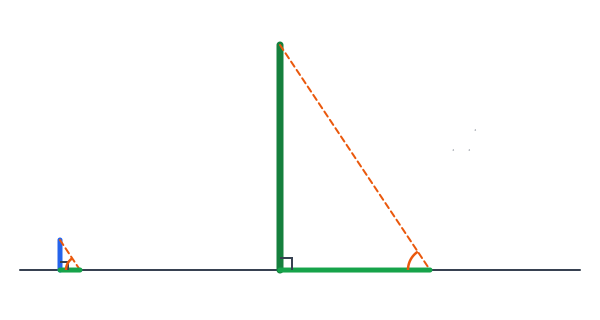
That is why the sun is so useful for measuring. At one moment, the sun’s rays hit the ground at the same angle everywhere nearby. So a person and a tree, with their shadows, form two similar right triangles.
The AA Similarity Postulate
\text{If } \angle A \cong \angle D \text{ and } \angle B \cong \angle E, \text{ then } \triangle ABC \sim \triangle DEF.- Two right triangles are similar if one pair of acute angles matches, because the right angles already match.
- Parallel lines make congruent corresponding and alternate interior angles, which often give the two angles you need.
- Vertical angles and shared angles (the reflexive property) are other common sources of matching angles.
How to Use AA Similarity
- Find two pairs of congruent angles. Look for right angles, parallel lines, vertical angles and shared angles.
- Write the similarity statement with matching vertices in the same order.
- Set up a proportion with corresponding sides.
- Cross multiply and solve.
- Check that the answer makes sense: the larger triangle should have the longer sides.
Worked Examples
Example 1: Are the triangles similar?
In \triangle ABC, m\angle A = 40^\circ and m\angle B = 75^\circ. In \triangle DEF, m\angle D = 40^\circ and m\angle F = 65^\circ. Are the triangles similar? If so, write a similarity statement.
- Find the third angle of \triangle ABC (see triangle angle sum theorem): 180^\circ - 40^\circ - 75^\circ = 65^\circ, so m\angle C = 65^\circ.
- Find the third angle of \triangle DEF: 180^\circ - 40^\circ - 65^\circ = 75^\circ, so m\angle E = 75^\circ.
- Match the angles: A and D are 40°, B and E are 75°, C and F are 65°.
- Two pairs of angles match, so the triangles are similar by AA.
Answer: Yes. \triangle ABC \sim \triangle DEF.
Example 2: A parallel line inside a triangle
In \triangle ABC, D is on AB and E is on AC, with \overline{DE} \parallel \overline{BC}. AD = 4, AB = 10 and DE = 6. Find BC.
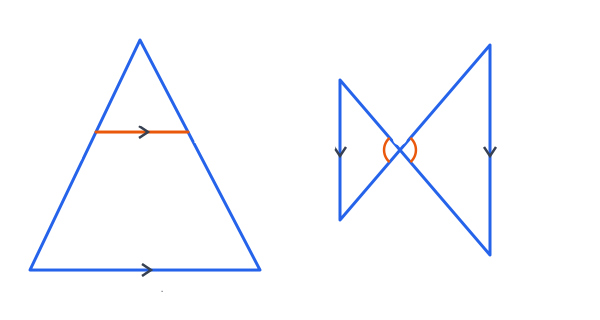
- \angle ADE \cong \angle ABC because they are corresponding angles for the parallel lines.
- \angle A \cong \angle A because the angle is shared.
- By AA, \triangle ADE \sim \triangle ABC.
- Write the proportion: \tfrac{AD}{AB} = \tfrac{DE}{BC}
- Substitute: \tfrac{4}{10} = \tfrac{6}{BC}
- Cross multiply (see proportions): 4 \cdot BC = 60
- Divide both sides by 4: BC = 15
Answer: BC = 15.
Example 3: Solve for x in a bowtie
In the right figure above, segments AE and BD cross at C, and \overline{AB} \parallel \overline{DE}. AC = 8, CE = 12, AB = x + 3 and DE = 18. Find x.
- \angle ACB \cong \angle ECD because they are vertical angles.
- \angle A \cong \angle E because they are alternate interior angles for the parallel lines.
- By AA, \triangle ABC \sim \triangle EDC.
- Write the proportion: \tfrac{AC}{EC} = \tfrac{AB}{ED}
- Substitute: \tfrac{8}{12} = \tfrac{x + 3}{18}
- Cross multiply: 12(x + 3) = 8 \cdot 18
- Multiply on the right: 12(x + 3) = 144
- Divide both sides by 12: x + 3 = 12
- Subtract 3 from both sides: x = 9
Answer: x = 9, so AB = 12. Check: \tfrac{8}{12} = \tfrac{12}{18} = \tfrac{2}{3}.
Example 4: Word problem with shadows
A 6-foot-tall person casts a shadow 4 feet long. At the same moment, a tree casts a shadow 30 feet long. How tall is the tree? This is the first picture above.
- The person and the tree both stand straight up, so each makes a right angle with the ground.
- The sun’s rays hit the ground at the same angle for both.
- By AA, the two triangles are similar.
- Match height to shadow in both triangles: \tfrac{6}{4} = \tfrac{h}{30}
- Cross multiply: 4h = 6 \cdot 30
- Multiply: 4h = 180
- Divide both sides by 4: h = 45
Answer: The tree is 45 feet tall.
Example 5: Two-column proof with AA
Given: \overline{AB} \parallel \overline{DE}, and AE and BD cross at C (right figure above).
Prove: \triangle ABC \sim \triangle EDC
| Statements | Reasons |
|---|---|
| 1. \overline{AB} \parallel \overline{DE} | Given |
| 2. \angle A \cong \angle E | Alternate interior angles theorem |
| 3. \angle B \cong \angle D | Alternate interior angles theorem |
| 4. \triangle ABC \sim \triangle EDC | AA similarity (steps 2 and 3) |
You could also use the vertical angles at C as one of the two pairs. Any two pairs of congruent angles are enough.
Common Mistakes
| Mistake | Example of the error | Fix |
|---|---|---|
| Writing the vertices out of order | \triangle ABC \sim \triangle DEC in the bowtie | Match each angle: A with E and B with D, so \triangle ABC \sim \triangle EDC. |
| Using part of a side in a nested triangle | \tfrac{AD}{DB} = \tfrac{DE}{BC} | Use whole sides of the similar triangles: \tfrac{AD}{AB} = \tfrac{DE}{BC}. |
| Thinking AA proves congruence | Two matching angles, so “the triangles are congruent” | AA proves similar, not congruent. The sizes can differ. |
| Mixing up the ratio order | \tfrac{6}{4} = \tfrac{30}{h} | Keep the same order: height over shadow in both ratios. |
| Forgetting the third angle | Comparing 40°, 75° with 40°, 65° and saying “not similar” | Find the missing angles first. Here they match. |
Other Ways to Prove Triangles Similar
- AA: two pairs of congruent angles (this lesson).
- SSS similarity: all three pairs of sides are proportional.
- SAS similarity: two pairs of sides are proportional and the included angles are congruent.
- The next lesson covers SSS and SAS similarity. They are useful when you know sides instead of angles.
Practice Problems
- One triangle has angles of 50° and 60°. Another has angles of 60° and 70°. Are they similar?
- One triangle has angles of 45° and 85°. Another has angles of 45° and 55°. Are they similar?
- Two right triangles each have an acute angle of 35°. Are they similar? Explain.
- In \triangle ABC, \overline{DE} \parallel \overline{BC} with D on AB and E on AC. AD = 3, DB = 6 and DE = 5. Find BC.
- \triangle ABC \sim \triangle XYZ, with AB = 12, XY = 8 and BC = 15. Find YZ.
- A meter stick standing straight up casts a shadow 0.8 m long. At the same time, a flagpole casts a shadow 6.4 m long. How tall is the flagpole?
- Two triangles are similar by AA. Matching sides give the proportion \tfrac{x - 2}{6} = \tfrac{10}{15}. Find x.
- Maya puts a mirror on the ground 9 m from a building. She stands 2 m from the mirror and sees the top of the building in it. Her eyes are 1.6 m above the ground. The angles at the mirror match. How tall is the building?
- Complete the proof. Given: \overline{DE} \parallel \overline{BC} in \triangle ABC, with D on AB and E on AC. Prove: \triangle ADE \sim \triangle ABC. Statements: (1) \overline{DE} \parallel \overline{BC}. (2) \angle ADE \cong \angle ABC. (3) \angle A \cong \angle A. (4) \triangle ADE \sim \triangle ABC. Give a reason for each statement.
- Are any two equilateral triangles similar? Explain.
Show answers
- Third angles: 180 - 50 - 60 = 70 and 180 - 60 - 70 = 50
Both triangles have angles 50°, 60° and 70°
Yes, similar by AA. - Third angles: 180 - 45 - 85 = 50 and 180 - 45 - 55 = 80
The angles are 45°, 85°, 50° and 45°, 55°, 80°
Only one pair matches, so they are not similar. - Yes. Both have a right angle and a 35° angle, so two pairs of angles match (AA).
- Find AB: 3 + 6 = 9
\triangle ADE \sim \triangle ABC by AA, so \tfrac{AD}{AB} = \tfrac{DE}{BC}
Substitute: \tfrac{3}{9} = \tfrac{5}{BC}
Cross multiply: 3 \cdot BC = 45
Divide by 3: BC = 15 - Proportion: \tfrac{AB}{XY} = \tfrac{BC}{YZ}, so \tfrac{12}{8} = \tfrac{15}{YZ}
Cross multiply: 12 \cdot YZ = 120
Divide by 12: YZ = 10 - Height over shadow: \tfrac{1}{0.8} = \tfrac{h}{6.4}
Cross multiply: 0.8h = 6.4
Divide by 0.8: h = 8
The flagpole is 8 m tall. - Cross multiply: 15(x - 2) = 60
Divide by 15: x - 2 = 4
Add 2: x = 6 - The two triangles are similar by AA (right angles at the ground and matching angles at the mirror)
Height over distance: \tfrac{1.6}{2} = \tfrac{h}{9}
Cross multiply: 2h = 14.4
Divide by 2: h = 7.2
The building is 7.2 m tall. - (1) Given
(2) Corresponding angles theorem
(3) Reflexive property of congruence
(4) AA similarity (steps 2 and 3) - Yes. Every angle of an equilateral triangle is 60°, so any two of them have two pairs of congruent angles.
FAQ
What is the AA similarity postulate?
If two angles of one triangle are congruent to two angles of another triangle, the triangles are similar.
Why don’t you need all three angles for AA?
The angles of every triangle add to 180°. If two pairs match, the third pair must match too.
Does AA prove triangles congruent?
No. AA proves the triangles have the same shape, so they are similar. They can be different sizes.
How do you find the height of a tree with similar triangles?
Measure the tree’s shadow, a person’s height and the person’s shadow at the same time. Set height over shadow equal for both and solve.
Summary
- Two pairs of congruent angles prove two triangles similar (AA).
- Look for right angles, parallel lines, vertical angles and shared angles.
- Write the similarity statement in matching order.
- Use proportions of corresponding sides to find missing lengths.
- Shadow and mirror problems use AA similarity.
Previous lesson: Similar Polygons
Next lesson: SSS and SAS Similarity
Back to the Geometry Index