
Triangle Angle Bisector Theorem
The triangle angle bisector theorem says that an angle bisector of a triangle splits the opposite side into two parts that are proportional to the other two sides. If \overline{AD} bisects \angle A, then \tfrac{BD}{DC} = \tfrac{AB}{AC}. Use it to find a missing segment or a missing side length.
Before this lesson: You should know the Triangle Proportionality Theorem, Perpendicular and Angle Bisectors and Proportions.
What the Theorem Means
An angle bisector cuts an angle into two equal angles. In a triangle, the bisector of one angle runs across to the opposite side. It does not usually hit the midpoint of that side. This is different from the angle bisector theorem in Perpendicular and Angle Bisectors, which says any point on an angle bisector is the same distance from both sides of the angle.
Instead, it lands closer to the shorter side. If one side next to the angle is 6 and the other is 9, the opposite side is split in the ratio 6 to 9, which is 2 to 3.
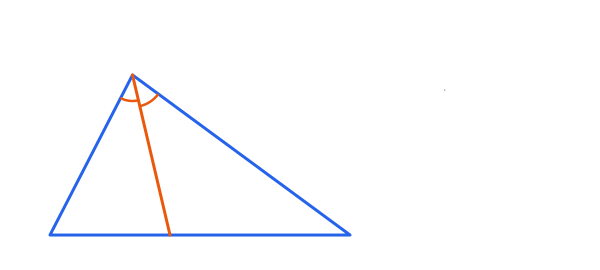
The Triangle Angle Bisector Theorem
\text{If } \overline{AD} \text{ bisects } \angle BAC, \text{ then } \dfrac{BD}{DC} = \dfrac{AB}{AC}.- Each segment of the opposite side pairs with the side it touches: BD touches AB, and DC touches AC.
- The converse is also true: if \tfrac{BD}{DC} = \tfrac{AB}{AC}, then \overline{AD} bisects \angle BAC.
- You can also write the proportion as \tfrac{BD}{AB} = \tfrac{DC}{AC}. It is the same relationship.
How to Use the Triangle Angle Bisector Theorem
- Find the angle that is bisected and the side across from it.
- Match each part of that side with the side of the triangle it touches.
- Write the proportion: \tfrac{BD}{DC} = \tfrac{AB}{AC}
- Substitute the known lengths. If you only know the whole side, call one part x and the other part the whole minus x.
- Cross multiply and solve.
Worked Examples
Example 1: Find a missing segment
In \triangle ABC, \overline{AD} bisects \angle A. AB = 8, AC = 12 and BD = 6. Find DC.
- Write the proportion: \tfrac{BD}{DC} = \tfrac{AB}{AC}
- Substitute: \tfrac{6}{DC} = \tfrac{8}{12}
- Cross multiply (see proportions): 8 \cdot DC = 6 \cdot 12
- Multiply: 8 \cdot DC = 72
- Divide both sides by 8: DC = 9
Answer: DC = 9. Check: \tfrac{6}{9} = \tfrac{2}{3} and \tfrac{8}{12} = \tfrac{2}{3}.
Example 2: Find a missing side
In \triangle ABC, \overline{AD} bisects \angle A. BD = 5, DC = 7 and AB = 10. Find AC.
- Write the proportion: \tfrac{BD}{DC} = \tfrac{AB}{AC}
- Substitute: \tfrac{5}{7} = \tfrac{10}{AC}
- Cross multiply: 5 \cdot AC = 7 \cdot 10
- Multiply: 5 \cdot AC = 70
- Divide both sides by 5: AC = 14
Answer: AC = 14.
Example 3: Split a whole side
In \triangle ABC, AB = 6, AC = 9 and BC = 10. \overline{AD} bisects \angle A. Find BD and DC. This is the first picture above.
- Let BD = x, so DC = 10 - x.
- Write the proportion: \tfrac{x}{10 - x} = \tfrac{6}{9}
- Cross multiply: 9x = 6(10 - x)
- Distribute (see distributive property): 9x = 60 - 6x
- Add 6x to both sides: 15x = 60
- Divide both sides by 15: x = 4
- Find DC: 10 - 4 = 6
Answer: BD = 4 and DC = 6.
Example 4: Word problem with a path
A triangular lot has two fences, 120 ft and 180 ft long, that meet at a corner. A straight path bisects the angle at that corner and runs to the third side, which is 200 ft long. How far from each end of the third side does the path meet it?
- Let the part next to the 120 ft fence be x, so the other part is 200 - x.
- Write the proportion: \tfrac{x}{200 - x} = \tfrac{120}{180}
- Simplify the right side: \tfrac{x}{200 - x} = \tfrac{2}{3}
- Cross multiply: 3x = 2(200 - x)
- Distribute: 3x = 400 - 2x
- Add 2x to both sides: 5x = 400
- Divide both sides by 5: x = 80
- Find the other part: 200 - 80 = 120
Answer: The path meets the third side 80 ft from the end next to the 120 ft fence and 120 ft from the other end.
Example 5: Paragraph proof of the theorem
Given: \overline{AD} bisects \angle BAC in \triangle ABC.
Prove: \tfrac{BD}{DC} = \tfrac{AB}{AC}
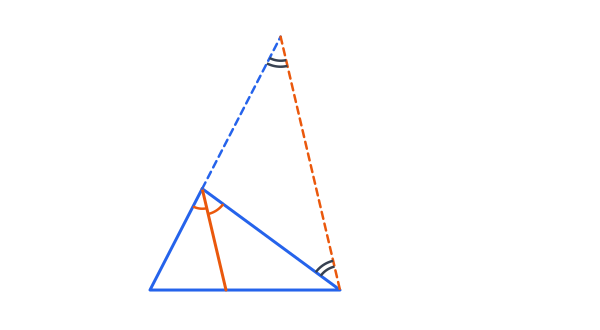
Extend \overline{BA} past A, and draw a line through C parallel to \overline{AD}. Call the point where they meet E. Then \angle AEC \cong \angle BAD because they are corresponding angles. Also, \angle ACE \cong \angle DAC because they are alternate interior angles.
Since \angle BAD \cong \angle DAC, the two new angles are congruent too: \angle AEC \cong \angle ACE. So \triangle ACE is isosceles, and AE = AC (see isosceles and equilateral triangles).
In \triangle BCE, \overline{AD} \parallel \overline{EC}. By the triangle proportionality theorem, \tfrac{BD}{DC} = \tfrac{BA}{AE}. Replace AE with AC to get \tfrac{BD}{DC} = \tfrac{AB}{AC}.
Common Mistakes
| Mistake | Example of the error | Fix |
|---|---|---|
| Pairing a segment with the wrong side | \tfrac{BD}{DC} = \tfrac{AC}{AB} | Pair each segment with the side it touches: BD with AB, DC with AC. |
| Thinking the bisector hits the midpoint | AB = 6, AC = 9, BC = 10, so “BD = 5” | The bisector hits the midpoint only when AB = AC. Here BD = 4. |
| Using the whole side as a part | \tfrac{BD}{BC} = \tfrac{AB}{AC} | Compare part to part: \tfrac{BD}{DC} = \tfrac{AB}{AC}. |
| Mixing it up with a perpendicular bisector | Assuming AD is perpendicular to BC | An angle bisector splits the angle in half. It is usually not perpendicular to the opposite side. |
| Forgetting the second part | Finding BD = 4 and stopping when asked for both parts | Subtract from the whole side: DC = 10 - 4 = 6. |
Angle Bisectors, Medians and Perpendicular Bisectors
| Segment | What it does | Where it meets the opposite side |
|---|---|---|
| Angle bisector | Splits an angle into two equal angles | In the ratio of the two nearby sides |
| Median | Joins a vertex to the midpoint of the opposite side | At the midpoint |
| Perpendicular bisector | Crosses a side at its midpoint at a right angle | At the midpoint, at 90° |
The three angle bisectors of a triangle meet at one point, the incenter. See circumcenter and incenter. For medians, see medians and altitudes of triangles.
Practice Problems
- In \triangle ABC, \overline{AD} bisects \angle A. AB = 5, AC = 10 and BD = 3. Find DC.
- In \triangle ABC, \overline{AD} bisects \angle A. AB = 12, AC = 8 and DC = 4. Find BD.
- In \triangle ABC, \overline{AD} bisects \angle A. BD = 4, DC = 6 and AC = 15. Find AB.
- In \triangle ABC, \overline{AD} bisects \angle A. AB = x, AC = 14, BD = 3 and DC = 7. Find x.
- In \triangle ABC, AB = 7, AC = 21 and BC = 16. \overline{AD} bisects \angle A. Find BD and DC.
- In \triangle ABC, \overline{AD} bisects \angle A. BD = x + 1, DC = 2x, AB = 6 and AC = 8. Find x, BD and DC.
- In \triangle ABC, D is on BC. AB = 9, AC = 12, BD = 6 and DC = 8. Does \overline{AD} bisect \angle A?
- In \triangle ABC, D is on BC. AB = 10, AC = 15, BD = 5 and DC = 8. Does \overline{AD} bisect \angle A?
- Two roads lead from town A: one 30 mi to town B and one 50 mi to town C. The road from B to C is 64 mi long. A new road bisects the angle at A and meets road BC at D. How far is D from B?
- Complete the proof. Given: \overline{AD} bisects \angle BAC, AB = 6, AC = 9 and BD = 4. Prove: DC = 6. Statements: (1) the given facts. (2) \tfrac{BD}{DC} = \tfrac{AB}{AC}. (3) \tfrac{4}{DC} = \tfrac{6}{9}. (4) 6 \cdot DC = 36. (5) DC = 6. Give a reason for each statement.
Show answers
- Proportion: \tfrac{3}{DC} = \tfrac{5}{10}
Cross multiply: 5 \cdot DC = 30
Divide by 5: DC = 6 - Proportion: \tfrac{BD}{4} = \tfrac{12}{8}
Cross multiply: 8 \cdot BD = 48
Divide by 8: BD = 6 - Proportion: \tfrac{4}{6} = \tfrac{AB}{15}
Cross multiply: 6 \cdot AB = 60
Divide by 6: AB = 10 - Proportion: \tfrac{3}{7} = \tfrac{x}{14}
Cross multiply: 7x = 42
Divide by 7: x = 6 - Let BD = x, so DC = 16 - x
Proportion: \tfrac{x}{16 - x} = \tfrac{7}{21} = \tfrac{1}{3}
Cross multiply: 3x = 16 - x
Add x to both sides: 4x = 16
Divide by 4: x = 4
BD = 4 and DC = 16 - 4 = 12 - Proportion: \tfrac{x + 1}{2x} = \tfrac{6}{8}
Cross multiply: 8(x + 1) = 12x
Distribute: 8x + 8 = 12x
Subtract 8x from both sides: 8 = 4x
Divide by 4: x = 2
BD = 2 + 1 = 3 and DC = 2 \cdot 2 = 4 - Ratios: \tfrac{BD}{DC} = \tfrac{6}{8} = 0.75 and \tfrac{AB}{AC} = \tfrac{9}{12} = 0.75
The ratios are equal, so yes, AD bisects \angle A (converse). - Ratios: \tfrac{BD}{DC} = \tfrac{5}{8} = 0.625 and \tfrac{AB}{AC} = \tfrac{10}{15} \approx 0.667
The ratios are different, so no. - Let BD = x, so DC = 64 - x
Proportion: \tfrac{x}{64 - x} = \tfrac{30}{50} = \tfrac{3}{5}
Cross multiply: 5x = 3(64 - x)
Distribute: 5x = 192 - 3x
Add 3x to both sides: 8x = 192
Divide by 8: x = 24
D is 24 mi from B. - (1) Given
(2) Triangle angle bisector theorem
(3) Substitution
(4) Cross products property: 6 \cdot DC = 4 \cdot 9
(5) Division property of equality
FAQ
What is the triangle angle bisector theorem?
An angle bisector of a triangle divides the opposite side into two segments in the same ratio as the other two sides.
Does an angle bisector cut the opposite side in half?
Only when the two sides next to the angle are equal, as in an isosceles triangle. Otherwise the bisector lands closer to the shorter side.
What is the converse of the triangle angle bisector theorem?
If a segment from a vertex splits the opposite side in the same ratio as the other two sides, then it bisects the angle at that vertex.
How do you find both segments when you know the whole side?
Call one segment x and the other the whole side minus x. Set up the proportion, solve for x, then subtract.
Summary
- If \overline{AD} bisects \angle A, then \tfrac{BD}{DC} = \tfrac{AB}{AC}.
- Pair each segment with the side it touches.
- The bisector lands closer to the shorter side, not at the midpoint.
- If you know the whole side, use x and the whole minus x.
- The converse tells you when a segment is an angle bisector.
Previous lesson: Triangle Proportionality Theorem
Next lesson: Pythagorean Theorem
Back to the Geometry Index