
Triangle Proportionality Theorem
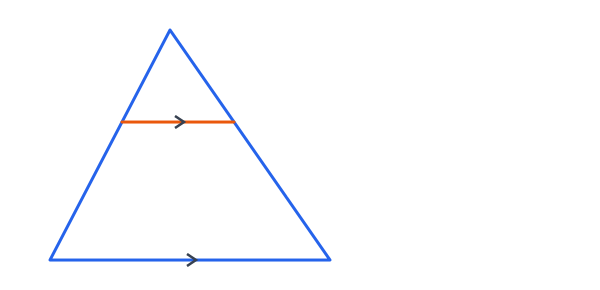
The triangle proportionality theorem says that if a line is parallel to one side of a triangle and crosses the other two sides, it splits those sides proportionally. So if \overline{DE} \parallel \overline{BC}, then \tfrac{AD}{DB} = \tfrac{AE}{EC}. It is also called the side splitter theorem. Its converse lets you test whether two segments are parallel.
Before this lesson: You should know AA Similarity, SSS and SAS Similarity, Parallel Lines and Transversals and Proportions.
Why a Parallel Line Splits Sides Proportionally
Draw a segment inside a triangle, parallel to one side. It cuts off a small triangle at the top. The small triangle and the whole triangle have the same angles, so they are similar by AA.
Because the triangles are similar, each side is cut in the same ratio. If the parallel segment is 40% of the way down one side, it is also 40% of the way down the other side. The triangle midsegment theorem is the special case where the segment joins the midpoints, so both sides are cut in half.
The Triangle Proportionality Theorem and Its Converse
Theorem: if a line parallel to one side of a triangle crosses the other two sides, it divides them proportionally.
\text{If } \overline{DE} \parallel \overline{BC}, \text{ then } \dfrac{AD}{DB} = \dfrac{AE}{EC}.Converse: if a line divides two sides of a triangle proportionally, it is parallel to the third side.
\text{If } \dfrac{AD}{DB} = \dfrac{AE}{EC}, \text{ then } \overline{DE} \parallel \overline{BC}.Three parallel lines: if three or more parallel lines cross two transversals, they divide the transversals proportionally. A transversal is a line that crosses other lines.
How to Use the Triangle Proportionality Theorem
- Check that the segment is parallel to a side of the triangle.
- Write the proportion with matching parts: top part over bottom part on both sides.
- Substitute the known lengths.
- Cross multiply and solve.
- To find the length of the parallel segment itself, use similar triangles with whole sides instead.
Worked Examples
Example 1: Find a missing segment
In \triangle ABC, \overline{DE} \parallel \overline{BC}. AD = 4, DB = 6 and AE = 6. Find EC = x. This is the first picture above.
- Write the proportion: \tfrac{AD}{DB} = \tfrac{AE}{EC}
- Substitute: \tfrac{4}{6} = \tfrac{6}{x}
- Cross multiply (see proportions): 4x = 6 \cdot 6
- Multiply: 4x = 36
- Divide both sides by 4: x = 9
Answer: EC = 9. Check: \tfrac{4}{6} = \tfrac{2}{3} and \tfrac{6}{9} = \tfrac{2}{3}.
Example 2: Solve for x with an expression
In \triangle ABC, \overline{DE} \parallel \overline{BC}. AD = x + 2, DB = 9, AE = 8 and EC = 12. Find x and AD.
- Write the proportion: \tfrac{AD}{DB} = \tfrac{AE}{EC}
- Substitute: \tfrac{x + 2}{9} = \tfrac{8}{12}
- Cross multiply: 12(x + 2) = 9 \cdot 8
- Multiply on the right: 12(x + 2) = 72
- Divide both sides by 12: x + 2 = 6
- Subtract 2 from both sides: x = 4
- Find AD: AD = 4 + 2 = 6
Answer: x = 4 and AD = 6.
Example 3: Use the converse to test for parallel
In \triangle ABC, D is on AB and E is on AC. AD = 6, DB = 9, AE = 8 and EC = 12. Is \overline{DE} parallel to \overline{BC}?
- Find the first ratio: \tfrac{AD}{DB} = \tfrac{6}{9}
- Simplify: \tfrac{6}{9} = \tfrac{2}{3}
- Find the second ratio: \tfrac{AE}{EC} = \tfrac{8}{12}
- Simplify: \tfrac{8}{12} = \tfrac{2}{3}
- The ratios are equal, so the converse applies.
Answer: Yes, \overline{DE} \parallel \overline{BC}.
Example 4: Word problem with parallel streets
Three parallel streets cross Main Avenue and Oak Avenue. Along Main, the blocks are 300 ft and 450 ft long. Along Oak, the first block is 400 ft long. How long is the second block on Oak?
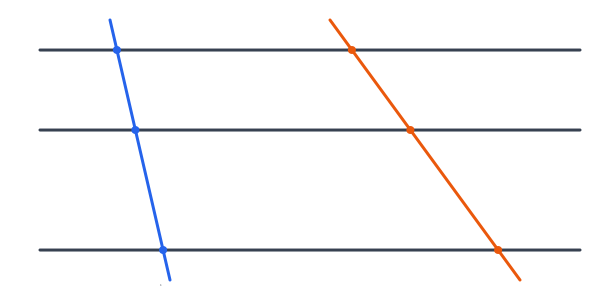
- The streets are parallel, so they divide the avenues proportionally.
- Write the proportion, first block over second block: \tfrac{300}{450} = \tfrac{400}{x}
- Cross multiply: 300x = 450 \cdot 400
- Multiply: 300x = 180{,}000
- Divide both sides by 300: x = 600
Answer: The second block on Oak Avenue is 600 ft long.
Example 5: Paragraph proof of the theorem
Given: \overline{DE} \parallel \overline{BC} in \triangle ABC, with D on AB and E on AC.
Prove: \tfrac{AD}{DB} = \tfrac{AE}{EC}
Since \overline{DE} \parallel \overline{BC}, \angle ADE \cong \angle ABC because they are corresponding angles. Also, \angle A \cong \angle A. So \triangle ADE \sim \triangle ABC by AA. Corresponding sides of similar triangles are proportional, so \tfrac{AB}{AD} = \tfrac{AC}{AE}.
- Replace each whole side with its two parts: \tfrac{AD + DB}{AD} = \tfrac{AE + EC}{AE}
- Split each fraction: 1 + \tfrac{DB}{AD} = 1 + \tfrac{EC}{AE}
- Subtract 1 from both sides: \tfrac{DB}{AD} = \tfrac{EC}{AE}
- Flip both fractions: \tfrac{AD}{DB} = \tfrac{AE}{EC}
Common Mistakes
| Mistake | Example of the error | Fix |
|---|---|---|
| Using the side splitter to find the parallel segment | \tfrac{AD}{DB} = \tfrac{DE}{BC} | For DE or BC, use whole sides of the similar triangles: \tfrac{AD}{AB} = \tfrac{DE}{BC}. |
| Mixing up the order | \tfrac{AD}{DB} = \tfrac{EC}{AE} | Keep the same order on both sides: top part over bottom part. |
| Assuming a segment is parallel | Using the theorem when DE only looks parallel | Use the converse first: check that the two ratios are equal. |
| Cross multiplying the wrong pairs | \tfrac{4}{6} = \tfrac{6}{x} becomes 4 \cdot 6 = 6x | Multiply across the diagonals: 4x = 6 \cdot 6. |
| Using a whole side on one side of the proportion only | \tfrac{AD}{AB} = \tfrac{AE}{EC} | Use parts with parts, \tfrac{AD}{DB} = \tfrac{AE}{EC}, or wholes with wholes, \tfrac{AD}{AB} = \tfrac{AE}{AC}. |
Proportions You Can Write
| When \overline{DE} \parallel \overline{BC} | Proportion |
|---|---|
| Parts of the sides | \tfrac{AD}{DB} = \tfrac{AE}{EC} |
| Top part to whole side | \tfrac{AD}{AB} = \tfrac{AE}{AC} |
| Bottom part to whole side | \tfrac{DB}{AB} = \tfrac{EC}{AC} |
| Parallel segments (similar triangles) | \tfrac{AD}{AB} = \tfrac{DE}{BC} |
Practice Problems
- In \triangle ABC, \overline{DE} \parallel \overline{BC}. AD = 3, DB = 6 and AE = 4. Find EC.
- In \triangle ABC, \overline{DE} \parallel \overline{BC}. AD = 10, DB = 5 and EC = 4. Find AE.
- In \triangle ABC, \overline{DE} \parallel \overline{BC}. AD = x, DB = 12, AE = 5 and EC = 15. Find x.
- In \triangle ABC, \overline{DE} \parallel \overline{BC}. AD = x - 1, DB = 8, AE = 6 and EC = 12. Find x.
- AD = 4, DB = 10, AE = 6 and EC = 15. Is \overline{DE} \parallel \overline{BC}?
- AD = 5, DB = 8, AE = 6 and EC = 9. Is \overline{DE} \parallel \overline{BC}?
- In \triangle ABC, \overline{DE} \parallel \overline{BC}. AD = 4, DB = 8 and DE = 5. Find BC.
- Three parallel lines cross two transversals. On one transversal, the segments are 4 and 10. On the other, the matching segments are 6 and x. Find x.
- A triangular garden ABC has a fence DE parallel to side BC, with D on AB and E on AC. AD = 9 m, DB = 6 m and AC = 20 m. Find AE.
- Complete the proof. Given: AD = 2, DB = 3, AE = 4 and EC = 6 in \triangle ABC. Prove: \overline{DE} \parallel \overline{BC}. Statements: (1) the given lengths. (2) \tfrac{AD}{DB} = \tfrac{2}{3}. (3) \tfrac{AE}{EC} = \tfrac{2}{3}. (4) \tfrac{AD}{DB} = \tfrac{AE}{EC}. (5) \overline{DE} \parallel \overline{BC}. Give a reason for each statement.
Show answers
- Proportion: \tfrac{3}{6} = \tfrac{4}{EC}
Cross multiply: 3 \cdot EC = 24
Divide by 3: EC = 8 - Proportion: \tfrac{10}{5} = \tfrac{AE}{4}
Cross multiply: 5 \cdot AE = 40
Divide by 5: AE = 8 - Proportion: \tfrac{x}{12} = \tfrac{5}{15}
Cross multiply: 15x = 60
Divide by 15: x = 4 - Proportion: \tfrac{x - 1}{8} = \tfrac{6}{12}
Cross multiply: 12(x - 1) = 48
Divide by 12: x - 1 = 4
Add 1: x = 5 - Ratios: \tfrac{4}{10} = 0.4 and \tfrac{6}{15} = 0.4
The ratios are equal, so yes, \overline{DE} \parallel \overline{BC}. - Ratios: \tfrac{5}{8} = 0.625 and \tfrac{6}{9} \approx 0.667
The ratios are different, so no, DE is not parallel to BC. - Find AB: 4 + 8 = 12
Similar triangles: \tfrac{AD}{AB} = \tfrac{DE}{BC}
Substitute: \tfrac{4}{12} = \tfrac{5}{BC}
Cross multiply: 4 \cdot BC = 60
Divide by 4: BC = 15 - Proportion: \tfrac{4}{10} = \tfrac{6}{x}
Cross multiply: 4x = 60
Divide by 4: x = 15 - Let AE = t, so EC = 20 - t
Proportion: \tfrac{9}{6} = \tfrac{t}{20 - t}
Cross multiply: 9(20 - t) = 6t
Distribute (see distributive property): 180 - 9t = 6t
Add 9t to both sides: 180 = 15t
Divide by 15: t = 12
AE = 12 m - (1) Given
(2) Substitution
(3) Substitution and simplifying: \tfrac{4}{6} = \tfrac{2}{3}
(4) Transitive property of equality
(5) Converse of the triangle proportionality theorem
FAQ
What is the triangle proportionality theorem?
If a line is parallel to one side of a triangle and crosses the other two sides, it divides those two sides proportionally.
What is the side splitter theorem?
It is another name for the triangle proportionality theorem. The parallel segment “splits” the two sides in the same ratio.
What is the converse of the triangle proportionality theorem?
If a segment divides two sides of a triangle proportionally, then it is parallel to the third side. Use it to prove that two segments are parallel.
Can the theorem find the length of the parallel segment?
Not directly. To find DE or BC, use the similar triangles and whole sides: \tfrac{AD}{AB} = \tfrac{DE}{BC}.
Summary
- If \overline{DE} \parallel \overline{BC}, then \tfrac{AD}{DB} = \tfrac{AE}{EC}.
- The converse proves segments parallel when the ratios are equal.
- Three or more parallel lines divide any two transversals proportionally.
- Keep the same order in both ratios: top part over bottom part.
- To find the parallel segment, use similar triangles with whole sides.
Previous lesson: SSS and SAS Similarity
Next lesson: Triangle Angle Bisector Theorem
Back to the Geometry Index