
SSS and SAS Similarity
SSS and SAS similarity are two ways to prove triangles similar using their sides. With SSS similarity, all three pairs of sides are proportional. With SAS similarity, two pairs of sides are proportional and the angles between them are congruent. Then the triangles have the same shape, so you can find missing sides and angles.
Before this lesson: You should know AA Similarity, Similar Polygons and Proportions.
Why Proportional Sides Are Enough
Similar triangles are scaled copies of each other. Every side is multiplied by the same number, called the scale factor. So if all three side ratios are equal, one triangle is just a stretched or shrunk copy of the other.
This works like the SSS and SAS congruence shortcuts. The difference is that the sides don’t have to be equal. They only have to share the same ratio.
The SSS and SAS Similarity Theorems
SSS similarity theorem: if all three pairs of corresponding sides are proportional, the triangles are similar.
\text{If } \dfrac{AB}{DE} = \dfrac{BC}{EF} = \dfrac{AC}{DF}, \text{ then } \triangle ABC \sim \triangle DEF.SAS similarity theorem: if two pairs of corresponding sides are proportional and the included angles are congruent, the triangles are similar. The included angle is the angle between the two sides.
\text{If } \dfrac{AB}{DE} = \dfrac{AC}{DF} \text{ and } \angle A \cong \angle D, \text{ then } \triangle ABC \sim \triangle DEF.How to Use SSS and SAS Similarity
- List the sides of each triangle from shortest to longest. This pairs up the corresponding sides.
- Divide each side of one triangle by the matching side of the other.
- For SSS, check that all three ratios are equal.
- For SAS, check that two ratios are equal and the angle between those sides matches.
- If the test passes, write the similarity statement with matching vertices in the same order.
Worked Examples
Example 1: Use SSS to test two triangles
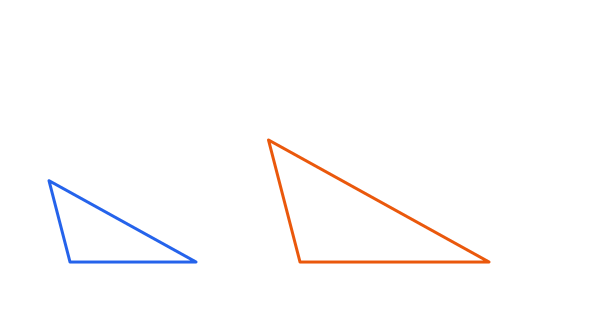
In \triangle ABC, AB = 4, BC = 6 and AC = 8. In \triangle DEF, DE = 6, EF = 9 and DF = 12. Are the triangles similar? This is the first picture above.
- Pair the shortest sides: \tfrac{DE}{AB} = \tfrac{6}{4}
- Simplify: \tfrac{6}{4} = \tfrac{3}{2}
- Pair the middle sides: \tfrac{EF}{BC} = \tfrac{9}{6}
- Simplify: \tfrac{9}{6} = \tfrac{3}{2}
- Pair the longest sides: \tfrac{DF}{AC} = \tfrac{12}{8}
- Simplify: \tfrac{12}{8} = \tfrac{3}{2}
- All three ratios equal \tfrac{3}{2}, so the triangles are similar by SSS.
Answer: Yes. \triangle ABC \sim \triangle DEF with a scale factor of \tfrac{3}{2}.
Example 2: When SSS fails
One triangle has sides 5, 7 and 10. Another has sides 10, 14 and 18. Are they similar?
- Pair the shortest sides: \tfrac{5}{10} = 0.5
- Pair the middle sides: \tfrac{7}{14} = 0.5
- Pair the longest sides: \tfrac{10}{18} \approx 0.556
- The third ratio is different from the other two.
Answer: No. The triangles are not similar, even though two ratios match. SSS needs all three.
Example 3: Use SAS to find a missing side
In \triangle ABC, D is on AB and E is on AC. AD = 3, DB = 6, AE = 4, EC = 8 and DE = 4. Find BC.
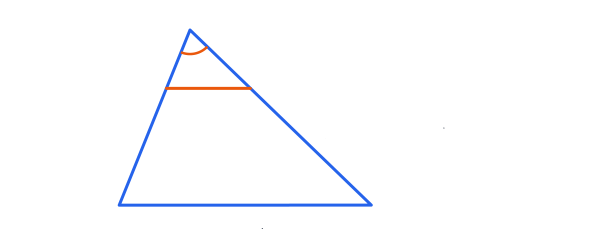
- Find the whole side AB (see segment addition postulate): AB = 3 + 6 = 9
- Find the whole side AC: AC = 4 + 8 = 12
- Find the first ratio: \tfrac{AD}{AB} = \tfrac{3}{9} = \tfrac{1}{3}
- Find the second ratio: \tfrac{AE}{AC} = \tfrac{4}{12} = \tfrac{1}{3}
- \angle A is in both triangles, so the included angles match.
- By SAS similarity, \triangle ADE \sim \triangle ABC.
- Write the proportion for the third sides: \tfrac{DE}{BC} = \tfrac{1}{3}
- Substitute: \tfrac{4}{BC} = \tfrac{1}{3}
- Cross multiply (see proportions): BC = 4 \cdot 3
- Multiply: BC = 12
Answer: BC = 12.
Example 4: Word problem with a sign
A large triangular sign has sides of 18 in, 24 in and 30 in. The angle between the 18 in and 24 in sides is 90°. A small version has sides of 12 in, 16 in and 20 in. Is the small sign similar to the large one? What is the angle between its 12 in and 16 in sides?
- Pair the shortest sides: \tfrac{12}{18} = \tfrac{2}{3}
- Pair the middle sides: \tfrac{16}{24} = \tfrac{2}{3}
- Pair the longest sides: \tfrac{20}{30} = \tfrac{2}{3}
- All three ratios are equal, so the signs are similar by SSS.
- The 12 in and 16 in sides match the 18 in and 24 in sides.
- Corresponding angles of similar triangles are congruent, so the angle between them is also 90°.
Answer: Yes, the signs are similar with a scale factor of \tfrac{2}{3}. The angle is 90°.
Example 5: Two-column proof with SAS
Given: In the second picture above, AD = 3, AB = 9, AE = 4 and AC = 12.
Prove: \triangle ADE \sim \triangle ABC
| Statements | Reasons |
|---|---|
| 1. AD = 3, AB = 9, AE = 4, AC = 12 | Given |
| 2. \tfrac{AD}{AB} = \tfrac{3}{9} = \tfrac{1}{3} | Substitution and simplifying |
| 3. \tfrac{AE}{AC} = \tfrac{4}{12} = \tfrac{1}{3} | Substitution and simplifying |
| 4. \tfrac{AD}{AB} = \tfrac{AE}{AC} | Transitive property of equality |
| 5. \angle A \cong \angle A | Reflexive property of congruence |
| 6. \triangle ADE \sim \triangle ABC | SAS similarity (steps 4 and 5) |
Since the triangles are similar, \angle ADE \cong \angle ABC. These are corresponding angles, so \overline{DE} \parallel \overline{BC}.
Common Mistakes
| Mistake | Example of the error | Fix |
|---|---|---|
| Pairing sides in the wrong order | Comparing 4 with 9 and 6 with 6 for sides 4, 6, 8 and 6, 9, 12 | Sort each triangle’s sides from shortest to longest, then pair them. |
| Checking only two ratios for SSS | \tfrac{5}{10} = \tfrac{7}{14}, so “similar” | Check all three. Here \tfrac{10}{18} is different, so they are not similar. |
| Using an angle that is not between the sides | Two side ratios match and an angle opposite one side matches | For SAS, the angle must be between the two sides you compared. |
| Using part of a side in a nested triangle | \tfrac{AD}{DB} = \tfrac{DE}{BC}, so \tfrac{3}{6} = \tfrac{4}{BC} and BC = 8 | Use whole sides: \tfrac{AD}{AB} = \tfrac{DE}{BC}, so BC = 12. |
| Thinking the sides must be equal | “6 is not 4, so SSS fails” | Similarity needs equal ratios, not equal sides. |
Choosing AA, SSS or SAS
| What you know | Shortcut to use |
|---|---|
| Two pairs of congruent angles | AA similarity |
| All three pairs of sides | SSS similarity |
| Two pairs of sides and the angle between them | SAS similarity |
| Two pairs of sides and an angle not between them | No shortcut. This is not enough. |
Practice Problems
- One triangle has sides 3, 4 and 5. Another has sides 9, 12 and 15. Are they similar?
- One triangle has sides 6, 8 and 9. Another has sides 9, 12 and 14. Are they similar?
- One triangle has sides 10, 15 and 20. Another has sides 4, 6 and 8. Are they similar? If so, what is the scale factor from the larger triangle to the smaller one?
- One triangle has sides 4 and 6 with a 40° angle between them. Another has sides 6 and 9 with a 40° angle between them. Are they similar?
- One triangle has sides 5 and 7 with a 60° angle between them. Another has sides 10 and 15 with a 60° angle between them. Are they similar?
- In \triangle PST, Q is on PS and R is on PT. PQ = 4, PS = 10, PR = 6, PT = 15 and QR = 8. Find ST.
- One triangle has sides 6, 8 and 10. Another has sides 9, 12 and x, where x is its longest side. Find x so the triangles are similar by SSS.
- One triangle has sides 4 and x with a 55° angle between them. Another has sides 10 and 15 with a 55° angle between them. The side of length 4 matches the side of length 10. Find x so the triangles are similar by SAS.
- Complete the proof. Given: XY = 4, YZ = 6, XZ = 8, AB = 6, BC = 9 and AC = 12. Prove: \triangle XYZ \sim \triangle ABC. Statements: (1) the given lengths. (2) \tfrac{XY}{AB} = \tfrac{2}{3}. (3) \tfrac{YZ}{BC} = \tfrac{2}{3}. (4) \tfrac{XZ}{AC} = \tfrac{2}{3}. (5) \triangle XYZ \sim \triangle ABC. Give a reason for each statement.
- A triangular park has sides of 120 m, 160 m and 200 m. A map shows it as a triangle with sides of 3 cm, 4 cm and 5 cm. Is the map triangle similar to the park? How many meters does 1 cm on the map stand for?
Show answers
- Ratios: \tfrac{9}{3} = 3, \tfrac{12}{4} = 3, \tfrac{15}{5} = 3
All three are equal, so yes, similar by SSS. - Ratios: \tfrac{9}{6} = 1.5, \tfrac{12}{8} = 1.5, \tfrac{14}{9} \approx 1.56
The third ratio is different, so they are not similar. - Ratios: \tfrac{4}{10} = 0.4, \tfrac{6}{15} = 0.4, \tfrac{8}{20} = 0.4
Yes, similar by SSS.
Scale factor from larger to smaller: 0.4 = \tfrac{2}{5} - Ratios: \tfrac{6}{4} = 1.5 and \tfrac{9}{6} = 1.5
The included angles are both 40°.
Yes, similar by SAS. - Ratios: \tfrac{10}{5} = 2 and \tfrac{15}{7} \approx 2.14
The ratios are different, so they are not similar. - First ratio: \tfrac{PQ}{PS} = \tfrac{4}{10} = \tfrac{2}{5}
Second ratio: \tfrac{PR}{PT} = \tfrac{6}{15} = \tfrac{2}{5}
\angle P is shared, so \triangle PQR \sim \triangle PST by SAS.
Proportion: \tfrac{QR}{ST} = \tfrac{2}{5}, so \tfrac{8}{ST} = \tfrac{2}{5}
Cross multiply: 2 \cdot ST = 40
Divide by 2: ST = 20 - Scale factor from the short sides: \tfrac{9}{6} = 1.5
Check the middle sides: \tfrac{12}{8} = 1.5
Longest side: x = 10 \cdot 1.5
Multiply: x = 15 - Proportion: \tfrac{4}{10} = \tfrac{x}{15}
Cross multiply: 10x = 60
Divide by 10: x = 6 - (1) Given
(2) Substitution and simplifying: \tfrac{4}{6} = \tfrac{2}{3}
(3) Substitution and simplifying: \tfrac{6}{9} = \tfrac{2}{3}
(4) Substitution and simplifying: \tfrac{8}{12} = \tfrac{2}{3}
(5) SSS similarity (steps 2, 3 and 4) - Ratios: \tfrac{120}{3} = 40, \tfrac{160}{4} = 40, \tfrac{200}{5} = 40
All three are equal, so yes, the triangles are similar by SSS.
1 cm on the map stands for 40 m.
FAQ
What is SSS similarity?
If all three pairs of corresponding sides of two triangles are proportional, the triangles are similar.
What is SAS similarity?
If two pairs of sides are proportional and the angles between them are congruent, the triangles are similar.
What is the difference between SAS similarity and SAS congruence?
SAS congruence needs two pairs of equal sides. SAS similarity only needs the two pairs of sides to have the same ratio. Both need the included angles to match.
Is SSA a way to prove triangles similar?
No. Two proportional sides with an angle that is not between them can fit triangles of different shapes. Use SAS, SSS or AA instead.
Summary
- SSS similarity: all three side ratios are equal.
- SAS similarity: two side ratios are equal and the included angles are congruent.
- Sort the sides from shortest to longest to pair them.
- Check every ratio. One mismatch means the triangles are not similar.
- In nested triangles, use whole sides, not parts.
Previous lesson: AA Similarity
Next lesson: Triangle Proportionality Theorem
Back to the Geometry Index