
Equation of a Circle
The equation of a circle with center (h, k) and radius r is (x - h)^2 + (y - k)^2 = r^2. This is called standard form. It says every point (x, y) on the circle is exactly r units from the center. You can read the center and radius straight from it.
Before this lesson: You should know the Distance Formula, the Parts of a Circle and Completing the Square.
Where the Equation Comes From
A circle is all the points that are the same distance from the center. Pick any point (x, y) on a circle with center (h, k) and radius r. Draw a right triangle with the radius as its hypotenuse.
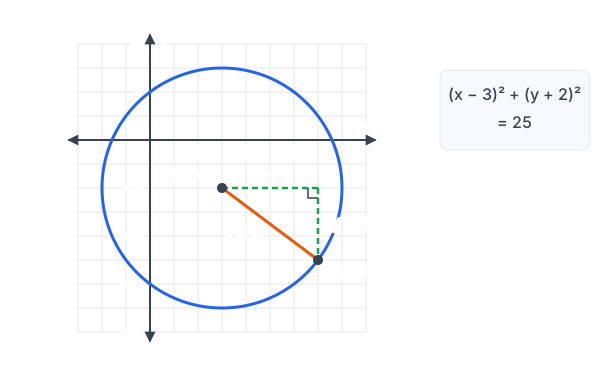
The horizontal leg is x - h and the vertical leg is y - k. By the Pythagorean theorem, the legs squared add to the radius squared. This is also the distance formula with the distance set equal to r.
Standard Form of a Circle
(x - h)^2 + (y - k)^2 = r^2
- The center is (h, k). Watch the signs: (x - 3) means h = 3, and (y + 2) means k = -2.
- The right side is r^2, not r. Take its square root to get the radius.
- A circle centered at the origin has the short form x^2 + y^2 = r^2.
How to Write and Read Circle Equations
- To write the equation, find the center (h, k) and the radius r.
- Substitute into (x - h)^2 + (y - k)^2 = r^2, and square the radius.
- To read an equation, flip the signs inside the parentheses to get the center, and take the square root of the right side to get the radius.
- If the equation is not in standard form, complete the square for x and for y first.
Worked Examples
Example 1: Write the equation from the center and radius
Write the equation of the circle with center (3, −2) and radius 5.
- Write standard form: (x - h)^2 + (y - k)^2 = r^2
- Substitute h = 3, k = -2 and r = 5: (x - 3)^2 + (y - (-2))^2 = 5^2
- Simplify the double negative: (x - 3)^2 + (y + 2)^2 = 5^2
- Square the radius: (x - 3)^2 + (y + 2)^2 = 25
Answer: (x - 3)^2 + (y + 2)^2 = 25
Example 2: Read the center and radius
Find the center and radius of (a) (x + 4)^2 + (y - 1)^2 = 49 and (b) x^2 + y^2 = 20.
- Part (a). Rewrite x + 4 as x - (-4), so h = -4. And y - 1 gives k = 1. Center: (-4, 1)
- Set r^2 = 49 and take the positive square root: r = 7
- Part (b). There is nothing subtracted from x or y, so the center is (0, 0)
- Set r^2 = 20 and take the positive square root: r = \sqrt{20}
- Simplify the radical (see simplifying square roots): r = \sqrt{4 \cdot 5} = 2\sqrt{5}
Answer: (a) center (−4, 1), radius 7 (b) center (0, 0), radius 2\sqrt{5} \approx 4.47
Example 3: Center and a point on the circle
A circle has center (2, 5) and passes through (−1, 9). Write its equation.
- The radius is the distance from the center to the point. Use the distance formula: r = \sqrt{(-1 - 2)^2 + (9 - 5)^2}
- Subtract: r = \sqrt{(-3)^2 + 4^2}
- Square: r = \sqrt{9 + 16}
- Add: r = \sqrt{25}
- Take the square root: r = 5
- Substitute into standard form: (x - 2)^2 + (y - 5)^2 = 5^2
- Square the radius: (x - 2)^2 + (y - 5)^2 = 25
Answer: (x - 2)^2 + (y - 5)^2 = 25
Example 4: Complete the square
Find the center and radius of x^2 + y^2 - 6x + 8y - 11 = 0.
- Group the x terms and the y terms, and move the constant: (x^2 - 6x) + (y^2 + 8y) = 11
- Half of −6 is −3, and (-3)^2 = 9. Half of 8 is 4, and 4^2 = 16. Add 9 and 16 to both sides: (x^2 - 6x + 9) + (y^2 + 8y + 16) = 11 + 9 + 16
- Factor each group as a perfect square (see perfect square trinomials): (x - 3)^2 + (y + 4)^2 = 11 + 9 + 16
- Add on the right: (x - 3)^2 + (y + 4)^2 = 36
- Read the center: (3, -4)
- Take the square root of 36: r = 6
Answer: Center (3, −4) and radius 6.
Example 5: Word problem with a cell tower
On a map grid in miles, a cell tower stands at (4, 3). Its signal reaches 10 miles in every direction. Write an equation for the edge of its range. Does a house at (−3, 10) get a signal?
- The edge of the range is a circle with center (4, 3) and radius 10: (x - 4)^2 + (y - 3)^2 = 100
- Substitute the house’s coordinates into the left side: (-3 - 4)^2 + (10 - 3)^2
- Subtract: (-7)^2 + 7^2
- Square: 49 + 49
- Add: 98
- Compare with r^2 = 100: 98 \lt 100, so the house is less than 10 miles from the tower.
Answer: The edge is (x - 4)^2 + (y - 3)^2 = 100. The house is inside the circle, so it gets a signal.
Common Mistakes
| Mistake | Example of the error | Fix |
|---|---|---|
| Using the wrong sign for the center | (x + 4)^2 means h = 4 | Flip the sign: (x + 4)^2 = (x - (-4))^2, so h = -4. |
| Forgetting to square the radius | Radius 5 gives (x - 3)^2 + (y + 2)^2 = 5 | Square it: = 25. |
| Reading r^2 as the radius | = 49 means r = 49 | Take the square root: r = 7. |
| Adding to only one side when completing the square | (x^2 - 6x + 9) + (y^2 + 8y + 16) = 11 | Add 9 and 16 to the right side too: = 36. |
| Using the diameter as the radius | Diameter 10 gives r^2 = 100 | Halve first: r = 5, so r^2 = 25. |
Related Idea: Inside, On or Outside
To test a point, put its coordinates into the left side of the equation and compare with r^2.
| Result | Where the point is |
|---|---|
| Less than r^2 | Inside the circle |
| Equal to r^2 | On the circle |
| Greater than r^2 | Outside the circle |
In Precalculus, circles join parabolas, ellipses and hyperbolas as the conic sections.
Practice Problems
- Write the equation of the circle with center (0, 0) and radius 6.
- Write the equation of the circle with center (−2, 7) and radius 3.
- Write the equation of the circle with center (5, 0) and radius \sqrt{11}.
- Find the center and radius of (x - 8)^2 + (y + 3)^2 = 64.
- Find the center and radius of x^2 + (y + 6)^2 = 50.
- The endpoints of a diameter are (1, 2) and (7, 10). Write the equation of the circle.
- A circle has center (−3, 4) and passes through the origin. Write its equation.
- Find the center and radius of x^2 + y^2 + 10x - 4y + 20 = 0.
- Is the point (6, −1) on the circle (x - 2)^2 + (y + 4)^2 = 25?
- A sprinkler at (0, 0) waters a circle with radius 15 ft. Does it reach a plant at (9, 13)?
Show answers
- Substitute h = 0, k = 0, r = 6: x^2 + y^2 = 6^2
Square the radius: x^2 + y^2 = 36 - Substitute: (x - (-2))^2 + (y - 7)^2 = 3^2
Simplify the sign: (x + 2)^2 + (y - 7)^2 = 3^2
Square the radius: (x + 2)^2 + (y - 7)^2 = 9 - Substitute: (x - 5)^2 + (y - 0)^2 = (\sqrt{11})^2
Simplify: (x - 5)^2 + y^2 = 11 - Flip the signs inside the parentheses: center (8, -3)
Take the square root of 64: r = 8 - Center: (0, -6)
Take the square root: r = \sqrt{50}
Simplify: r = \sqrt{25 \cdot 2} = 5\sqrt{2} \approx 7.07 - Find the center with the midpoint formula: \left(\frac{1 + 7}{2}, \frac{2 + 10}{2}\right)
Add: \left(\frac{8}{2}, \frac{12}{2}\right)
Divide: (4, 6)
Find the radius from the center to (7, 10): r = \sqrt{(7 - 4)^2 + (10 - 6)^2}
Subtract: r = \sqrt{3^2 + 4^2}
Square: r = \sqrt{9 + 16}
Add: r = \sqrt{25}
Take the square root: r = 5
Write the equation: (x - 4)^2 + (y - 6)^2 = 25 - Find the radius from (−3, 4) to (0, 0): r = \sqrt{(0 - (-3))^2 + (0 - 4)^2}
Subtract: r = \sqrt{3^2 + (-4)^2}
Square: r = \sqrt{9 + 16}
Add: r = \sqrt{25}
Take the square root: r = 5
Write the equation: (x + 3)^2 + (y - 4)^2 = 25 - Group and move the constant: (x^2 + 10x) + (y^2 - 4y) = -20
Half of 10 is 5, and 5^2 = 25. Half of −4 is −2, and (-2)^2 = 4. Add both to each side: (x^2 + 10x + 25) + (y^2 - 4y + 4) = -20 + 25 + 4
Factor: (x + 5)^2 + (y - 2)^2 = -20 + 25 + 4
Add on the right: (x + 5)^2 + (y - 2)^2 = 9
Center (-5, 2), radius \sqrt{9} = 3 - Substitute into the left side: (6 - 2)^2 + (-1 + 4)^2
Simplify inside: 4^2 + 3^2
Square: 16 + 9
Add: 25
It equals r^2 = 25, so yes, the point is on the circle. - The edge of the watered area is x^2 + y^2 = 225. Substitute the plant: 9^2 + 13^2
Square: 81 + 169
Add: 250
Compare: 250 \gt 225, so the plant is outside the circle. No, the sprinkler does not reach it.
FAQ
What is the standard form of the equation of a circle?
(x - h)^2 + (y - k)^2 = r^2, where (h, k) is the center and r is the radius.
How do you find the center and radius from an equation?
Put the equation in standard form. The center is (h, k), so flip the signs inside the parentheses. The radius is the square root of the number on the right.
How do you write the equation of a circle from two points?
If the points are the ends of a diameter, the center is their midpoint and the radius is half the distance between them. If one point is the center, the radius is the distance to the other point.
What is the general form of a circle equation?
It looks like x^2 + y^2 + Dx + Ey + F = 0. Complete the square for x and y to change it to standard form.
Summary
- Standard form: (x - h)^2 + (y - k)^2 = r^2, with center (h, k) and radius r.
- The equation is the distance formula (or the Pythagorean theorem) with the distance equal to r.
- Watch signs: (x + 4)^2 means h = -4. Square the radius on the right side.
- Complete the square to change general form into standard form.
- Plug in a point and compare with r^2 to see if it is inside, on or outside.
Previous lesson: Area of a Sector
Next lesson: Area of Regular Polygons
Back to the Geometry Index