
Identifying Conic Sections
Identifying conic sections from an equation starts with the squared terms. Write the equation as Ax^2 + Cy^2 + Dx + Ey + F = 0. If A = C, it is a circle. If A and C have the same sign but differ, it is an ellipse. Opposite signs give a hyperbola, and only one squared term gives a parabola.
Before this lesson: Equation of a Circle, Focus and Directrix of a Parabola, Ellipses, Hyperbolas and Completing the Square
What it means to identify a conic
A conic section is the curve you get when a flat plane slices through a double cone. Tilt the plane and you get a circle, an ellipse, a parabola or a hyperbola.
Every one of these curves has an equation with x^2, y^2 or both. When the equation is multiplied out, it is in general form, and the shape is hidden. Your job is to read the shape from the coefficients, then rewrite the equation in standard form, the form that shows the center, vertex and size.
The quick test only looks at A and C, the coefficients of x^2 and y^2. The D, E and F terms move the graph around, but they do not change its shape.
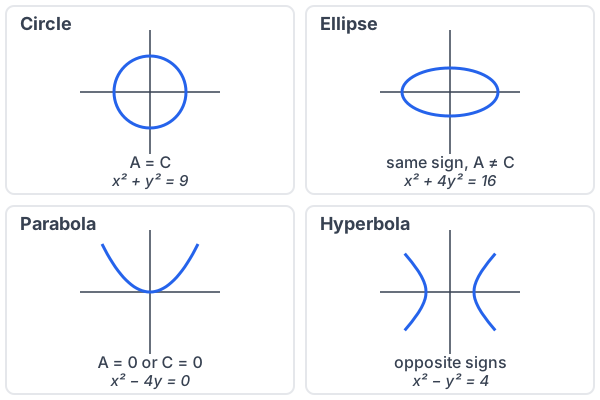
How to identify conic sections from the general form
Write the equation with every term on the left and 0 on the right:
Ax^2 + Cy^2 + Dx + Ey + F = 0
| Conic | Test on A and C | Example |
|---|---|---|
| Circle | A = C | 2x^2 + 2y^2 - 8 = 0 |
| Ellipse | A and C have the same sign, and A \ne C | x^2 + 4y^2 - 16 = 0 |
| Hyperbola | A and C have opposite signs | x^2 - y^2 - 4 = 0 |
| Parabola | A = 0 or C = 0 (only one variable is squared) | x^2 - 4y = 0 |
A shortcut for the first three rows: the product AC is positive for a circle or an ellipse and negative for a hyperbola. AC = 0 means a parabola.
Steps to write a conic in standard form
- Identify the conic from A and C.
- Group the x terms and the y terms, and move the constant F to the right side.
- Factor out A from the x terms and C from the y terms when they are not 1.
- Complete the square in each group. Add the same amount to the right side, multiplied by the factor in front of the group.
- Factor each perfect square trinomial and simplify the right side.
- For an ellipse or hyperbola, divide so the right side is 1. For a parabola, factor the number in front of the other variable.
Identifying conic sections examples
Example 1: Name the conic
Identify each conic from its equation. You do not need to graph it.
3x^2 + 3y^2 - 12x + 5 = 0
A = 3 and C = 3. They are equal, so this is a circle.
x^2 + 4y^2 - 2x - 8 = 0
A = 1 and C = 4. Same sign but not equal, so this is an ellipse.
y^2 - 8x + 6y + 1 = 0
There is no x^2 term, so A = 0. This is a parabola.
5x^2 - 2y^2 + 10y - 3 = 0
A = 5 and C = −2. Opposite signs, so this is a hyperbola.
Answer: circle, ellipse, parabola, hyperbola.
Example 2: A circle in standard form
Identify the conic x^2 + y^2 + 6x - 4y - 12 = 0 and write it in standard form.
x^2 + y^2 + 6x - 4y - 12 = 0
A = 1 and C = 1 are equal, so this is a circle.
x^2 + 6x + y^2 - 4y - 12 = 0
Group the x terms and the y terms.
x^2 + 6x + y^2 - 4y = 12
Add 12 to both sides.
(x^2 + 6x + 9) + (y^2 - 4y + 4) = 12 + 9 + 4
Complete the square (see completing the square): add \left(\frac{6}{2}\right)^2 = 9 and \left(\frac{-4}{2}\right)^2 = 4 to both sides.
(x + 3)^2 + (y - 2)^2 = 12 + 9 + 4
Factor each perfect square trinomial (see perfect square trinomials).
(x + 3)^2 + (y - 2)^2 = 25
Add on the right side.
r = \sqrt{25} = 5Take the square root of the right side to get the radius.
Answer: a circle, (x + 3)^2 + (y - 2)^2 = 25, with center (−3, 2) and radius 5.
Example 3: An ellipse with factored coefficients
Identify the conic 4x^2 + 9y^2 - 16x + 54y + 61 = 0 and write it in standard form.
4x^2 + 9y^2 - 16x + 54y + 61 = 0
A = 4 and C = 9 have the same sign but are not equal, so this is an ellipse.
4x^2 - 16x + 9y^2 + 54y = -61
Group the x terms and the y terms, and subtract 61 from both sides.
4(x^2 - 4x) + 9(y^2 + 6y) = -61
Factor 4 out of the x terms and 9 out of the y terms (see factoring out the GCF).
4(x^2 - 4x + 4) + 9(y^2 + 6y + 9) = -61 + 16 + 81
Complete the square in each group. The 4 inside is multiplied by 4, so add 4 \cdot 4 = 16 on the right. The 9 inside is multiplied by 9, so add 9 \cdot 9 = 81.
4(x - 2)^2 + 9(y + 3)^2 = -61 + 16 + 81
Factor each perfect square trinomial.
4(x - 2)^2 + 9(y + 3)^2 = 36
Add on the right side.
\frac{4(x - 2)^2}{36} + \frac{9(y + 3)^2}{36} = 1Divide both sides by 36 to get 1 on the right.
\frac{(x - 2)^2}{9} + \frac{(y + 3)^2}{4} = 1Simplify each fraction.
Answer: an ellipse with center (2, −3). The larger denominator, 9, is under x, so a = 3 runs left and right and b = 2 runs up and down.
Example 4: A hyperbola with a negative coefficient
Identify the conic 9y^2 - 4x^2 - 36y - 8x - 4 = 0 and write it in standard form.
9y^2 - 4x^2 - 36y - 8x - 4 = 0
A = −4 and C = 9 have opposite signs, so this is a hyperbola.
9y^2 - 36y - 4x^2 - 8x = 4
Group the y terms and the x terms, and add 4 to both sides.
9(y^2 - 4y) - 4(x^2 + 2x) = 4
Factor 9 out of the y terms and −4 out of the x terms.
9(y^2 - 4y + 4) - 4(x^2 + 2x + 1) = 4 + 36 - 4
Complete the square in each group. Adding 4 inside the first group adds 9 \cdot 4 = 36. Adding 1 inside the second adds -4 \cdot 1 = -4.
9(y - 2)^2 - 4(x + 1)^2 = 4 + 36 - 4
Factor each perfect square trinomial.
9(y - 2)^2 - 4(x + 1)^2 = 36
Simplify the right side.
\frac{9(y - 2)^2}{36} - \frac{4(x + 1)^2}{36} = 1Divide both sides by 36.
\frac{(y - 2)^2}{4} - \frac{(x + 1)^2}{9} = 1Simplify each fraction.
Answer: a hyperbola with center (−1, 2). The y term is positive, so it opens up and down, with a = 2 and b = 3.
Example 5: Word problem (satellite dish)
An engineer’s design file stores the cross section of a satellite dish as x^2 - 6x - 8y + 17 = 0, measured in feet. What shape is it, and where should the receiver go? (The receiver belongs at the focus.)
x^2 - 6x - 8y + 17 = 0
Only x is squared, so C = 0. The cross section is a parabola.
x^2 - 6x - 8y = -17
Subtract 17 from both sides.
x^2 - 6x = 8y - 17
Add 8y to both sides, so only x terms are on the left.
x^2 - 6x + 9 = 8y - 17 + 9
Complete the square: add \left(\frac{-6}{2}\right)^2 = 9 to both sides.
(x - 3)^2 = 8y - 17 + 9
Factor the perfect square trinomial.
(x - 3)^2 = 8y - 8
Combine the constants.
(x - 3)^2 = 8(y - 1)
Factor 8 out of the right side.
4p = 8
Match the form (x - h)^2 = 4p(y - k). The vertex is (3, 1).
p = 2
Divide both sides by 4.
(h, k + p) = (3, 1 + 2) = (3, 3)
The parabola opens up, so the focus is p units above the vertex.
Answer: the dish is a parabola with vertex (3, 1). The receiver goes at the focus, (3, 3), which is 2 feet above the bottom of the dish.
Common mistakes
| Mistake | Example of the error | Fix |
|---|---|---|
| Calling every equation with x^2 and y^2 a circle | 4x^2 + 9y^2 - 36 = 0 called a circle | A circle needs A = C. Here 4 ≠ 9, so it is an ellipse. |
| Adding only the number inside the parentheses to the right side | 4(x^2 - 4x + 4): adding 4 to the right side | The 4 inside is multiplied by 4, so add 16 to the right side. |
| Losing the sign when the factor in front is negative | -4(x^2 + 2x + 1): adding +1 to the right side | You really added -4 \cdot 1 = -4, so add −4. |
| Ignoring an xy term | x^2 + 4xy + y^2 - 3 = 0 called a circle because A = C | With an xy term, use B^2 - 4AC = 12 \gt 0: a hyperbola. |
| Not checking the right side at the end | (x - 2)^2 + (y + 1)^2 = -5 graphed as a circle | A sum of squares cannot be negative, so there is no graph. |
| Choosing the direction of a hyperbola by the bigger denominator | \frac{(y - 2)^2}{4} - \frac{(x + 1)^2}{9} = 1 said to open left and right because 9 is bigger | For a hyperbola, the positive term decides. The y term is positive, so it opens up and down. |
Related methods
When the equation has an xy term
The full general form is Ax^2 + Bxy + Cy^2 + Dx + Ey + F = 0. An xy term turns the graph, so the A and C test no longer works. Use the discriminant of the conic, B^2 - 4AC, instead. It works much like the discriminant of a quadratic equation.
| Value of B^2 - 4AC | Conic |
|---|---|
| Less than 0 | Ellipse (a circle if B = 0 and A = C) |
| Equal to 0 | Parabola |
| Greater than 0 | Hyperbola |
When B = 0, the discriminant is just −4AC, so this test matches the sign of AC from the table above.
Degenerate conics
Sometimes completing the square gives a surprise on the right side. A circle or ellipse equal to 0 is a single point, and one equal to a negative number has no graph. A hyperbola equal to 0 is a pair of crossing lines. These are called degenerate conics, because the plane passes through the tip of the cone.
Conics also appear together in systems. To find where two of them cross, see nonlinear systems of equations.
Practice problems
- Identify the conic: 2x^2 + 2y^2 - 8x + 3y - 1 = 0
- Identify the conic: 3x^2 - y^2 + 6x - 4 = 0
- Identify the conic: y^2 + 4x - 2y + 9 = 0
- Identify the conic: x^2 + 4xy + y^2 - 3 = 0
- Write in standard form and identify: x^2 + y^2 - 10x + 2y + 17 = 0
- Write in standard form and identify: x^2 + 4y^2 + 6x - 8y + 9 = 0
- Write in standard form and identify: x^2 - y^2 - 4x - 6y - 9 = 0
- Write in standard form and identify: y^2 + 8y - 4x + 4 = 0
- Write in standard form and identify: x^2 + y^2 - 4x + 2y + 10 = 0
- A museum room has an elliptical floor. Its outline, in meters, is 25x^2 + 16y^2 - 100x - 300 = 0. Sound from one focus reflects to the other. Write the equation in standard form and find the two foci (the “whisper spots”).
Show answers
1.
2x^2 + 2y^2 - 8x + 3y - 1 = 0
A = 2 and C = 2 are equal.
Answer: a circle.
2.
3x^2 - y^2 + 6x - 4 = 0
A = 3 and C = −1 have opposite signs.
Answer: a hyperbola.
3.
y^2 + 4x - 2y + 9 = 0
There is no x^2 term, so A = 0.
Answer: a parabola (it opens left or right, since y is squared).
4.
B^2 - 4AC = 4^2 - 4(1)(1)
The equation has an xy term, so use the discriminant with A = 1, B = 4 and C = 1.
B^2 - 4AC = 16 - 4
Evaluate the square and the product.
B^2 - 4AC = 12
Subtract.
Answer: 12 is greater than 0, so the graph is a hyperbola, even though A = C.
5.
x^2 - 10x + y^2 + 2y = -17
Group the x and y terms, and subtract 17 from both sides.
(x^2 - 10x + 25) + (y^2 + 2y + 1) = -17 + 25 + 1
Complete the square: add 25 and 1 to both sides.
(x - 5)^2 + (y + 1)^2 = -17 + 25 + 1
Factor each trinomial.
(x - 5)^2 + (y + 1)^2 = 9
Add on the right side.
Answer: (x - 5)^2 + (y + 1)^2 = 9, a circle with center (5, −1) and radius 3.
6.
x^2 + 6x + 4y^2 - 8y = -9
Group the x and y terms, and subtract 9 from both sides.
(x^2 + 6x) + 4(y^2 - 2y) = -9
Factor 4 out of the y terms.
(x^2 + 6x + 9) + 4(y^2 - 2y + 1) = -9 + 9 + 4
Complete the square. Adding 1 inside the y group adds 4 \cdot 1 = 4.
(x + 3)^2 + 4(y - 1)^2 = -9 + 9 + 4
Factor each trinomial.
(x + 3)^2 + 4(y - 1)^2 = 4
Add on the right side.
\frac{(x + 3)^2}{4} + \frac{4(y - 1)^2}{4} = 1Divide both sides by 4.
\frac{(x + 3)^2}{4} + \frac{(y - 1)^2}{1} = 1Simplify the second fraction.
Answer: an ellipse with center (−3, 1), a = 2 (horizontal) and b = 1.
7.
x^2 - 4x - y^2 - 6y = 9
Group the x and y terms, and add 9 to both sides.
(x^2 - 4x) - (y^2 + 6y) = 9
Factor −1 out of the y terms.
(x^2 - 4x + 4) - (y^2 + 6y + 9) = 9 + 4 - 9
Complete the square. Adding 9 inside the y group adds -1 \cdot 9 = -9.
(x - 2)^2 - (y + 3)^2 = 9 + 4 - 9
Factor each trinomial.
(x - 2)^2 - (y + 3)^2 = 4
Simplify the right side.
\frac{(x - 2)^2}{4} - \frac{(y + 3)^2}{4} = 1Divide both sides by 4.
Answer: a hyperbola that opens left and right, with center (2, −3), a = 2 and b = 2.
8.
y^2 + 8y + 4 = 4x
Add 4x to both sides.
y^2 + 8y = 4x - 4
Subtract 4 from both sides, so only y terms are on the left.
y^2 + 8y + 16 = 4x - 4 + 16
Complete the square: add \left(\frac{8}{2}\right)^2 = 16 to both sides.
(y + 4)^2 = 4x - 4 + 16
Factor the trinomial.
(y + 4)^2 = 4x + 12
Combine the constants.
(y + 4)^2 = 4(x + 3)
Factor 4 out of the right side.
Answer: a parabola with vertex (−3, −4). Since 4p = 4, p = 1, so it opens right and the focus is (−2, −4).
9.
x^2 - 4x + y^2 + 2y = -10
Group the x and y terms, and subtract 10 from both sides.
(x^2 - 4x + 4) + (y^2 + 2y + 1) = -10 + 4 + 1
Complete the square: add 4 and 1 to both sides.
(x - 2)^2 + (y + 1)^2 = -10 + 4 + 1
Factor each trinomial.
(x - 2)^2 + (y + 1)^2 = -5
Add on the right side.
Answer: A = C, so it looks like a circle, but a sum of squares can never equal −5. The equation has no graph (a degenerate case).
10.
25x^2 + 16y^2 - 100x - 300 = 0
A = 25 and C = 16 have the same sign but are not equal, so the room is an ellipse.
25x^2 - 100x + 16y^2 = 300
Group the x terms, and add 300 to both sides.
25(x^2 - 4x) + 16y^2 = 300
Factor 25 out of the x terms.
25(x^2 - 4x + 4) + 16y^2 = 300 + 100
Complete the square. Adding 4 inside adds 25 \cdot 4 = 100.
25(x - 2)^2 + 16y^2 = 300 + 100
Factor the trinomial.
25(x - 2)^2 + 16y^2 = 400
Add on the right side.
\frac{25(x - 2)^2}{400} + \frac{16y^2}{400} = 1Divide both sides by 400.
\frac{(x - 2)^2}{16} + \frac{y^2}{25} = 1Simplify each fraction. The larger denominator, 25, is under y, so the long axis is vertical.
c^2 = 25 - 16
For an ellipse, c^2 = a^2 - b^2.
c^2 = 9
Subtract.
c = 3
Take the square root.
Answer: the center is (2, 0), and the foci are 3 m above and below it, at (2, 3) and (2, −3). Those are the two whisper spots.
Identifying conic sections FAQ
How do you identify a conic section from its equation?
Look at A and C, the coefficients of x^2 and y^2. Equal values mean a circle, the same sign means an ellipse, opposite signs mean a hyperbola, and only one squared term means a parabola.
What is the general form of a conic section?
It is Ax^2 + Bxy + Cy^2 + Dx + Ey + F = 0. Most precalculus problems have B = 0, so there is no xy term.
How can you tell if an equation is an ellipse or a hyperbola?
Check the signs of the x^2 and y^2 terms when both are on the same side. Same signs make an ellipse, and opposite signs make a hyperbola.
What is a degenerate conic?
It is a conic equation whose graph is a single point, a line, a pair of lines or nothing at all. You usually find out after completing the square, when the right side is 0 or negative.
Summary
- Write the equation as Ax^2 + Cy^2 + Dx + Ey + F = 0 and look at A and C.
- A = C: circle. Same sign: ellipse. Opposite signs: hyperbola. A = 0 or C = 0: parabola.
- With an xy term, use B^2 - 4AC: negative for an ellipse, 0 for a parabola, positive for a hyperbola.
- Complete the square in x and y to reach standard form, and multiply what you add by any factor in front of the group.
- If the right side ends up 0 or negative, the conic is degenerate.
Previous lesson: Hyperbolas
Next lesson: Magnitude and Direction of a Vector
Back to the Precalculus Index