
Magnitude and Direction of a Vector
The magnitude and direction of a vector tell how long the vector is and which way it points. For a vector \langle a, b \rangle, the magnitude is \|\vec{v}\| = \sqrt{a^2 + b^2}. The direction angle \theta is measured counterclockwise from the positive x-axis, with \tan\theta = \frac{b}{a} adjusted for the quadrant.
Before this lesson: Distance Formula, Pythagorean Theorem, Reference Angles and Inverse Trig Functions
What a vector is
A vector is a quantity with both a size and a direction. A wind of 20 mph from the west is a vector. A speed of 20 mph with no direction is not. A number with size only is called a scalar.
We draw a vector as an arrow. The tail is the initial point, and the tip is the terminal point. The length of the arrow is the vector’s magnitude, and the way it points is its direction.
The component form \langle a, b \rangle lists how far the arrow moves right (a) and up (b). Negative components mean left or down. Two arrows with the same length and direction are the same vector, wherever they start.
Magnitude and direction formulas
For a vector from P(x_1, y_1) to Q(x_2, y_2), subtract the initial point from the terminal point:
\vec{PQ} = \langle x_2 - x_1,\ y_2 - y_1 \rangleFor a vector \vec{v} = \langle a, b \rangle, the components are the legs of a right triangle, and the vector is the hypotenuse:
\|\vec{v}\| = \sqrt{a^2 + b^2} \qquad \tan\theta = \frac{b}{a}The calculator’s \tan^{-1} only gives angles between −90° and 90°, so it can point you the wrong way. The safe method is to find the reference angle \theta_R = \tan^{-1}\left|\frac{b}{a}\right|, then use the quadrant of the vector:
| Quadrant | Signs of a and b | Direction angle |
|---|---|---|
| I | a positive, b positive | \theta = \theta_R |
| II | a negative, b positive | \theta = 180^\circ - \theta_R |
| III | a negative, b negative | \theta = 180^\circ + \theta_R |
| IV | a positive, b negative | \theta = 360^\circ - \theta_R |
Going the other way, a vector with magnitude \|\vec{v}\| and direction angle \theta has components \langle \|\vec{v}\|\cos\theta,\ \|\vec{v}\|\sin\theta \rangle.
Magnitude and direction of a vector examples
Example 1: Component form and magnitude from two points
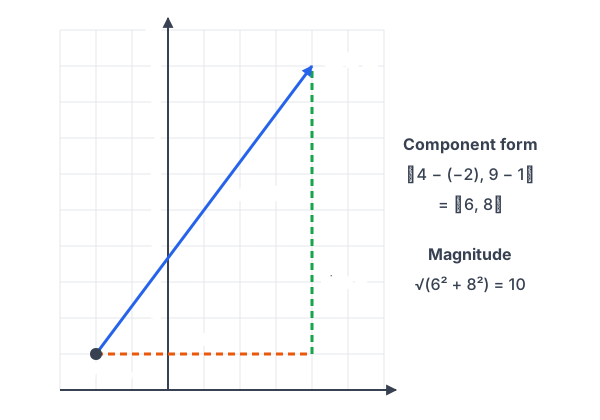
Find the component form and the magnitude of the vector from P(-2, 1) to Q(4, 9).
\vec{PQ} = \langle x_2 - x_1, y_2 - y_1 \rangleSubtract the initial point from the terminal point.
\vec{PQ} = \langle 4 - (-2), 9 - 1 \rangleSubstitute Q(4, 9) and P(−2, 1).
\vec{PQ} = \langle 6, 8 \rangleSubtract each pair (see subtracting integers).
\|\vec{PQ}\| = \sqrt{6^2 + 8^2}Use the magnitude formula, which comes from the Pythagorean theorem.
\|\vec{PQ}\| = \sqrt{36 + 64}Square each component.
\|\vec{PQ}\| = \sqrt{100}Add.
\|\vec{PQ}\| = 10Take the square root.
Answer: \vec{PQ} = \langle 6, 8 \rangle and its magnitude is 10. The same length comes from the distance formula for P and Q.
Example 2: A vector in Quadrant I
Find the magnitude and direction angle of \vec{v} = \langle 5, 12 \rangle.
\|\vec{v}\| = \sqrt{5^2 + 12^2}Use the magnitude formula.
\|\vec{v}\| = \sqrt{25 + 144}Square each component.
\|\vec{v}\| = \sqrt{169}Add.
\|\vec{v}\| = 13Take the square root.
\tan\theta = \frac{12}{5}Set up \tan\theta = \frac{b}{a}. Both components are positive, so the vector is in Quadrant I.
\theta = \tan^{-1}\left(\frac{12}{5}\right)Undo the tangent with the inverse tangent (see inverse trig functions).
\theta \approx 67.4^\circ
Use a calculator in degree mode. In Quadrant I, this is the direction angle.
Answer: the magnitude is 13 and the direction angle is about 67.4°.
Example 3: A vector in Quadrant II
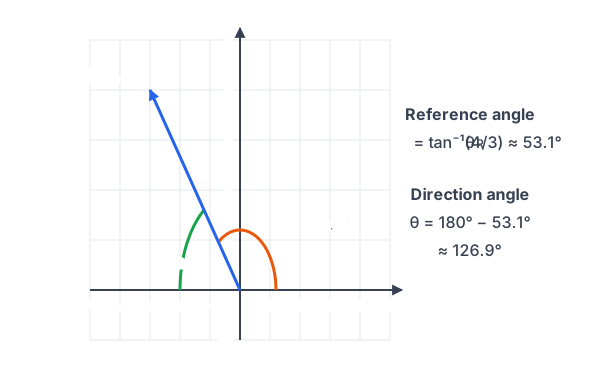
Find the magnitude and direction angle of \vec{u} = \langle -3, 4 \rangle.
\|\vec{u}\| = \sqrt{(-3)^2 + 4^2}Use the magnitude formula. Keep −3 in parentheses so its square is positive.
\|\vec{u}\| = \sqrt{9 + 16}Square each component.
\|\vec{u}\| = \sqrt{25}Add.
\|\vec{u}\| = 5Take the square root.
\theta_R = \tan^{-1}\left(\frac{4}{3}\right)Find the reference angle from the absolute values of the components (see reference angles).
\theta_R \approx 53.1^\circ
Use a calculator in degree mode.
\theta \approx 180^\circ - 53.1^\circ
The x-component is negative and the y-component is positive, so the vector is in Quadrant II. Subtract the reference angle from 180°.
\theta \approx 126.9^\circ
Subtract.
Answer: the magnitude is 5 and the direction angle is about 126.9°. Typing \tan^{-1}\left(\frac{4}{-3}\right) gives about −53.1°, which points into Quadrant IV, the wrong way.
Example 4: A vector in Quadrant IV
Find the magnitude and direction angle of \vec{w} = \langle 7, -2 \rangle. Round to the nearest hundredth and tenth of a degree.
\|\vec{w}\| = \sqrt{7^2 + (-2)^2}Use the magnitude formula.
\|\vec{w}\| = \sqrt{49 + 4}Square each component.
\|\vec{w}\| = \sqrt{53}Add. 53 has no perfect square factor, so the root does not simplify.
\|\vec{w}\| \approx 7.28Round to the nearest hundredth.
\theta_R = \tan^{-1}\left(\frac{2}{7}\right)Find the reference angle from the absolute values of the components.
\theta_R \approx 15.9^\circ
Use a calculator in degree mode.
\theta \approx 360^\circ - 15.9^\circ
The x-component is positive and the y-component is negative, so the vector is in Quadrant IV. Subtract the reference angle from 360°.
\theta \approx 344.1^\circ
Subtract.
Answer: the magnitude is about 7.28 and the direction angle is about 344.1°.
Example 5: Word problem with a kicked ball
A soccer ball leaves a player’s foot at 18 meters per second, at an angle of 35° above the ground. Find the horizontal and vertical components of its velocity.
\vec{v} = \langle \|\vec{v}\|\cos\theta, \|\vec{v}\|\sin\theta \rangleWrite the components from the magnitude and direction angle (see trigonometric ratios).
\vec{v} = \langle 18\cos 35^\circ, 18\sin 35^\circ \rangleSubstitute the speed 18 and the angle 35°.
\vec{v} \approx \langle 18(0.8192), 18(0.5736) \rangleFind the cosine and sine in degree mode, to 4 decimal places.
\vec{v} \approx \langle 14.7, 10.3 \rangleMultiply, and round to the nearest tenth.
Answer: the ball moves forward at about 14.7 m/s and upward at about 10.3 m/s. As a check, \sqrt{14.7^2 + 10.3^2} \approx 17.9, close to 18. The small gap comes from rounding.
Common mistakes
| Mistake | Example of the error | Fix |
|---|---|---|
| Using \tan^{-1}\left(\frac{b}{a}\right) without checking the quadrant | For \langle -3, 4 \rangle, giving the direction as −53.1° | Find the reference angle, 53.1°, then use Quadrant II: 180° − 53.1° = 126.9°. |
| Subtracting the points in the wrong order | From P(1, 2) to Q(4, 7), writing \langle 1 - 4, 2 - 7 \rangle | Terminal minus initial: \langle 4 - 1, 7 - 2 \rangle = \langle 3, 5 \rangle. |
| Losing the sign when squaring a negative component | Typing -3^2 and getting −9 | Use parentheses: (-3)^2 = 9. |
| Adding the components instead of using the formula | \|\langle 3, 4 \rangle\| = 3 + 4 = 7 | The magnitude is \sqrt{3^2 + 4^2} = 5. |
| Swapping sine and cosine for the components | \langle 10\sin 30^\circ, 10\cos 30^\circ \rangle | The x-component uses cosine: \langle 10\cos 30^\circ, 10\sin 30^\circ \rangle. |
| Leaving the calculator in radian mode | \tan^{-1}(2) \approx 1.11, read as 1.11° | Switch to degree mode: \tan^{-1}(2) \approx 63.4^\circ. |
Related forms
i and j notation
Many books write vectors with the unit vectors \mathbf{i} = \langle 1, 0 \rangle and \mathbf{j} = \langle 0, 1 \rangle, which each have length 1. The vector \langle a, b \rangle is the same as a\mathbf{i} + b\mathbf{j}, so \langle 5, -2 \rangle = 5\mathbf{i} - 2\mathbf{j}.
Magnitude and direction as polar coordinates
The magnitude and direction angle of \langle a, b \rangle are the r and \theta of the point (a, b) in polar coordinates. Changing component form to magnitude and direction is the same work as changing rectangular coordinates to polar.
Bearings
Navigation often gives direction as a bearing, such as “30° north of east” or “N 60° E”. Sketch the vector first, then find the standard-position angle. For example, 30° north of east is 30°, and 30° south of east is 360° − 30° = 330°.
Practice problems
- Find the component form of the vector from A(3, -1) to B(8, 11).
- Find the magnitude of \langle -6, 8 \rangle.
- Find the magnitude of \langle 2, -5 \rangle. Round to the nearest hundredth.
- Find the direction angle of \langle 4, 4 \rangle.
- Find the direction angle of \langle -2, -6 \rangle to the nearest tenth of a degree.
- Find the direction angle of \langle -8, 3 \rangle to the nearest tenth of a degree.
- Find the magnitude and direction angle of \langle 0, -7 \rangle.
- A vector has magnitude 12 and direction angle 150°. Write it in component form, exactly and to the nearest hundredth.
- Find the component form, magnitude and direction angle of the vector from P(-4, 6) to Q(2, -2).
- A hiker walks 5 km east and then 2 km south. Find the distance and direction from her starting point to where she ends.
Show answers
1.
\vec{AB} = \langle 8 - 3, 11 - (-1) \rangleSubtract the initial point A from the terminal point B.
\vec{AB} = \langle 5, 12 \rangleSubtract each pair.
Answer: \langle 5, 12 \rangle
2.
\|\vec{v}\| = \sqrt{(-6)^2 + 8^2}Use the magnitude formula.
\|\vec{v}\| = \sqrt{36 + 64}Square each component.
\|\vec{v}\| = \sqrt{100}Add.
\|\vec{v}\| = 10Take the square root.
Answer: 10
3.
\|\vec{v}\| = \sqrt{2^2 + (-5)^2}Use the magnitude formula.
\|\vec{v}\| = \sqrt{4 + 25}Square each component.
\|\vec{v}\| = \sqrt{29}Add.
\|\vec{v}\| \approx 5.39Round to the nearest hundredth.
Answer: \sqrt{29} \approx 5.39
4.
\tan\theta = \frac{4}{4}Set up \tan\theta = \frac{b}{a}. Both components are positive, so the vector is in Quadrant I.
\tan\theta = 1
Divide.
\theta = 45^\circ
The angle in Quadrant I whose tangent is 1 is 45°.
Answer: 45°
5.
\theta_R = \tan^{-1}\left(\frac{6}{2}\right)Find the reference angle from the absolute values of the components.
\theta_R = \tan^{-1}(3)Divide.
\theta_R \approx 71.6^\circ
Use a calculator in degree mode.
\theta \approx 180^\circ + 71.6^\circ
Both components are negative, so the vector is in Quadrant III. Add the reference angle to 180°.
\theta \approx 251.6^\circ
Add.
Answer: about 251.6°
6.
\theta_R = \tan^{-1}\left(\frac{3}{8}\right)Find the reference angle from the absolute values of the components.
\theta_R \approx 20.6^\circ
Use a calculator in degree mode.
\theta \approx 180^\circ - 20.6^\circ
The x-component is negative and the y-component is positive, so the vector is in Quadrant II.
\theta \approx 159.4^\circ
Subtract.
Answer: about 159.4°
7.
\|\vec{v}\| = \sqrt{0^2 + (-7)^2}Use the magnitude formula.
\|\vec{v}\| = \sqrt{49}Square and add.
\|\vec{v}\| = 7Take the square root.
\theta = 270^\circ
The vector has no horizontal part and points straight down, along the negative y-axis. \tan\theta is undefined here, so use the sketch.
Answer: magnitude 7, direction angle 270°
8.
\vec{v} = \langle 12\cos 150^\circ, 12\sin 150^\circ \rangleWrite the components from the magnitude and direction angle.
\vec{v} = \left\langle 12\left(-\frac{\sqrt{3}}{2}\right), 12\left(\frac{1}{2}\right) \right\rangleUse the exact values for 150° (see the unit circle).
\vec{v} = \langle -6\sqrt{3}, 6 \rangleMultiply.
\vec{v} \approx \langle -10.39, 6 \rangleUse \sqrt{3} \approx 1.732 and round to the nearest hundredth.
Answer: \langle -6\sqrt{3}, 6 \rangle \approx \langle -10.39, 6 \rangle
9.
\vec{PQ} = \langle 2 - (-4), -2 - 6 \rangleSubtract the initial point from the terminal point.
\vec{PQ} = \langle 6, -8 \rangleSubtract each pair.
\|\vec{PQ}\| = \sqrt{6^2 + (-8)^2}Use the magnitude formula.
\|\vec{PQ}\| = \sqrt{36 + 64}Square each component.
\|\vec{PQ}\| = \sqrt{100}Add.
\|\vec{PQ}\| = 10Take the square root.
\theta_R = \tan^{-1}\left(\frac{8}{6}\right)Find the reference angle from the absolute values of the components.
\theta_R \approx 53.1^\circ
Use a calculator in degree mode.
\theta \approx 360^\circ - 53.1^\circ
The x-component is positive and the y-component is negative, so the vector is in Quadrant IV.
\theta \approx 306.9^\circ
Subtract.
Answer: \langle 6, -8 \rangle, magnitude 10, direction angle about 306.9°
10.
\vec{d} = \langle 5, -2 \rangleEast is the positive x-direction and south is the negative y-direction.
\|\vec{d}\| = \sqrt{5^2 + (-2)^2}Use the magnitude formula.
\|\vec{d}\| = \sqrt{25 + 4}Square each component.
\|\vec{d}\| = \sqrt{29}Add.
\|\vec{d}\| \approx 5.39Round to the nearest hundredth.
\theta_R = \tan^{-1}\left(\frac{2}{5}\right)Find the reference angle from the absolute values of the components.
\theta_R \approx 21.8^\circ
Use a calculator in degree mode.
\theta \approx 360^\circ - 21.8^\circ
The vector is in Quadrant IV.
\theta \approx 338.2^\circ
Subtract.
Answer: she ends about 5.39 km from her start, at a direction angle of about 338.2°, which is about 21.8° south of east.
Magnitude and direction of a vector FAQ
How do you find the magnitude of a vector?
Square each component, add the squares and take the square root: \|\langle a, b \rangle\| = \sqrt{a^2 + b^2}. For \langle 6, 8 \rangle, that is \sqrt{100} = 10.
How do you find the direction of a vector?
Find the reference angle \tan^{-1}\left|\frac{b}{a}\right|, then place it in the vector’s quadrant. Quadrant II subtracts it from 180°, Quadrant III adds it to 180°, and Quadrant IV subtracts it from 360°.
What is the component form of a vector?
It is \langle a, b \rangle, the horizontal and vertical change from the tail to the tip. From (x_1, y_1) to (x_2, y_2), it is \langle x_2 - x_1, y_2 - y_1 \rangle.
Can the magnitude of a vector be negative?
No. Magnitude is a length, so it is always 0 or positive. Only the zero vector \langle 0, 0 \rangle has magnitude 0, and it has no direction.
Summary
- A vector has a magnitude (length) and a direction, and its component form \langle a, b \rangle gives its horizontal and vertical change.
- From P to Q, subtract: terminal point minus initial point.
- Magnitude: \|\vec{v}\| = \sqrt{a^2 + b^2}.
- Direction: find the reference angle \tan^{-1}\left|\frac{b}{a}\right|, then adjust for the quadrant.
- From magnitude and direction back to components: \langle \|\vec{v}\|\cos\theta, \|\vec{v}\|\sin\theta \rangle.
Previous lesson: Identifying Conic Sections
Next lesson: Adding and Subtracting Vectors
Back to the Precalculus Index