
Polar Coordinates
Polar coordinates name a point by its distance from the origin and its angle, written (r, \theta), instead of by x and y. To convert from polar to rectangular, use x = r \cos \theta and y = r \sin \theta. To go back, use r = \sqrt{x^2 + y^2} and \tan \theta = \frac{y}{x}, checking the quadrant.
Before this lesson: You should know The Unit Circle, Radians and Coterminal Angles.
What Polar Coordinates Mean
Rectangular coordinates tell you how far to go right and up. Polar coordinates tell you which way to face and how far to walk. The origin is called the pole, and the positive x-axis is the polar axis.
In (r, \theta), \theta is the angle measured counterclockwise from the polar axis. The number r is the distance from the pole along that direction. A polar grid uses circles for r and rays for \theta.
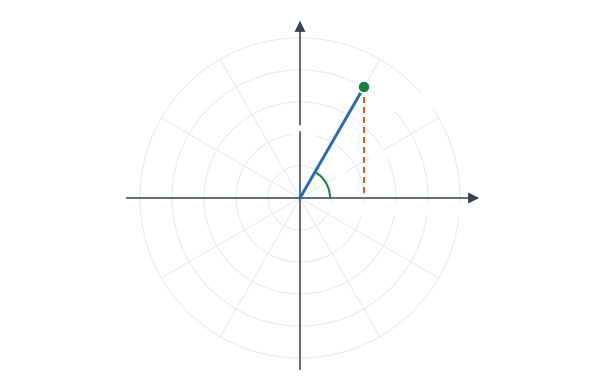
One point, many names
In rectangular coordinates, each point has one name. In polar coordinates, each point has many. Adding 2\pi to the angle lands on the same ray, so (4, \frac{\pi}{3}) is also (4, \frac{7\pi}{3}).
A negative r means walk backward, in the opposite direction. So (-4, \frac{4\pi}{3}) is the same point too, because \frac{4\pi}{3} points the opposite way from \frac{\pi}{3}.
Conversion Formulas
Polar to rectangular:
x = r \cos \theta, \quad y = r \sin \theta
Rectangular to polar:
r = \sqrt{x^2 + y^2}, \quad \tan \theta = \frac{y}{x}These come from a right triangle with legs x and y and hypotenuse r. When you use \tan \theta = \frac{y}{x}, the calculator only gives angles in Quadrants I and IV. Always check which quadrant (x, y) is in, and adjust.
Worked Examples
Example 1: Polar to rectangular
Convert (4, \frac{\pi}{3}) to rectangular coordinates.
x = 4 \cos \frac{\pi}{3}Find x.
x = 4 \cdot \frac{1}{2} = 2Use \cos \frac{\pi}{3} = \frac{1}{2}.
y = 4 \sin \frac{\pi}{3}Find y.
y = 4 \cdot \frac{\sqrt{3}}{2} = 2\sqrt{3}Use \sin \frac{\pi}{3} = \frac{\sqrt{3}}{2}.
Answer: (2, 2\sqrt{3}), which is about (2, 3.46). This matches the picture above.
Example 2: Rectangular to polar
Convert (-3, 3) to polar coordinates with r \gt 0 and 0 \le \theta \lt 2\pi.
r = \sqrt{(-3)^2 + 3^2}Find r.
r = \sqrt{9 + 9} = \sqrt{18}Square.
r = \sqrt{9 \cdot 2} = 3\sqrt{2}Simplify the radical (see simplifying square roots)
\tan \theta = \frac{3}{-3} = -1Find the tangent.
The reference angle is \frac{\pi}{4}, and (-3, 3) is in Quadrant II (see reference angles)
\theta = \pi - \frac{\pi}{4} = \frac{3\pi}{4}Find the angle.
Answer: (3\sqrt{2}, \frac{3\pi}{4}). A calculator gives \tan^{-1}(-1) = -\frac{\pi}{4}, which points into Quadrant IV, so it is the wrong direction.
Example 3: Other names for the same point
Give two other polar names for (2, \frac{\pi}{6}): one with a positive r, and one with a negative r.
Add 2\pi to the angle, using a common denominator: \frac{\pi}{6} + \frac{12\pi}{6} = \frac{13\pi}{6}, so (2, \frac{13\pi}{6})
\frac{\pi}{6} + \frac{6\pi}{6} = \frac{7\pi}{6}For a negative r, add \pi to point the opposite way.
(-2, \frac{7\pi}{6})Then use r = -2.
Answer: (2, \frac{13\pi}{6}) and (-2, \frac{7\pi}{6}). Other answers, like (2, -\frac{11\pi}{6}), are also correct.
Example 4: Convert a polar equation
Write r = 6 \sin \theta in rectangular form, and describe its graph.
r^2 = 6r \sin \theta
Multiply both sides by r.
x^2 + y^2 = 6y
Replace r^2 with x^2 + y^2 and r \sin \theta with y.
x^2 + y^2 - 6y = 0
Subtract 6y from both sides.
Complete the square for y (see completing the square): add 9 to both sides to get x^2 + y^2 - 6y + 9 = 9
x^2 + (y - 3)^2 = 9
Factor the perfect square.
Answer: x^2 + (y - 3)^2 = 9, a circle with center (0, 3) and radius 3 (see equation of a circle).
Example 5: Word problem with a radar screen
A radar screen shows a plane 50 km from the tower, at an angle of 120^\circ counterclockwise from due east. How far east or west and how far north or south of the tower is the plane?
(50, 120^\circ)
The radar gives polar coordinates.
x = 50 \cos 120^\circ
Find x.
x = 50 \cdot (-\frac{1}{2}) = -25Use \cos 120^\circ = -\frac{1}{2}.
y = 50 \sin 120^\circ
Find y.
y = 50 \cdot \frac{\sqrt{3}}{2} = 25\sqrt{3} \approx 43.30Use \sin 120^\circ = \frac{\sqrt{3}}{2}.
Answer: The plane is 25 km west and about 43.30 km north of the tower. A negative x means west.
Common Mistakes
| Mistake | Example of the error | Fix |
|---|---|---|
| Trusting the calculator angle | (-3, 3) gives \theta = -\frac{\pi}{4} | Check the quadrant: (-3, 3) is in Quadrant II, so \theta = \frac{3\pi}{4}. |
| Swapping sine and cosine | x = r \sin \theta | x goes with cosine and y goes with sine. |
| Forgetting the square root | r = x^2 + y^2 = 18 | r = \sqrt{x^2 + y^2} = \sqrt{18}. |
| Thinking each point has one name | Marking (2, \frac{13\pi}{6}) wrong when the answer is (2, \frac{\pi}{6}) | Angles that differ by 2\pi give the same point. |
| Plotting a negative r on the same ray | Plotting (-2, \frac{\pi}{6}) in Quadrant I | A negative r goes the opposite way, into Quadrant III here. |
Related Methods
Degrees or radians
Polar angles can be in degrees or radians. Use whichever the problem uses, and set your calculator to match.
Converting equations both ways
To turn a rectangular equation into polar form, replace x with r \cos \theta and y with r \sin \theta. For example, x^2 + y^2 = 25 becomes r^2 = 25, so r = 5.
Complex numbers
A complex number a + bi can be plotted at (a, b). Its polar form uses the same r and \theta, which leads to the trigonometric form of complex numbers.
Practice Problems
Give exact answers when possible. Use r \gt 0 and 0 \le \theta \lt 2\pi unless the problem says otherwise.
- Convert (6, \frac{\pi}{6}) to rectangular coordinates.
- Convert (5, \frac{3\pi}{2}) to rectangular coordinates.
- Convert (-4, \frac{\pi}{4}) to rectangular coordinates.
- Convert (0, -7) to polar coordinates.
- Convert (2, -2\sqrt{3}) to polar coordinates.
- Convert (-5, -12) to polar coordinates. Round \theta to the nearest hundredth of a radian.
- Give two other polar names for (3, \frac{2\pi}{3}): one with a negative angle and one with a negative r.
- Write x^2 + y^2 = 25 in polar form.
- Write r = 4 \cos \theta in rectangular form.
- A lighthouse spots a boat 8 km away at 210^\circ counterclockwise from due east. How far west and south of the lighthouse is the boat?
Show answers
1.
x = 6 \cos \frac{\pi}{6} = 6 \cdot \frac{\sqrt{3}}{2} = 3\sqrt{3}Find x: multiply r by the cosine of the angle.
y = 6 \sin \frac{\pi}{6} = 6 \cdot \frac{1}{2} = 3Find y: multiply r by the sine of the angle.
Answer: (3\sqrt{3}, 3)
2.
x = 5 \cos \frac{3\pi}{2} = 5 \cdot 0 = 0Find x: multiply r by the cosine of the angle.
y = 5 \sin \frac{3\pi}{2} = 5 \cdot (-1) = -5Find y: multiply r by the sine of the angle.
Answer: (0, -5)
3.
x = -4 \cos \frac{\pi}{4} = -4 \cdot \frac{\sqrt{2}}{2} = -2\sqrt{2}Find x: multiply r by the cosine of the angle.
y = -4 \sin \frac{\pi}{4} = -4 \cdot \frac{\sqrt{2}}{2} = -2\sqrt{2}Find y: multiply r by the sine of the angle.
Answer: (-2\sqrt{2}, -2\sqrt{2}), in Quadrant III
4.
r = \sqrt{0^2 + (-7)^2} = \sqrt{49} = 7Find r with the Pythagorean theorem.
The point is on the negative y-axis, so \theta = \frac{3\pi}{2}
Answer: (7, \frac{3\pi}{2})
5.
r = \sqrt{2^2 + (-2\sqrt{3})^2} = \sqrt{4 + 12} = \sqrt{16} = 4Find r with the Pythagorean theorem.
\tan \theta = \frac{-2\sqrt{3}}{2} = -\sqrt{3}, so the reference angle is \frac{\pi}{3}
\theta = 2\pi - \frac{\pi}{3} = \frac{5\pi}{3}The point is in Quadrant IV.
Answer: (4, \frac{5\pi}{3})
6.
r = \sqrt{(-5)^2 + (-12)^2} = \sqrt{25 + 144} = \sqrt{169} = 13Find r with the Pythagorean theorem.
\tan^{-1}(\frac{12}{5}) \approx 1.18Reference angle (see inverse trig functions)
\theta \approx \pi + 1.176 \approx 4.32
The point is in Quadrant III.
Answer: (13, 4.32)
7.
Subtract 2\pi: \frac{2\pi}{3} - \frac{6\pi}{3} = -\frac{4\pi}{3}, so (3, -\frac{4\pi}{3})
Add \pi and use r = -3: \frac{2\pi}{3} + \frac{3\pi}{3} = \frac{5\pi}{3}, so (-3, \frac{5\pi}{3})
Answer: (3, -\frac{4\pi}{3}) and (-3, \frac{5\pi}{3})
8.
r^2 = 25
Replace x^2 + y^2 with r^2.
r = 5
Take the square root, using r \gt 0.
Answer: r = 5, a circle of radius 5
9.
r^2 = 4r \cos \theta
Multiply both sides by r.
x^2 + y^2 = 4x
Replace.
x^2 - 4x + y^2 = 0
Subtract 4x.
x^2 - 4x + 4 + y^2 = 4
Complete the square.
(x - 2)^2 + y^2 = 4
Factor the perfect square.
Answer: (x - 2)^2 + y^2 = 4, a circle with center (2, 0) and radius 2
10.
x = 8 \cos 210^\circ = 8 \cdot (-\frac{\sqrt{3}}{2}) = -4\sqrt{3} \approx -6.93Find x: multiply r by the cosine of the angle.
y = 8 \sin 210^\circ = 8 \cdot (-\frac{1}{2}) = -4Find y: multiply r by the sine of the angle.
Answer: about 6.93 km west and 4 km south
FAQ
How do you convert polar to rectangular coordinates?
Use x = r \cos \theta and y = r \sin \theta. Multiply the distance by the cosine and sine of the angle.
How do you convert rectangular to polar coordinates?
Find r = \sqrt{x^2 + y^2}. Then find the angle from \tan \theta = \frac{y}{x}, and adjust it for the quadrant the point is in.
Can r be negative in polar coordinates?
Yes. A negative r means you go the opposite way from the angle. The point (-r, \theta) is the same as (r, \theta + \pi).
Why do points have more than one polar name?
Angles repeat every 2\pi, and a negative r can reach the same point from the opposite angle. So every point has endless polar names.
Summary
- A polar point (r, \theta) is a distance r from the pole at angle \theta.
- Polar to rectangular: x = r \cos \theta, y = r \sin \theta.
- Rectangular to polar: r = \sqrt{x^2 + y^2}, \tan \theta = \frac{y}{x}, then check the quadrant.
- Each point has many polar names: add 2\pi, or use -r with \theta + \pi.
- Convert equations with x^2 + y^2 = r^2, x = r \cos \theta and y = r \sin \theta.
Previous lesson: Area of Oblique Triangles
Next lesson: Graphing Polar Equations
Back to the Trigonometry Index