
Coterminal Angles
Coterminal angles are angles in standard position that share the same terminal side. To find an angle coterminal with \theta, add or subtract 360°, one full turn. Every angle has infinitely many coterminal angles, given by \theta + 360^\circ n, where n is any integer.
Before this lesson: You should know Angles in Standard Position and Adding and Subtracting Integers.
Same Ending, Different Turns
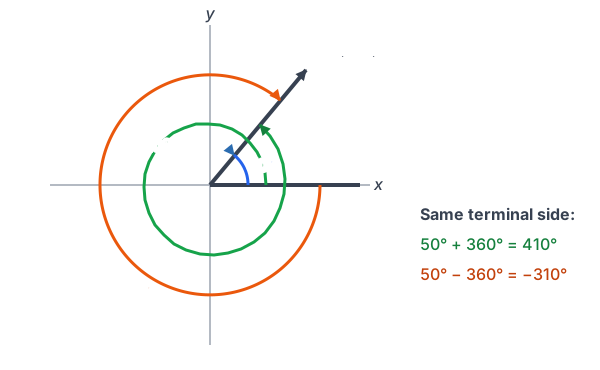
Picture the terminal side of a 50° angle. Now turn one more full circle counterclockwise. You end on the same ray, but the angle is now 50^\circ + 360^\circ = 410^\circ. If you start over and turn clockwise instead until you reach that ray, you turn 50^\circ - 360^\circ = -310^\circ.
All three angles, 50°, 410° and −310°, end on the same terminal side. That is what coterminal means: “same terminal side.” They have the same trig values, which is why this idea matters in trigonometry.
The Coterminal Angle Formula
\theta + 360^\circ n, \quad n = \ldots, -2, -1, 0, 1, 2, \ldots
Each value of the integer n gives a different coterminal angle. A positive n adds full turns, and a negative n subtracts them. Two angles are coterminal exactly when their difference is a multiple of 360°.
- To find a coterminal angle, add or subtract 360°.
- To find the coterminal angle between 0° and 360°, divide the angle by 360 to see how many full turns it holds.
- Subtract that many full turns (or add them, for a negative angle) until the result is between 0° and 360°.
- To test whether two angles are coterminal, subtract them and check whether the difference is a multiple of 360°.
Worked Examples
Example 1: One positive and one negative coterminal angle
Find a positive angle and a negative angle that are coterminal with 50^\circ.
50^\circ + 360^\circ = 410^\circ
Add one full turn.
50^\circ - 360^\circ = -310^\circ
Subtract one full turn.
Answer: 410^\circ and -310^\circ. Other correct answers include 770^\circ and -670^\circ.
Example 2: Reduce a large angle
Find the angle between 0° and 360° that is coterminal with 820^\circ.
Divide by 360 to count the full turns: \frac{820}{360} \approx 2.28, so there are 2 full turns
2 \cdot 360^\circ = 720^\circ
Find 2 full turns in degrees.
820^\circ - 720^\circ = 100^\circ
Subtract them.
Answer: 100^\circ. It is in Quadrant II.
Example 3: A negative angle
Find the angle between 0° and 360° that is coterminal with -530^\circ.
-530^\circ + 360^\circ = -170^\circ
Add one full turn. It is still negative.
-170^\circ + 360^\circ = 190^\circ
Add another full turn.
Answer: 190^\circ. You added 2 \cdot 360^\circ = 720^\circ in all.
Example 4: Test two angles
Are 145^\circ and -935^\circ coterminal?
145^\circ - (-935^\circ) = 145^\circ + 935^\circ = 1080^\circ
Subtract the angles (see adding and subtracting integers)
\frac{1080}{360} = 3Divide the difference by 360.
The result is a whole number, so the difference is 3 full turns.
Answer: Yes, they are coterminal.
Example 5: Word problem with a Ferris wheel
A Ferris wheel seat starts level with the center, on the right side. The wheel turns counterclockwise through 1170^\circ. Where is the seat when the wheel stops?
Put the center at the origin, so the seat starts on the positive x-axis.
Divide by 360 to count the full turns: \frac{1170}{360} = 3.25, so there are 3 full turns
3 \cdot 360^\circ = 1080^\circ
Find 3 full turns in degrees.
1170^\circ - 1080^\circ = 90^\circ
Subtract them.
An angle of 90° ends on the positive y-axis.
Answer: The seat is at the very top of the wheel, after three and a quarter turns.
Common Mistakes
| Mistake | Example of the error | Fix |
|---|---|---|
| Adding 180° instead of 360° | Saying 50° and 230° are coterminal | A full turn is 360°. 230° points the opposite way. |
| Stopping too early with a negative angle | Giving −170° as the answer between 0° and 360° for −530° | Keep adding 360° until the angle is between 0° and 360°: 190°. |
| Using the decimal part of the division as degrees | \frac{820}{360} \approx 2.28, so the answer is 28° | Use only the whole number of turns, then subtract: 820^\circ - 720^\circ = 100^\circ. |
| Subtracting a negative wrong | 145^\circ - (-935^\circ) = -790^\circ | Subtracting a negative means adding: 145^\circ + 935^\circ = 1080^\circ. |
| Thinking an angle has only one coterminal angle | Listing only 410° for 50° | Any number of full turns works, so there are infinitely many. |
Related Methods
Coterminal angles in radians
One full turn is also 2\pi radians, as the next lesson shows. In radians, coterminal angles are \theta + 2\pi n. For example, \frac{\pi}{4} and \frac{9\pi}{4} are coterminal.
Using the remainder
For a positive angle, the coterminal angle between 0° and 360° is the remainder when you divide by 360. For 820°, 820 = 2 \cdot 360 + 100, so the remainder is 100°.
Why it matters later
Coterminal angles have the same sine, cosine and tangent. In trigonometric ratios you used angles less than 90°. Later in this course you will reduce any angle to one between 0° and 360° before finding its trig values.
Practice Problems
- Find one positive and one negative angle coterminal with 30^\circ.
- Find one positive and one negative angle coterminal with 200^\circ.
- Find one positive and one negative angle coterminal with -75^\circ.
- Find the angle between 0° and 360° coterminal with 765^\circ.
- Find the angle between 0° and 360° coterminal with 1000^\circ.
- Find the angle between 0° and 360° coterminal with -100^\circ.
- Find the angle between 0° and 360° coterminal with -800^\circ.
- Are 60^\circ and 780^\circ coterminal?
- Are 25^\circ and -385^\circ coterminal?
- A bicycle wheel turns clockwise through -1350^\circ. Find the angle between 0° and 360° that is coterminal with this rotation.
Show answers
1.
30^\circ + 360^\circ = 390^\circ
Add 360°.
30^\circ - 360^\circ = -330^\circ
Subtract 360°.
Answer: 390^\circ and -330^\circ
2.
200^\circ + 360^\circ = 560^\circ
Add 360°.
200^\circ - 360^\circ = -160^\circ
Subtract 360°.
Answer: 560^\circ and -160^\circ
3.
-75^\circ + 360^\circ = 285^\circ
Add 360°.
-75^\circ - 360^\circ = -435^\circ
Subtract 360°.
Answer: 285^\circ and -435^\circ
4.
Count the full turns: \frac{765}{360} \approx 2.13, so 2 turns
2 \cdot 360^\circ = 720^\circ
Find 2 turns.
765^\circ - 720^\circ = 45^\circ
Subtract.
Answer: 45^\circ
5.
Count the full turns: \frac{1000}{360} \approx 2.78, so 2 turns
2 \cdot 360^\circ = 720^\circ
Find 2 turns.
1000^\circ - 720^\circ = 280^\circ
Subtract.
Answer: 280^\circ
6.
-100^\circ + 360^\circ = 260^\circ
Add 360°.
Answer: 260^\circ
7.
-800^\circ + 360^\circ = -440^\circ
Add 360°.
-440^\circ + 360^\circ = -80^\circ
Add 360° again.
-80^\circ + 360^\circ = 280^\circ
Add 360° again.
Answer: 280^\circ
8.
780^\circ - 60^\circ = 720^\circ
Subtract.
\frac{720}{360} = 2Divide by 360 (a whole number).
Answer: yes, they are coterminal
9.
25^\circ - (-385^\circ) = 25^\circ + 385^\circ = 410^\circ
Subtract.
\frac{410}{360} \approx 1.14Divide by 360 (not a whole number).
Answer: no, they are not coterminal
10.
Count the full turns: \frac{1350}{360} = 3.75, so add 4 turns to get a positive angle
4 \cdot 360^\circ = 1440^\circ
Find 4 turns.
-1350^\circ + 1440^\circ = 90^\circ
Add.
Answer: 90^\circ
FAQ
What are coterminal angles?
They are angles in standard position that end on the same terminal side. For example, 30°, 390° and −330° are all coterminal.
How do you find a coterminal angle?
Add or subtract 360° as many times as you like. In radians, add or subtract 2\pi.
How many coterminal angles does an angle have?
Infinitely many. Every whole number of full turns, forward or backward, gives another one.
How do you know if two angles are coterminal?
Subtract them. If the difference is a multiple of 360°, such as 0°, 360° or −720°, they are coterminal.
Summary
- Coterminal angles share the same terminal side.
- Add or subtract 360° to find one: \theta + 360^\circ n.
- Every angle has infinitely many coterminal angles.
- To reduce an angle, remove whole turns until it is between 0° and 360°.
- Two angles are coterminal when their difference is a multiple of 360°.
Previous lesson: Angles in Standard Position
Next lesson: Radians
Back to the Trigonometry Index