
Angles in Standard Position
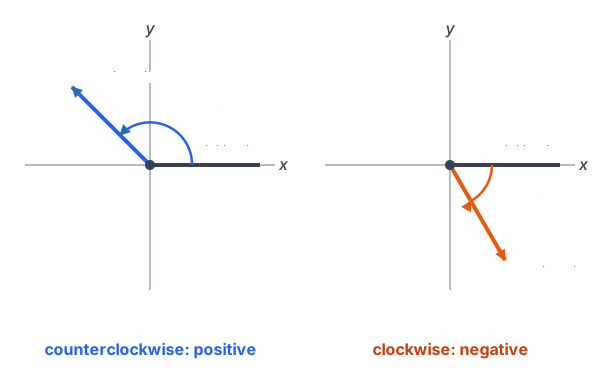
An angle in standard position has its vertex at the origin and its initial side on the positive x-axis. The terminal side is where the rotation stops. Turning counterclockwise makes a positive angle, and turning clockwise makes a negative angle. The quadrant where the terminal side lands helps describe the angle.
Before this lesson: You should know Measuring and Classifying Angles, the Coordinate Plane and Trigonometric Ratios.
Angles as Rotations
In geometry, an angle is two rays that share an endpoint, and its measure is between 0° and 180°. In trigonometry, an angle is a rotation. One ray stays put, and the other turns around the vertex. Because a ray can keep turning, an angle can be bigger than 360° or even negative.
Putting every angle in the same place makes them easy to compare. That place is called standard position:
- The vertex is at the origin, (0, 0).
- The initial side lies along the positive x-axis.
- The terminal side is the ray after the rotation.
- A positive angle turns counterclockwise. A negative angle turns clockwise.
Quadrants and Quadrantal Angles
Greek letters such as \theta (theta) are often used to name angles. The quadrant that holds the terminal side depends on the size of \theta:
| Terminal side in | Positive angles | Negative angles |
|---|---|---|
| Quadrant I | 0^\circ \lt \theta \lt 90^\circ | -360^\circ \lt \theta \lt -270^\circ |
| Quadrant II | 90^\circ \lt \theta \lt 180^\circ | -270^\circ \lt \theta \lt -180^\circ |
| Quadrant III | 180^\circ \lt \theta \lt 270^\circ | -180^\circ \lt \theta \lt -90^\circ |
| Quadrant IV | 270^\circ \lt \theta \lt 360^\circ | -90^\circ \lt \theta \lt 0^\circ |
An angle whose terminal side lies on an axis, such as 0°, 90°, 180°, 270° or −90°, is a quadrantal angle. It is not in any quadrant.
- Draw the initial side on the positive x-axis.
- If the angle is more than 360° or less than −360°, add or subtract 360° until it is between −360° and 360°. Each 360° is one full turn.
- Turn counterclockwise for a positive angle or clockwise for a negative angle.
- Use the table to name the quadrant, or the axis for a quadrantal angle.
Worked Examples
Example 1: A positive angle
Draw 135^\circ in standard position and name its quadrant.
Start with the initial side on the positive x-axis.
The angle is positive, so turn counterclockwise.
90^\circ \lt 135^\circ \lt 180^\circ
Compare with the quadrant borders.
135^\circ - 90^\circ = 45^\circ
Find how far past 90° it goes.
Draw the terminal side 45° past the positive y-axis.
Answer: The terminal side is in Quadrant II, halfway between the positive y-axis and the negative x-axis.
Example 2: A negative angle
Draw -60^\circ in standard position and name its quadrant.
Start with the initial side on the positive x-axis.
The angle is negative, so turn clockwise.
-90^\circ \lt -60^\circ \lt 0^\circ
Compare with the quadrant borders.
Draw the terminal side 60° below the positive x-axis.
Answer: The terminal side is in Quadrant IV.
Example 3: An angle greater than 360°
Name the quadrant of 500^\circ.
The angle is more than 360°, so it makes one full turn first.
500^\circ - 360^\circ = 140^\circ
Subtract one full turn.
90^\circ \lt 140^\circ \lt 180^\circ
Compare with the quadrant borders.
Answer: Quadrant II. The angle turns once all the way around, then 140° more.
Example 4: A large negative angle
Name the quadrant of -250^\circ.
The angle is negative, so it turns clockwise.
-270^\circ \lt -250^\circ \lt -180^\circ
Compare with the borders for negative angles.
Check by adding one full turn: -250^\circ + 360^\circ = 110^\circ
Compare: 90^\circ \lt 110^\circ \lt 180^\circ, which is also Quadrant II
Answer: Quadrant II. Turning 250° clockwise ends at the same place as turning 110° counterclockwise.
Example 5: Word problem with a skateboard spin
A skateboarder faces east, along the positive x-axis, and does a “540,” a counterclockwise spin of 540°. Which way does the skateboarder face when the spin ends?
540^\circ - 360^\circ = 180^\circ
The spin is more than 360°, so subtract one full turn.
An angle of 180° is a quadrantal angle. Its terminal side is the negative x-axis.
The negative x-axis points west.
Answer: The skateboarder ends facing west, the opposite direction, after one and a half turns.
Common Mistakes
| Mistake | Example of the error | Fix |
|---|---|---|
| Turning the wrong way | Drawing −60° counterclockwise into Quadrant I | Negative angles turn clockwise, so −60° is in Quadrant IV. |
| Starting from the wrong side | Measuring 135° from the positive y-axis | The initial side is always the positive x-axis. |
| Mixing up the quadrant numbers | Calling the top left quadrant Quadrant IV | Quadrants are numbered I to IV counterclockwise, starting at the top right. |
| Putting a quadrantal angle in a quadrant | Saying 270° is in Quadrant III | 270° lies on the negative y-axis, between Quadrants III and IV. |
| Forgetting full turns | Saying 500° is not a real angle | Subtract 360°: 500° ends where 140° ends. |
Related Methods
Degrees, minutes and seconds
A degree can be split into 60 minutes (′), and a minute into 60 seconds (″). To change 25.75^\circ, multiply the decimal part by 60: 0.75 \cdot 60 = 45, so 25.75^\circ = 25^\circ 45'.
Angles that share a terminal side
In Example 4, −250° and 110° end on the same ray. Angles like these are called coterminal angles, and they are the topic of the next lesson.
Measuring in radians
Angles can also be measured in radians, where one full turn is 2\pi instead of 360°. Radians come later in this unit and are the main unit in calculus.
Practice Problems
- Name the quadrant of 75^\circ.
- Name the quadrant of 210^\circ.
- Name the quadrant of -45^\circ.
- Name the quadrant of 300^\circ.
- Name the quadrant of -135^\circ.
- Where is the terminal side of 180^\circ?
- Name the quadrant of 420^\circ.
- Name the quadrant of -390^\circ.
- The terminal side of an angle lies on the negative y-axis. Give one positive angle and one negative angle between −360° and 360° that fit.
- A wind turbine blade starts on the positive x-axis and turns 1,000° counterclockwise. In which quadrant does it stop?
Show answers
1.
0^\circ \lt 75^\circ \lt 90^\circ
Compare.
Answer: Quadrant I
2.
180^\circ \lt 210^\circ \lt 270^\circ
Compare.
Answer: Quadrant III
3.
The angle is negative, so turn clockwise
-90^\circ \lt -45^\circ \lt 0^\circ
Compare.
Answer: Quadrant IV
4.
270^\circ \lt 300^\circ \lt 360^\circ
Compare.
Answer: Quadrant IV
5.
The angle is negative, so turn clockwise
-180^\circ \lt -135^\circ \lt -90^\circ
Compare.
Answer: Quadrant III
6.
180° is half a turn, so it is a quadrantal angle
Answer: on the negative x-axis
7.
420^\circ - 360^\circ = 60^\circ
Subtract one full turn.
0^\circ \lt 60^\circ \lt 90^\circ
Compare.
Answer: Quadrant I
8.
-390^\circ + 360^\circ = -30^\circ
Add one full turn.
-90^\circ \lt -30^\circ \lt 0^\circ
Compare.
Answer: Quadrant IV
9.
3 \cdot 90^\circ = 270^\circ
Counterclockwise, the negative y-axis is three quarter turns.
-90^\circ
Clockwise, it is one quarter turn.
Answer: 270^\circ and -90^\circ
10.
Find the number of full turns: \frac{1000}{360} \approx 2.8, so there are 2 full turns
2 \cdot 360^\circ = 720^\circ
Find the full turns in degrees.
1000^\circ - 720^\circ = 280^\circ
Subtract.
270^\circ \lt 280^\circ \lt 360^\circ
Compare.
Answer: Quadrant IV
FAQ
What is an angle in standard position?
It is an angle with its vertex at the origin and its initial side on the positive x-axis. The terminal side shows how far, and in which direction, the angle turns.
What is the difference between the initial side and the terminal side?
The initial side is where the rotation starts, on the positive x-axis. The terminal side is where the rotation ends.
How can an angle be negative?
A negative angle turns clockwise instead of counterclockwise. For example, −90° turns a quarter turn clockwise and ends on the negative y-axis.
What is a quadrantal angle?
It is an angle whose terminal side lies on the x-axis or y-axis, such as 0°, 90°, 180° or 270°. It does not lie in any quadrant.
Summary
- In standard position, the vertex is at the origin and the initial side is the positive x-axis.
- Positive angles turn counterclockwise; negative angles turn clockwise.
- The terminal side’s quadrant depends on the size of the angle.
- Quadrantal angles, like 90° and 180°, end on an axis.
- Add or subtract 360° to handle angles beyond one full turn.
Previous course: Algebra 2 Index
Next lesson: Coterminal Angles
Back to the Trigonometry Index