
Infinite Geometric Series
An infinite geometric series adds infinitely many terms of a geometric sequence. If the common ratio r is between −1 and 1, the sum gets closer and closer to one number: S = \frac{a_1}{1 - r}. If |r| \ge 1, the terms don’t shrink, so the series has no sum. It diverges.
Before this lesson: You should know Geometric Series, Geometric Sequences and Sigma Notation.
How an Endless Sum Can Have an Answer
Start with a square that has an area of 1. Shade half of it. Then shade half of what is left, which is \frac{1}{4}. Then half of what is left again, \frac{1}{8}. You can keep going forever, but the shaded part never goes past the whole square.
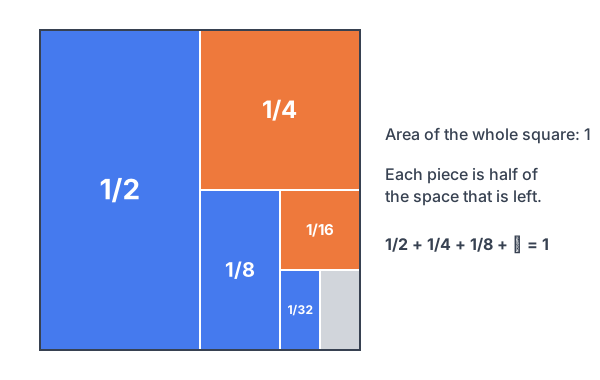
The running totals, called partial sums, show the pattern:
| Terms added | Partial sum |
|---|---|
| \frac{1}{2} | \frac{1}{2} = 0.5 |
| \frac{1}{2} + \frac{1}{4} | \frac{3}{4} = 0.75 |
| \frac{1}{2} + \frac{1}{4} + \frac{1}{8} | \frac{7}{8} = 0.875 |
| 4 terms | \frac{15}{16} = 0.9375 |
| 5 terms | \frac{31}{32} = 0.96875 |
The partial sums get closer and closer to 1. We say the series converges to 1, and we write \frac{1}{2} + \frac{1}{4} + \frac{1}{8} + \cdots = 1.
The Infinite Geometric Series Formula
S = \frac{a_1}{1 - r}, \quad \text{when } |r| \lt 1Here a_1 is the first term and r is the common ratio. The condition |r| \lt 1 means r is between −1 and 1 (see absolute value).
Why it works: the finite formula from geometric series is S_n = \frac{a_1(1 - r^n)}{1 - r}. When |r| \lt 1, the power r^n shrinks toward 0 as n grows. So 1 - r^n gets close to 1, and the sum gets close to \frac{a_1}{1 - r}.
If |r| \ge 1, the terms stay the same size or grow, so the partial sums never settle down. The series diverges and has no sum.
- Find the first term a_1 and the ratio r.
- Check whether |r| \lt 1. If not, the series diverges.
- If it does, substitute into S = \frac{a_1}{1 - r} and simplify.
Worked Examples
Example 1: A positive ratio
Find the sum of 12 + 6 + 3 + \cdots
r = \frac{6}{12} = \frac{1}{2}Find the ratio.
Check the ratio: |\frac{1}{2}| \lt 1, so the series converges
S = \frac{12}{1 - \frac{1}{2}}Substitute into the formula.
S = \frac{12}{\frac{1}{2}}Subtract in the denominator.
S = 12 \cdot 2 = 24
Divide by multiplying by the reciprocal (see multiplying and dividing fractions)
Answer: 24
Example 2: A negative ratio
Find the sum of 9 - 3 + 1 - \frac{1}{3} + \cdots
r = \frac{-3}{9} = -\frac{1}{3}Find the ratio.
Check the ratio: |-\frac{1}{3}| = \frac{1}{3} \lt 1, so the series converges
S = \frac{9}{1 - (-\frac{1}{3})}Substitute into the formula.
S = \frac{9}{\frac{4}{3}}Simplify the denominator.
S = 9 \cdot \frac{3}{4} = \frac{27}{4}Multiply by the reciprocal.
Answer: \frac{27}{4}, or 6.75. The terms jump above and below this value, getting closer each time.
Example 3: Converges or diverges?
Find the sum of each series if it exists: (a) \sum_{n=1}^{\infty} 4(\frac{2}{5})^{n - 1} and (b) \sum_{n=1}^{\infty} 4(\frac{5}{2})^{n - 1}.
4(\frac{2}{5})^0 = 4For (a), find the first term.
Read the ratio: r = \frac{2}{5}, and \frac{2}{5} \lt 1, so (a) converges
S = \frac{4}{1 - \frac{2}{5}}Substitute.
S = \frac{4}{\frac{3}{5}}Subtract in the denominator.
S = 4 \cdot \frac{5}{3} = \frac{20}{3}Multiply by the reciprocal.
For (b), read the ratio: r = \frac{5}{2}, and \frac{5}{2} \gt 1, so (b) diverges
Answer: (a) \frac{20}{3}; (b) no sum, because the terms 4, 10, 25, \ldots keep growing.
Example 4: Write a repeating decimal as a fraction
Write 0.\overline{36} = 0.363636\ldots as a fraction.
0.36 + 0.0036 + 0.000036 + \cdots
Write the decimal as a series.
a_1 = 0.36 = \frac{36}{100}Find the first term.
r = \frac{0.0036}{0.36} = \frac{1}{100}Find the ratio.
S = \frac{\frac{36}{100}}{1 - \frac{1}{100}}Substitute.
S = \frac{\frac{36}{100}}{\frac{99}{100}}Subtract in the denominator.
S = \frac{36}{100} \cdot \frac{100}{99} = \frac{36}{99}Multiply by the reciprocal.
\frac{36}{99} = \frac{4}{11}Simplify by dividing by the GCF, 9 (see greatest common factor)
Answer: 0.\overline{36} = \frac{4}{11}. Check: \frac{4}{11} = 0.3636\ldots
Example 5: Word problem with a bouncing ball
A ball is dropped from a height of 10 feet. Each time it hits the ground, it bounces back up to 60% of its last height. Find the total distance the ball travels, up and down, before it comes to rest.
The first drop is 10 feet down.
The first bounce goes up 0.6 \cdot 10 = 6 feet, then falls 6 feet.
The bounce heights form a geometric series: 6 + 3.6 + 2.16 + \cdots, with a_1 = 6 and r = 0.6
\frac{6}{1 - 0.6} = \frac{6}{0.4} = 15Find the sum of the bounce heights.
2 \cdot 15 = 30
Each bounce is traveled twice (up and down)
10 + 30 = 40
Add the first drop.
Answer: The ball travels a total of 40 feet.
Common Mistakes
| Mistake | Example of the error | Fix |
|---|---|---|
| Using the formula when the series diverges | 2 + 6 + 18 + \cdots = \frac{2}{1 - 3} = -1 | Check |r| \lt 1 first. Here r = 3, so there is no sum. |
| Losing the sign of the ratio | For 9 - 3 + 1 - \cdots, using r = \frac{1}{3} | Divide with the signs: r = \frac{-3}{9} = -\frac{1}{3}. |
| Using the wrong first term | For \sum_{n=1}^{\infty} 2(\frac{1}{4})^n, using a_1 = 2 | Plug in the lower limit: a_1 = 2 \cdot \frac{1}{4} = \frac{1}{2}. |
| Counting each bounce only once | Answering 25 feet for Example 5 | After the first drop, the ball goes up and comes back down, so double the bounce total. |
| Thinking an endless sum must be endless | Saying \frac{1}{2} + \frac{1}{4} + \cdots is infinite | When |r| \lt 1, the terms shrink fast enough that the sum has a limit. |
Related Methods
Repeating decimals with one digit
A one-digit repeat like 0.\overline{7} is 0.7 + 0.07 + \cdots, with r = \frac{1}{10}. Its sum is \frac{0.7}{0.9} = \frac{7}{9}. This is a way to see why repeating decimals are rational numbers.
Partial sums on a calculator
You can check a sum by finding a few partial sums with the finite formula. For Example 1, S_{10} = \frac{12(1 - (\frac{1}{2})^{10})}{\frac{1}{2}} \approx 23.98, which is already close to 24.
Series in calculus
Calculus 2 studies many kinds of infinite series and tests to decide whether they converge. The geometric series is the first and most important example.
Practice Problems
- Find the sum of 8 + 4 + 2 + \cdots
- Find the sum of 27 + 9 + 3 + \cdots
- Find the sum of 10 - 5 + \frac{5}{2} - \cdots
- Find the sum of 1 + 1.5 + 2.25 + \cdots, if it exists.
- Evaluate \sum_{n=1}^{\infty} 6(\frac{1}{3})^{n - 1}.
- Evaluate \sum_{n=1}^{\infty} 5(-0.2)^{n - 1}.
- Evaluate \sum_{n=1}^{\infty} 2(\frac{1}{4})^n.
- Write 0.\overline{7} as a fraction.
- An infinite geometric series has first term 12 and sum 16. Find the common ratio.
- A child on a swing travels 4 meters on the first swing. Each swing after that is 80% as long as the one before. About how far does the child travel in all?
Show answers
1.
Find the ratio: r = \frac{4}{8} = \frac{1}{2}, which is less than 1
S = \frac{8}{1 - \frac{1}{2}} = \frac{8}{\frac{1}{2}}Substitute.
S = 8 \cdot 2 = 16
Multiply by the reciprocal.
Answer: 16
2.
r = \frac{9}{27} = \frac{1}{3}Find the ratio.
S = \frac{27}{1 - \frac{1}{3}} = \frac{27}{\frac{2}{3}}Substitute.
S = 27 \cdot \frac{3}{2} = \frac{81}{2}Multiply by the reciprocal.
Answer: \frac{81}{2}, or 40.5
3.
Find the ratio: r = \frac{-5}{10} = -\frac{1}{2}, and |-\frac{1}{2}| \lt 1
S = \frac{10}{1 - (-\frac{1}{2})} = \frac{10}{\frac{3}{2}}Substitute.
S = 10 \cdot \frac{2}{3} = \frac{20}{3}Multiply by the reciprocal.
Answer: \frac{20}{3}
4.
r = \frac{1.5}{1} = 1.5Find the ratio.
Check: 1.5 \gt 1
Answer: the series diverges, so it has no sum
5.
Find the first term: 6(\frac{1}{3})^0 = 6, and r = \frac{1}{3}
S = \frac{6}{1 - \frac{1}{3}} = \frac{6}{\frac{2}{3}}Substitute.
S = 6 \cdot \frac{3}{2} = 9Multiply by the reciprocal.
Answer: 9
6.
Find the first term: 5(-0.2)^0 = 5, and r = -0.2
S = \frac{5}{1 - (-0.2)} = \frac{5}{1.2}Substitute.
\frac{5}{1.2} = \frac{50}{12} = \frac{25}{6}Rewrite as a fraction.
Answer: \frac{25}{6}
7.
Find the first term by plugging in n = 1: 2(\frac{1}{4})^1 = \frac{1}{2}, and r = \frac{1}{4}
S = \frac{\frac{1}{2}}{1 - \frac{1}{4}} = \frac{\frac{1}{2}}{\frac{3}{4}}Substitute.
S = \frac{1}{2} \cdot \frac{4}{3} = \frac{4}{6} = \frac{2}{3}Multiply by the reciprocal.
Answer: \frac{2}{3}
8.
Write as a series: 0.7 + 0.07 + 0.007 + \cdots, so a_1 = \frac{7}{10} and r = \frac{1}{10}
S = \frac{\frac{7}{10}}{1 - \frac{1}{10}} = \frac{\frac{7}{10}}{\frac{9}{10}}Substitute.
S = \frac{7}{10} \cdot \frac{10}{9} = \frac{7}{9}Multiply by the reciprocal.
Answer: \frac{7}{9}
9.
16 = \frac{12}{1 - r}Substitute.
16(1 - r) = 12
Multiply both sides by 1 - r.
1 - r = \frac{12}{16} = \frac{3}{4}Divide both sides by 16.
-r = -\frac{1}{4}Subtract 1 from both sides.
r = \frac{1}{4}Divide both sides by −1.
Answer: r = \frac{1}{4}
10.
The swings form a series with a_1 = 4 and r = 0.8
S = \frac{4}{1 - 0.8} = \frac{4}{0.2}Substitute.
S = 20
Divide.
Answer: about 20 meters
FAQ
When does an infinite geometric series converge?
It converges when the common ratio is between −1 and 1, written |r| \lt 1. Then its sum is \frac{a_1}{1 - r}. If |r| \ge 1, it diverges.
How can an infinite sum have a finite answer?
When |r| \lt 1, each term is a fixed fraction of the one before, so the terms shrink very fast. The partial sums get closer and closer to one number without ever passing it.
What is the sum of 1/2 + 1/4 + 1/8 + …?
The first term is \frac{1}{2} and the ratio is \frac{1}{2}, so the sum is \frac{\frac{1}{2}}{1 - \frac{1}{2}} = 1.
What does it mean for a series to diverge?
The partial sums do not settle on a single number. They may grow without end, like 1 + 2 + 4 + \cdots, or jump back and forth, like 1 - 1 + 1 - \cdots.
Summary
- An infinite geometric series converges only when |r| \lt 1.
- Its sum is S = \frac{a_1}{1 - r}.
- If |r| \ge 1, it diverges and has no sum.
- Find a_1 by plugging the lower limit into the rule.
- Repeating decimals and bouncing-ball problems are infinite geometric series.
Previous lesson: Geometric Series
Next course: Trigonometry Index
Back to the Algebra 2 Index