
Sigma Notation
Sigma notation is a short way to write a sum. The Greek capital letter sigma, \Sigma, means “add up.” The number below it gives the first value of the index, the number above it gives the last value, and the expression to its right gives each term. Plug in each value and add.
Before this lesson: You should know Arithmetic Sequences, Geometric Sequences and Function Notation.
Reading Sigma Notation
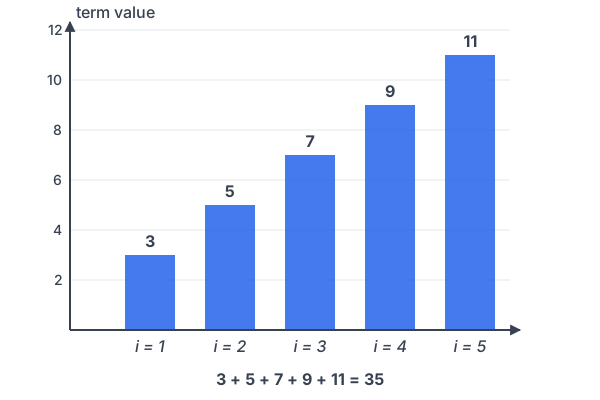
Writing out a long sum like 3 + 5 + 7 + \cdots + 99 takes space, and the pattern is easy to miss. Sigma notation packs the whole sum into one line. Here is a short example:
\sum_{i=1}^{5} (2i + 1) = 3 + 5 + 7 + 9 + 11| Part | Name | Meaning |
|---|---|---|
| i | Index of summation | The counter. It takes each whole-number value in turn. |
| 1 (below) | Lower limit | The first value of the index |
| 5 (above) | Upper limit | The last value of the index |
| 2i + 1 | Term (summand) | The rule for each term |
The number of terms is the upper limit minus the lower limit, plus 1. Here that is 5 - 1 + 1 = 5 terms. The index letter can be i, k, n or any other letter.
How to Evaluate a Sum in Sigma Notation
- Find the number of terms: upper limit minus lower limit, plus 1.
- Substitute the lower limit into the term rule.
- Repeat for each whole number up to the upper limit.
- Add all the terms.
These properties can save work. Here c is a constant (a number that does not change with the index).
| Property | Example |
|---|---|
| \sum_{i=1}^{n} c = nc | \sum_{i=1}^{4} 6 = 4 \cdot 6 = 24 |
| \sum_{i=1}^{n} c \, a_i = c \sum_{i=1}^{n} a_i | \sum_{i=1}^{3} 5i = 5(1 + 2 + 3) = 30 |
| \sum_{i=1}^{n} (a_i + b_i) = \sum_{i=1}^{n} a_i + \sum_{i=1}^{n} b_i | \sum_{i=1}^{3} (i + 2) = 6 + 6 = 12 |
Worked Examples
Example 1: Evaluate a linear sum
Evaluate \sum_{i=1}^{5} (2i + 1).
5 - 1 + 1 = 5
Count the terms.
2(1) + 1 = 3
Substitute i = 1.
2(2) + 1 = 5
Substitute i = 2.
2(3) + 1 = 7
Substitute i = 3.
2(4) + 1 = 9
Substitute i = 4.
2(5) + 1 = 11
Substitute i = 5.
3 + 5 + 7 + 9 + 11 = 35
Add the terms.
Answer: \sum_{i=1}^{5} (2i + 1) = 35
Example 2: A sum that does not start at 1
Evaluate \sum_{k=2}^{5} k^2.
5 - 2 + 1 = 4
Count the terms.
2^2 = 4
Substitute k = 2.
3^2 = 9
Substitute k = 3.
4^2 = 16
Substitute k = 4.
5^2 = 25
Substitute k = 5.
4 + 9 + 16 + 25 = 54
Add the terms.
Answer: \sum_{k=2}^{5} k^2 = 54
Example 3: An exponential term
Evaluate \sum_{n=0}^{4} 3(2)^n.
4 - 0 + 1 = 5
Count the terms.
3(2)^0 = 3 \cdot 1 = 3
Substitute n = 0.
3(2)^1 = 3 \cdot 2 = 6
Substitute n = 1.
3(2)^2 = 3 \cdot 4 = 12
Substitute n = 2.
3(2)^3 = 3 \cdot 8 = 24
Substitute n = 3.
3(2)^4 = 3 \cdot 16 = 48
Substitute n = 4.
3 + 6 + 12 + 24 + 48 = 93
Add the terms.
Answer: 93. The terms form a geometric sequence, so this is a geometric series.
Example 4: Write a sum in sigma notation
Write 4 + 7 + 10 + \cdots + 31 in sigma notation.
7 - 4 = 3
Find the common difference.
a_n = 4 + (n - 1) \cdot 3
Write the nth term (see arithmetic sequences)
a_n = 4 + 3n - 3
Distribute the 3.
a_n = 3n + 1
Combine like terms.
3n + 1 = 31
Set the last term equal to 31.
3n = 30
Subtract 1 from both sides.
Divide both sides by 3: n = 10, so there are 10 terms
Check the first term: 3(1) + 1 = 4
Answer: \sum_{n=1}^{10} (3n + 1)
Example 5: Word problem with seats in a theater
A small theater has 8 rows. Row 1 has 20 seats, and each row after that has 2 more seats than the row before it. Row n has 18 + 2n seats. How many seats are there in all?
\sum_{n=1}^{8} (18 + 2n)Write the total in sigma notation.
\sum_{n=1}^{8} 18 + \sum_{n=1}^{8} 2nSplit the sum with the sum property.
\sum_{n=1}^{8} 18 = 8 \cdot 18 = 144Use the constant property on the first sum.
\sum_{n=1}^{8} 2n = 2 \sum_{n=1}^{8} nFactor the 2 out of the second sum.
1 + 2 + 3 + 4 + 5 + 6 + 7 + 8 = 36
Add the numbers 1 through 8.
2 \cdot 36 = 72
Multiply by 2.
144 + 72 = 216
Add the two parts.
Check by listing the rows: 20 + 22 + 24 + 26 + 28 + 30 + 32 + 34 = 216
Answer: The theater has 216 seats.
Common Mistakes
| Mistake | Example of the error | Fix |
|---|---|---|
| Miscounting the terms | \sum_{i=3}^{7} has 7 - 3 = 4 terms | Add 1: 7 - 3 + 1 = 5 terms. |
| Starting at 1 when the index starts at 0 | In \sum_{n=0}^{4} 3(2)^n, skipping n = 0 | Always start at the lower limit. The n = 0 term is 3. |
| Multiplying before the exponent | 3(2)^2 = 6^2 = 36 | Do the exponent first: 3(2)^2 = 3 \cdot 4 = 12. |
| Factoring out a number that is added | \sum_{i=1}^{4} (i + 5) = 5 \sum_{i=1}^{4} i | Only a multiplied constant factors out: \sum_{i=1}^{4} i + \sum_{i=1}^{4} 5 = 10 + 20 = 30. |
| Squaring the whole sum | \sum_{k=1}^{3} k^2 = (1 + 2 + 3)^2 = 36 | Square each term, then add: 1 + 4 + 9 = 14. |
Related Methods
Shifting the index
The same sum can be written with a different starting value. \sum_{i=1}^{5} (2i + 1) and \sum_{i=0}^{4} (2i + 3) both equal 3 + 5 + 7 + 9 + 11. When you lower the limits by 1, replace i with i + 1 in the term.
Alternating signs
A factor of (-1)^i makes the signs switch back and forth. For example, \sum_{i=1}^{4} (-1)^i i = -1 + 2 - 3 + 4 = 2.
Formulas for long sums
Adding 100 terms one by one is slow. The next lessons give formulas for arithmetic series and geometric series. Sigma notation also returns in calculus, where it is used to add up the areas of thin rectangles.
Practice Problems
- Evaluate \sum_{i=1}^{4} 5i.
- Evaluate \sum_{k=1}^{6} (k - 2).
- Evaluate \sum_{n=3}^{6} n^2.
- Evaluate \sum_{j=0}^{3} 2^j.
- Evaluate \sum_{i=1}^{5} (-1)^i \, i.
- Evaluate \sum_{n=1}^{4} \frac{1}{n}.
- Write 2 + 4 + 6 + \cdots + 40 in sigma notation.
- Write 5 + 10 + 20 + 40 + 80 in sigma notation.
- Use a property to evaluate \sum_{i=1}^{10} 7.
- Maya saves $10 the first week, $15 the second week, and $5 more each week after that. In week w she saves 5w + 5 dollars. Write her total for 6 weeks in sigma notation and evaluate it.
Show answers
1.
4 - 1 + 1 = 4
Count the terms.
Find the terms: 5(1) = 5, 5(2) = 10, 5(3) = 15, 5(4) = 20
5 + 10 + 15 + 20 = 50
Add.
Answer: 50
2.
-1, 0, 1, 2, 3, 4
Find the terms for k = 1 to 6.
-1 + 0 + 1 + 2 + 3 + 4 = 9
Add.
Answer: 9
3.
6 - 3 + 1 = 4
Count the terms.
Find the terms: 3^2 = 9, 4^2 = 16, 5^2 = 25, 6^2 = 36
9 + 16 + 25 + 36 = 86
Add.
Answer: 86
4.
Find the terms: 2^0 = 1, 2^1 = 2, 2^2 = 4, 2^3 = 8
1 + 2 + 4 + 8 = 15
Add.
Answer: 15
5.
Find the terms: (-1)^1 \cdot 1 = -1, (-1)^2 \cdot 2 = 2, (-1)^3 \cdot 3 = -3, (-1)^4 \cdot 4 = 4, (-1)^5 \cdot 5 = -5
-1 + 2 - 3 + 4 - 5 = -3
Add (see adding and subtracting integers)
Answer: −3
6.
1, \frac{1}{2}, \frac{1}{3}, \frac{1}{4}Find the terms.
\frac{12}{12} + \frac{6}{12} + \frac{4}{12} + \frac{3}{12}Rewrite with the common denominator 12 (see adding and subtracting fractions)
\frac{12 + 6 + 4 + 3}{12} = \frac{25}{12}Add the numerators.
Answer: \frac{25}{12}
7.
The terms go up by 2, so term n is 2n
2n = 40
Set the last term equal to 40.
n = 20
Divide both sides by 2.
Answer: \sum_{n=1}^{20} 2n
8.
Each term is 2 times the one before, starting at 5, so term n is 5(2)^{n - 1}
Check the last term: 5(2)^{5 - 1} = 5 \cdot 16 = 80
Answer: \sum_{n=1}^{5} 5(2)^{n - 1}
9.
\sum_{i=1}^{10} 7 = 10 \cdot 7Use the constant property.
10 \cdot 7 = 70
Multiply.
Answer: 70
10.
\sum_{w=1}^{6} (5w + 5)Write the sum.
10, 15, 20, 25, 30, 35
Find the terms.
10 + 15 + 20 + 25 + 30 + 35 = 135
Add.
Answer: \sum_{w=1}^{6} (5w + 5) = 135, so she saves $135
FAQ
What does the sigma symbol mean in math?
The symbol \Sigma means “add up.” It tells you to add all the terms you get by putting each value of the index into the expression.
How do you find the number of terms in sigma notation?
Subtract the lower limit from the upper limit, then add 1. The sum \sum_{k=4}^{12} has 12 - 4 + 1 = 9 terms.
Does the index have to be i?
No. Any letter works, such as i, j, k or n. The letter only counts the terms, so changing it does not change the sum.
What is the difference between a series and sigma notation?
A series is the sum of the terms of a sequence. Sigma notation is one way to write a series in short form.
Summary
- \Sigma means add up the terms.
- The index starts at the lower limit and goes up by 1 until it reaches the upper limit.
- The number of terms is upper minus lower, plus 1.
- A constant factor can move outside the sum, and a sum of two terms can split into two sums.
- To write a sum in sigma notation, find a rule for the nth term and the number of terms.
Previous lesson: Solving Logarithmic Equations
Next lesson: Arithmetic Series
Back to the Algebra 2 Index