
Solving Logarithmic Equations
Solving logarithmic equations means finding the value of x that makes a log equation true. Get a single log on one side, rewrite it in exponential form, and solve. If each side is one log with the same base, set the insides equal. Always check for extraneous solutions.
Before this lesson: You should know Solving Exponential Equations, Properties of Logarithms and Logarithms.
Undo the Log With an Exponent
A log and an exponent undo each other. The equation \log_2 x = 3 asks, “2 to what power gives x?” The power is 3, so x = 2^3 = 8. Rewriting a log equation in exponential form frees the variable.
There is one catch. You can only take the log of a positive number, as you saw in graphing logarithmic functions. So an answer that makes the inside of any log zero or negative must be thrown out. Such an answer is called an extraneous solution.
Rules for Solving Log Equations
\log_b A = c \quad \text{means} \quad A = b^c\log_b A = \log_b B \quad \text{means} \quad A = B- Use the log properties to combine the logs on each side into a single log.
- If one side is a single log and the other is a number, rewrite in exponential form.
- If both sides are single logs with the same base, set the insides equal.
- Solve the equation that is left.
- Check every answer in the original equation. Reject any answer that makes the inside of a log zero or negative.
Worked Examples
Example 1: Rewrite in exponential form
Solve \log_3 (2x + 1) = 2.
2x + 1 = 3^2
Rewrite in exponential form.
2x + 1 = 9
Simplify the power.
2x = 8
Subtract 1 from both sides.
x = 4
Divide both sides by 2.
Check: \log_3 (2 \cdot 4 + 1) = \log_3 9 = 2
Answer: x = 4
Example 2: A log on each side
Solve \log (x + 4) = \log (3x - 2).
x + 4 = 3x - 2
Set the insides equal.
-2x + 4 = -2
Subtract 3x from both sides.
-2x = -6
Subtract 4 from both sides.
x = 3
Divide both sides by −2.
Check the insides: 3 + 4 = 7 and 3 \cdot 3 - 2 = 7. Both are positive, and \log 7 = \log 7.
Answer: x = 3
Example 3: Isolate a natural log
Solve 3 \ln x - 2 = 4. Give the exact answer and the answer rounded to the nearest hundredth.
3 \ln x = 6
Add 2 to both sides.
\ln x = 2
Divide both sides by 3.
x = e^2
Rewrite in exponential form with base e.
e^2 \approx 7.389
Evaluate with a calculator.
Answer: x = e^2 \approx 7.39. The inside, e^2, is positive, so the answer checks. The number e is the base of ln.
Example 4: Combine logs and check for extraneous solutions
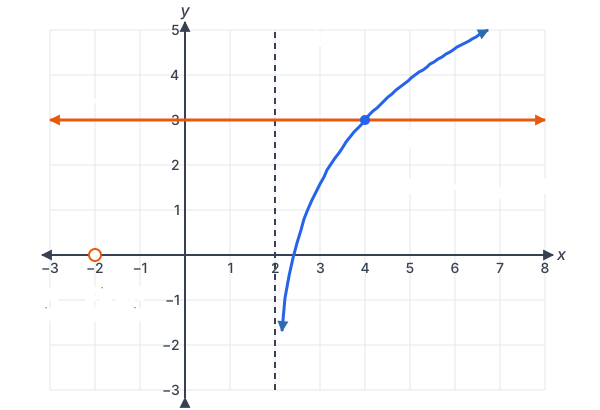
Solve \log_2 x + \log_2 (x - 2) = 3.
\log_2 [x(x - 2)] = 3
Use the product rule to combine the logs.
x(x - 2) = 2^3
Rewrite in exponential form.
x(x - 2) = 8
Simplify the power.
x^2 - 2x = 8
Distribute (see distributive property)
x^2 - 2x - 8 = 0
Subtract 8 from both sides.
(x - 4)(x + 2) = 0
Factor the trinomial (see factoring trinomials)
Set each factor equal to 0 (see solving quadratic equations by factoring): x - 4 = 0 or x + 2 = 0
Solve each equation: x = 4 or x = -2
Check x = 4: \log_2 4 + \log_2 2 = 2 + 1 = 3. It works.
Check x = -2: \log_2 (-2) is undefined, so x = -2 is extraneous.
Answer: x = 4. The graph shows why: the left side only exists for x \gt 2, so it meets the line y = 3 just once.
Example 5: Word problem with sound intensity
The sound level in decibels is L = 10 \log \frac{I}{10^{-12}}, where I is the intensity in watts per square meter. A busy street is 85 dB. What is its intensity?
10 \log \frac{I}{10^{-12}} = 85Set L equal to 85.
\log \frac{I}{10^{-12}} = 8.5Divide both sides by 10.
\frac{I}{10^{-12}} = 10^{8.5}Rewrite in exponential form.
I = 10^{8.5} \cdot 10^{-12}Multiply both sides by 10^{-12}.
I = 10^{-3.5}Add the exponents (see exponent rules)
10^{-3.5} \approx 0.000316Evaluate with a calculator.
Answer: about 3.16 \times 10^{-4} watts per square meter, written in scientific notation.
Common Mistakes
| Mistake | Example of the error | Fix |
|---|---|---|
| Not checking the answers | Keeping x = -2 in Example 4 | Plug each answer into the original equation. Reject any that makes the inside of a log zero or negative. |
| Using the wrong base | \log_3 (2x + 1) = 2 becomes 2x + 1 = 2^3 | The base of the log is the base of the power: 2x + 1 = 3^2. |
| Dropping the logs when one side is a number | \log x + \log 3 = 2 becomes x + 3 = 2 | Combine first: \log (3x) = 2, so 3x = 10^2. |
| Splitting the log of a sum | \log (x + 3) = \log x + \log 3 | There is no rule for the log of a sum. Only the log of a product splits. |
| Rejecting every negative answer | Throwing out x = -2 in \log_2 (x + 10) = 3 | Check the inside, not the sign of x: -2 + 10 = 8, which is positive, so x = -2 works. |
Related Methods
Solve by graphing
Graph each side as its own function and find where they meet. A graphing calculator or Desmos shows right away that an extraneous answer is not a real intersection.
Extraneous solutions in other equations
Checking answers is a habit you also need for solving radical equations and solving rational equations. In each case, a step can create an answer that does not work in the original equation.
Exponential equations
When the variable is in an exponent instead of inside a log, take the log of both sides instead. That method is in solving exponential equations.
Practice Problems
- Solve \log_2 x = 5.
- Solve \log_4 (x - 3) = 2.
- Solve \log x = -2.
- Solve \log_5 (3x + 1) = \log_5 (x + 9).
- Solve \ln (x + 2) = 3. Round to the nearest hundredth.
- Solve 2 \log_3 x = 4.
- Solve \log_6 x + \log_6 (x - 5) = 2.
- Solve \log_2 (x + 6) - \log_2 x = 2.
- Solve \log (x + 9) = 1 + \log x.
- The pH of a liquid is \text{pH} = -\log h, where h is the hydrogen ion concentration. Lemon juice has a pH of 2.3. Find h to three significant digits.
Show answers
1.
x = 2^5
Rewrite in exponential form.
x = 32
Simplify the power.
Answer: x = 32
2.
x - 3 = 4^2
Rewrite in exponential form.
x - 3 = 16
Simplify the power.
x = 19
Add 3 to both sides.
Check: \log_4 16 = 2
Answer: x = 19
3.
x = 10^{-2}Rewrite in exponential form.
x = \frac{1}{100}Simplify the power.
Answer: x = \frac{1}{100} = 0.01
4.
3x + 1 = x + 9
Set the insides equal.
2x + 1 = 9
Subtract x from both sides.
2x = 8
Subtract 1 from both sides.
x = 4
Divide both sides by 2.
Check the insides: 3 \cdot 4 + 1 = 13 and 4 + 9 = 13, both positive
Answer: x = 4
5.
x + 2 = e^3
Rewrite in exponential form.
x = e^3 - 2
Subtract 2 from both sides.
e^3 - 2 \approx 20.0855 - 2 = 18.0855
Evaluate.
Answer: x = e^3 - 2 \approx 18.09
6.
\log_3 x = 2
Divide both sides by 2.
x = 3^2
Rewrite in exponential form.
x = 9
Simplify the power.
Answer: x = 9
7.
\log_6 [x(x - 5)] = 2
Use the product rule.
x(x - 5) = 36
Rewrite in exponential form.
x^2 - 5x = 36
Distribute.
x^2 - 5x - 36 = 0
Subtract 36 from both sides.
(x - 9)(x + 4) = 0
Factor the trinomial.
Solve each factor: x = 9 or x = -4
Check x = -4: \log_6 (-4) is undefined, so reject it
Check x = 9: \log_6 9 + \log_6 4 = \log_6 36 = 2
Answer: x = 9
8.
\log_2 \frac{x + 6}{x} = 2Use the quotient rule.
\frac{x + 6}{x} = 2^2Rewrite in exponential form.
\frac{x + 6}{x} = 4Simplify the power.
x + 6 = 4x
Multiply both sides by x.
6 = 3x
Subtract x from both sides.
x = 2
Divide both sides by 3.
Check: \log_2 8 - \log_2 2 = 3 - 1 = 2
Answer: x = 2
9.
\log (x + 9) - \log x = 1
Subtract \log x from both sides.
\log \frac{x + 9}{x} = 1Use the quotient rule.
\frac{x + 9}{x} = 10^1Rewrite in exponential form.
x + 9 = 10x
Multiply both sides by x.
9 = 9x
Subtract x from both sides.
x = 1
Divide both sides by 9.
Check: \log 10 = 1 and 1 + \log 1 = 1 + 0 = 1
Answer: x = 1
10.
-\log h = 2.3
Substitute.
\log h = -2.3
Multiply both sides by −1.
h = 10^{-2.3}Rewrite in exponential form.
10^{-2.3} \approx 0.00501Evaluate with a calculator.
Answer: h \approx 5.01 \times 10^{-3}
FAQ
How do you solve a logarithmic equation?
Combine the logs into one log on each side. Then rewrite in exponential form, or set the insides equal if both sides are logs with the same base. Solve, and check each answer.
What is an extraneous solution of a log equation?
It is an answer you get from the algebra that does not work in the original equation, because it makes the inside of a log zero or negative. You must reject it.
Can the solution of a log equation be negative?
Yes. What matters is the inside of each log. In \log_2 (x + 10) = 3, the answer x = -2 works because -2 + 10 = 8 is positive.
How are log equations different from exponential equations?
In a log equation the variable is inside a log, so you rewrite it as an exponent. In an exponential equation the variable is in an exponent, so you take a log of both sides.
Summary
- \log_b A = c means A = b^c. Rewriting in exponential form frees the variable.
- \log_b A = \log_b B means A = B.
- Combine logs first with the product, quotient and power rules.
- The inside of every log must be positive.
- Check every answer and reject extraneous solutions.
Previous lesson: Solving Exponential Equations
Next lesson: Sigma Notation
Back to the Algebra 2 Index