
Solving Exponential Equations
Solving exponential equations means finding the exponent that makes the equation true. If both sides can be written as powers of the same base, set the exponents equal. If not, take the log of both sides, use the power rule to bring the variable down, and solve.
Before this lesson: You should know Properties of Logarithms, Logarithms and Exponent Rules.
What It Means to Solve for an Exponent
In an exponential equation, the variable is in an exponent, like 2^x = 10. Some are easy to solve by sight. You know 2^x = 8 means x = 3, because 2^3 = 8.
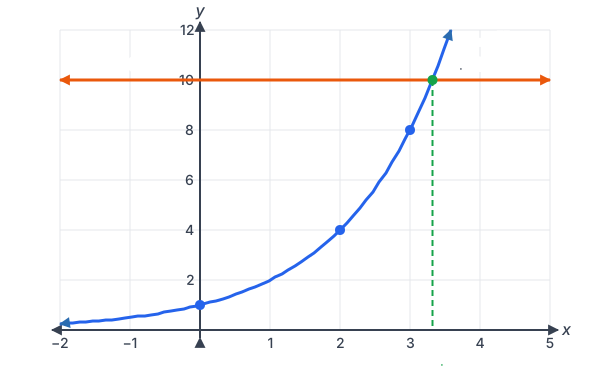
But 2^x = 10 has no whole-number answer. Since 2^3 = 8 and 2^4 = 16, the answer is between 3 and 4. Logarithms find the exact value: x = \log_2 10 \approx 3.32. On a graph, it is where the curve y = 2^x meets the line y = 10.
Two Ways to Solve
Method 1: Same base. If you can write both sides as powers of the same base, the exponents must be equal:
\text{If } b^m = b^n, \text{ then } m = n.Method 2: Take the log of both sides. Use this when the bases can’t match.
- Get the power by itself on one side.
- Take the log (or ln) of both sides.
- Use the power rule to move the exponent to the front: \log b^x = x \log b.
- Solve for x. Divide by the log, then do any other steps.
- Use a calculator only at the end, and round as asked.
Calculator note: For \frac{\log 40}{\log 5}, press LOG, 40, ), ÷, LOG, 5, ), then ENTER.
Worked Examples
Example 1: Same base on both sides
Solve 3^{x + 1} = 81.
81 = 3^4
Write 81 as a power of 3.
3^{x + 1} = 3^4Rewrite the equation.
x + 1 = 4
Set the exponents equal.
x = 3
Subtract 1 from both sides.
Check: 3^{3 + 1} = 3^4 = 81
Answer: x = 3
Example 2: Rewrite both bases
Solve 4^x = 8^{x - 1}.
Write each base as a power of 2: 4 = 2^2 and 8 = 2^3
(2^2)^x = (2^3)^{x - 1}Rewrite the equation.
2^{2x} = 2^{3x - 3}Multiply the exponents (see power of a power rule)
2x = 3x - 3
Set the exponents equal.
-x = -3
Subtract 3x from both sides.
x = 3
Divide both sides by −1.
Check: 4^3 = 64 and 8^{3 - 1} = 8^2 = 64
Answer: x = 3
Example 3: Take the log of both sides
Solve 5^x = 40. Round to the nearest hundredth.
\log 5^x = \log 40
40 is not a power of 5, so take the log of both sides.
x \log 5 = \log 40
Use the power rule (see properties of logarithms)
x = \frac{\log 40}{\log 5}Divide both sides by \log 5.
Evaluate each log: \log 40 \approx 1.60206 and \log 5 \approx 0.69897
\frac{1.60206}{0.69897} \approx 2.292Divide.
x \approx 2.29
Round to the nearest hundredth.
Check: 5^{2.29} \approx 39.9, which is close to 40.
Answer: x \approx 2.29
Example 4: Isolate the power first
Solve 2 \cdot 7^{x - 3} + 5 = 41. Round to the nearest hundredth.
2 \cdot 7^{x - 3} = 36Subtract 5 from both sides.
7^{x - 3} = 18Divide both sides by 2.
\log 7^{x - 3} = \log 18Take the log of both sides.
(x - 3) \log 7 = \log 18
Use the power rule.
x - 3 = \frac{\log 18}{\log 7}Divide both sides by \log 7.
Evaluate each log: \log 18 \approx 1.25527 and \log 7 \approx 0.84510
\frac{1.25527}{0.84510} \approx 1.4854Divide.
x \approx 1.4854 + 3 = 4.4854
Add 3 to both sides.
x \approx 4.49
Round to the nearest hundredth.
Answer: x \approx 4.49
Example 5: Word problem with population growth
A town has 12,000 people, and its population grows 3% each year. Its population after t years is P = 12{,}000(1.03)^t. After how many years will the town reach 18,000 people?
12{,}000(1.03)^t = 18{,}000Set P equal to 18,000.
1.03^t = 1.5
Divide both sides by 12,000.
\log 1.03^t = \log 1.5
Take the log of both sides.
t \log 1.03 = \log 1.5
Use the power rule.
t = \frac{\log 1.5}{\log 1.03}Divide both sides by \log 1.03.
Evaluate each log: \log 1.5 \approx 0.176091 and \log 1.03 \approx 0.012837
\frac{0.176091}{0.012837} \approx 13.72Divide.
Answer: about 13.7 years, so the town passes 18,000 people during year 14. The same steps work for compound interest problems.
Common Mistakes
| Mistake | Example of the error | Fix |
|---|---|---|
| Taking the log before isolating the power | \log (2^x + 5) = x \log 2 + \log 5 | Subtract 5 first. There is no rule for the log of a sum. |
| Combining the coefficient with the base | 3 \cdot 2^x = 48 becomes 6^x = 48 | Divide by 3 first: 2^x = 16. |
| Turning a quotient of logs into one log | \frac{\log 40}{\log 5} = \log 8 | The quotient rule is about \log \frac{M}{N}. Divide the two decimal values instead. |
| Setting exponents equal when the bases differ | 2^x = 3^{x - 1}, so x = x - 1 | Only equal bases let you match exponents. Take logs instead. |
| Rounding too early | Using \log 7 \approx 0.8 | Keep at least four decimal places until the last step. |
Related Methods
Use ln when the base is e
If the base is the number e, take the natural log of both sides, because \ln e^x = x. For e^{2x} = 30, you get 2x = \ln 30, so x = \frac{\ln 30}{2} \approx 1.70.
Write the answer as a log
The exact answer to 5^x = 40 is x = \log_5 40. The change of base formula turns it into \frac{\log 40}{\log 5}, the same value as Method 2.
Solve by graphing
Graph each side as its own function, y = 5^x and y = 40, and find where they meet. This gives a good estimate and a check on your algebra.
Practice Problems
- Solve 2^x = 32.
- Solve 5^{2x - 1} = 125.
- Solve 9^x = 27.
- Solve (\frac{1}{2})^x = 8.
- Solve 3^x = 20. Round to the nearest hundredth.
- Solve 6^{x + 2} = 50. Round to the nearest hundredth.
- Solve 4 \cdot 2^x = 100. Round to the nearest hundredth.
- Solve e^x = 15. Round to the nearest hundredth.
- Solve 3e^{2x} - 4 = 20. Round to the nearest hundredth.
- A lab starts with 500 bacteria, and the number doubles every hour: N = 500 \cdot 2^t. After how many hours will there be 20,000 bacteria?
Show answers
1.
32 = 2^5
Write 32 as a power of 2.
2^x = 2^5
Rewrite.
x = 5
Set the exponents equal.
Answer: x = 5
2.
125 = 5^3
Write 125 as a power of 5.
2x - 1 = 3
Set the exponents equal.
2x = 4
Add 1 to both sides.
x = 2
Divide both sides by 2.
Answer: x = 2
3.
Write each base as a power of 3: 9 = 3^2 and 27 = 3^3
(3^2)^x = 3^3
Rewrite.
3^{2x} = 3^3Multiply the exponents.
2x = 3
Set the exponents equal.
x = \frac{3}{2}Divide both sides by 2.
Answer: x = \frac{3}{2}
4.
Write each side as a power of 2: \frac{1}{2} = 2^{-1} and 8 = 2^3
(2^{-1})^x = 2^3Rewrite.
2^{-x} = 2^3Multiply the exponents.
-x = 3
Set the exponents equal.
x = -3
Divide both sides by −1.
Answer: x = -3
5.
\log 3^x = \log 20
Take the log of both sides.
x \log 3 = \log 20
Use the power rule.
x = \frac{\log 20}{\log 3}Divide by \log 3.
\frac{1.30103}{0.47712} \approx 2.727Evaluate.
Answer: x \approx 2.73
6.
\log 6^{x + 2} = \log 50Take the log of both sides.
(x + 2) \log 6 = \log 50
Use the power rule.
x + 2 = \frac{\log 50}{\log 6}Divide by \log 6.
\frac{1.69897}{0.77815} \approx 2.1833Evaluate.
x \approx 2.1833 - 2 = 0.1833
Subtract 2 from both sides.
Answer: x \approx 0.18
7.
2^x = 25
Divide both sides by 4.
\log 2^x = \log 25
Take the log of both sides.
x \log 2 = \log 25
Use the power rule.
x = \frac{\log 25}{\log 2}Divide by \log 2.
\frac{1.39794}{0.30103} \approx 4.644Evaluate.
Answer: x \approx 4.64
8.
\ln e^x = \ln 15
Take the natural log of both sides.
x = \ln 15
Use \ln e^x = x.
\ln 15 \approx 2.708
Evaluate.
Answer: x \approx 2.71
9.
3e^{2x} = 24Add 4 to both sides.
e^{2x} = 8Divide both sides by 3.
2x = \ln 8
Take the natural log of both sides.
x = \frac{\ln 8}{2}Divide both sides by 2.
\frac{2.07944}{2} = 1.03972Evaluate.
Answer: x \approx 1.04
10.
500 \cdot 2^t = 20{,}000Set N equal to 20,000.
2^t = 40
Divide both sides by 500.
t \log 2 = \log 40
Take the log of both sides.
t = \frac{\log 40}{\log 2}Divide by \log 2.
\frac{1.60206}{0.30103} \approx 5.32Evaluate.
Answer: after about 5.32 hours
FAQ
How do you solve an exponential equation without logs?
Write both sides as powers of the same base, then set the exponents equal. For 2^{x + 3} = 2^7, you get x + 3 = 7, so x = 4.
Should I use log or ln?
Either one works for any base, and both give the same answer. Use ln when the base is e, because \ln e^x = x saves a step.
Why do you take the log of both sides?
Doing the same thing to both sides keeps the equation true. The power rule then moves the variable out of the exponent, so you can solve for it with division.
Can an exponential equation have no solution?
Yes. A positive base raised to any power is always positive, so an equation like 2^x = -4 has no real solution.
Summary
- If both sides are powers of the same base, set the exponents equal.
- Otherwise, isolate the power, then take the log of both sides.
- The power rule turns \log b^x into x \log b, which frees the variable.
- Use ln when the base is e.
- Round only at the end, and check your answer in the original equation.
Previous lesson: Properties of Logarithms
Next lesson: Solving Logarithmic Equations
Back to the Algebra 2 Index