
The Number e
The number e is a special constant, about 2.71828, that shows up whenever something grows continuously. It is the value that \left(1 + \frac{1}{n}\right)^n gets closer to as n gets very large. It is used in continuous compound interest, A = Pe^{rt}, and in growth and decay models of the form y = ae^{kt}.
Before this lesson: You should know Exponential Functions, Exponential Growth and Decay, Compound Interest and Exponent Rules.
Where e Comes From
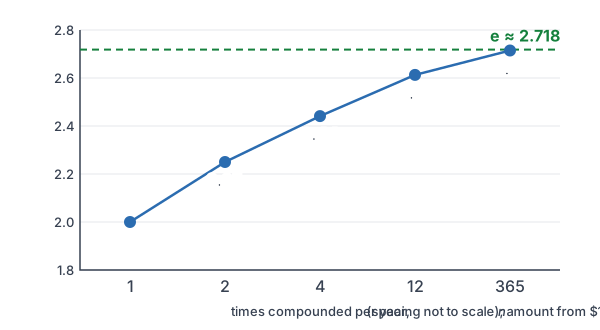
Imagine putting $1 in an account that pays 100% interest per year. Compounded once a year, you end with $2. Compounded twice, each half-year pays 50%, so you get 1.5^2 = 2.25. Compounding more often helps, but by less and less each time.
| Times compounded per year (n) | Amount \left(1 + \frac{1}{n}\right)^n |
|---|---|
| 1 | 2 |
| 2 | 2.25 |
| 4 | 2.4414 |
| 12 (monthly) | 2.6130 |
| 365 (daily) | 2.7146 |
| Continuously | e \approx 2.71828 |
The amounts level off at a number called e. Like \pi, it is irrational: its decimals never end or repeat.
Formulas with e
A = Pe^{rt} \qquad y = ae^{kt}In A = Pe^{rt}, P is the starting amount, r is the yearly rate as a decimal, and t is the time in years. In y = ae^{kt}, the model shows growth when k \gt 0 and decay when k \lt 0.
Calculator note: on a TI-84, press 2nd, then LN, to get e^x. On most other calculators, look for an e^x key. Round money to the nearest cent and other answers to the nearest hundredth.
Worked Examples
Example 1: Evaluate powers of e
Evaluate (a) e^3 and (b) e^{-0.5} to the nearest hundredth.
- (a) Enter e^3 on a calculator: 20.0855\ldots
- Round to the nearest hundredth: 20.09
- (b) Enter e^{-0.5}: 0.6065\ldots
- Round: 0.61. A negative exponent gives a number less than 1 (see zero and negative exponents).
Answer: (a) about 20.09 (b) about 0.61
Example 2: Simplify with exponent rules
Simplify (a) e^2 \cdot e^3, (b) \left(e^2\right)^3 and (c) \frac{e^5}{e^2}.
- (a) Same base, so add the exponents (see exponent rules): e^{2 + 3} = e^5
- (b) Power of a power, so multiply the exponents: e^{2 \cdot 3} = e^6
- (c) Same base, so subtract the exponents: e^{5 - 2} = e^3
Answer: (a) e^5 (b) e^6 (c) e^3. The letter e is just a number, so every exponent rule works.
Example 3: Continuous compound interest
You invest $2,000 at 5% interest compounded continuously. How much is in the account after 10 years?
- Write the formula: A = Pe^{rt}
- Substitute P = 2000, r = 0.05 and t = 10: A = 2000e^{0.05 \cdot 10}
- Multiply in the exponent: A = 2000e^{0.5}
- Evaluate with a calculator and round to the nearest cent: A \approx 3297.44
Answer: about $3,297.44
Example 4: Continuous versus monthly
How much more does Example 3 earn than monthly compounding at the same rate (see compound interest)?
- Write the monthly formula: A = P\left(1 + \frac{r}{n}\right)^{nt}
- Substitute n = 12: A = 2000\left(1 + \frac{0.05}{12}\right)^{120}
- Evaluate and round: A \approx 3294.02
- Subtract: 3297.44 - 3294.02 = 3.42
Answer: Continuous compounding earns only about $3.42 more. That matches the table: compounding more often helps less and less.
Example 5: Word problem with decay
The amount of a medicine in a patient’s blood is modeled by A = 50e^{-0.2t} milligrams, where t is hours after the dose. Is this growth or decay? How much is left after 3 hours?
- The exponent’s coefficient is −0.2, which is negative, so this is decay (see exponential growth and decay).
- Substitute t = 3: A = 50e^{-0.2 \cdot 3}
- Multiply in the exponent: A = 50e^{-0.6}
- Evaluate and round to the nearest hundredth: A \approx 27.44
Answer: Decay; about 27.44 mg remain after 3 hours.
Common Mistakes
| Mistake | Example of the error | Fix |
|---|---|---|
| Treating e as a variable | Trying to solve for e | e is a constant, about 2.71828, like \pi. |
| Using the percent, not the decimal | A = 2000e^{5 \cdot 10} | Write 5% as 0.05: 2000e^{0.5}. |
| Multiplying instead of using the exponent | e^{0.5} typed as e \times 0.5 | Use the e^x key so 0.5 is the exponent. |
| Rounding too early | Rounding e^{0.5} to 1.6 first | Keep full calculator precision until the last step. |
| Mixing up growth and decay | 50e^{-0.2t} is growth | A negative k means decay. |
Practice Problems
- Evaluate e^4 to the nearest hundredth.
- Evaluate e^{-1} to the nearest hundredth.
- Simplify e^3 \cdot e^4.
- Simplify \left(e^{2x}\right)^3.
- Simplify \frac{e^7}{e^2}.
- Does y = 3e^{0.4t} show growth or decay? What about y = 10e^{-1.2t}?
- Find the value of $1,000 invested at 4% compounded continuously for 5 years.
- Find the value of $5,000 invested at 3% compounded continuously for 20 years.
- A town’s population is modeled by P = 1200e^{0.03t}, where t is years from now. Estimate the population in 10 years.
- Compare $1,000 at 6% for 2 years compounded once a year and compounded continuously. How much more does continuous compounding earn?
Show answers
- Calculator: e^4 = 54.598\ldots
Round: about 54.60 - Calculator: e^{-1} = 0.3678\ldots
Round: about 0.37 - Add the exponents: e^{3 + 4}
Answer: e^7 - Multiply the exponents: e^{2x \cdot 3}
Answer: e^{6x} - Subtract the exponents: e^{7 - 2}
Answer: e^5 - First: k = 0.4 \gt 0, so growth
Second: k = -1.2 \lt 0, so decay - Substitute: A = 1000e^{0.04 \cdot 5}
Multiply the exponent: A = 1000e^{0.2}
Evaluate: A \approx 1221.40
Answer: about $1,221.40 - Substitute: A = 5000e^{0.03 \cdot 20}
Multiply the exponent: A = 5000e^{0.6}
Evaluate: A \approx 9110.59
Answer: about $9,110.59 - Substitute: P = 1200e^{0.03 \cdot 10}
Multiply the exponent: P = 1200e^{0.3}
Evaluate: P \approx 1619.83
Answer: about 1,620 people - Yearly: 1000(1.06)^2
Square: 1000(1.1236)
Multiply: 1123.60
Continuous: 1000e^{0.06 \cdot 2}
Multiply the exponent: 1000e^{0.12}
Evaluate: about 1127.50
Subtract: 1127.50 - 1123.60 = 3.90
Answer: about $3.90 more
FAQ
What is the number e?
It is an irrational constant, about 2.71828. It is the limit of \left(1 + \frac{1}{n}\right)^n as n grows, and it is the base used for continuous growth.
What is the formula for continuous compound interest?
A = Pe^{rt}, where P is the principal, r is the rate as a decimal, and t is the time in years.
Why is e used instead of other bases?
Growth that happens at every instant leads to e naturally. It also makes calculus formulas simpler, which is why scientists use it so often.
How do you type e on a calculator?
On a TI-84, press 2nd, then LN, to get e^x. Type the exponent and close the parenthesis. For e itself, enter e^1.
Summary
- e \approx 2.71828 is the limit of \left(1 + \frac{1}{n}\right)^n.
- Continuous compounding: A = Pe^{rt}.
- y = ae^{kt} shows growth when k \gt 0 and decay when k \lt 0.
- All exponent rules work with base e.
- Use the e^x key and round only at the end.
Previous lesson: Graphing Rational Functions
Next lesson: Logarithms
Back to the Algebra 2 Index