
Logarithms
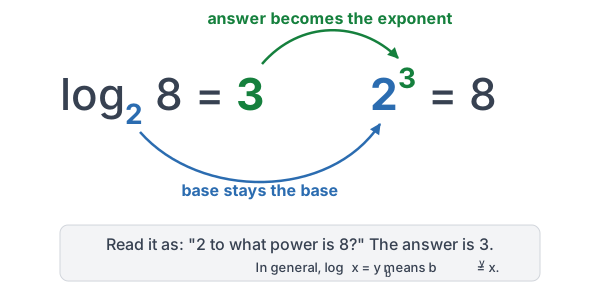
Logarithms answer the question “what exponent do I need?” The logarithm \log_b x is the power you raise b to in order to get x. So \log_2 8 = 3 because 2^3 = 8. Every logarithm can be rewritten as an exponential equation: \log_b x = y means b^y = x.
Before this lesson: You should know Exponent Rules, Zero and Negative Exponents, Inverse Functions and The Number e.
A Logarithm Is an Exponent
You know how to find 2^3: multiply to get 8. A logarithm runs the question backward. It starts with 8 and asks, “2 to what power is 8?” The answer, 3, is the logarithm.
In \log_b x, the small number b is the base and x is the argument. The base must be positive and not 1, and the argument must be positive.
The Definition and Special Logarithms
\log_b x = y \quad \text{means} \quad b^y = x| Name | How it is written | Base |
|---|---|---|
| Common logarithm | \log x | 10 |
| Natural logarithm | \ln x | e \approx 2.718 |
| Any other base | \log_b x | b, written as a subscript |
Four facts come straight from the definition. For any allowed base b:
- \log_b 1 = 0, because b^0 = 1.
- \log_b b = 1, because b^1 = b.
- \log_b b^x = x, because the log undoes the exponent.
- b^{\log_b x} = x, because the exponent undoes the log. Logarithms and exponential functions are inverses (see inverse functions).
Calculator note: use the LOG key for base 10 and the LN key for base e. Round to the nearest hundredth.
Worked Examples
Example 1: Switch between forms
Rewrite (a) \log_3 81 = 4 in exponential form, (b) 5^2 = 25 in logarithmic form, and (c) e^0 = 1 in logarithmic form.
- (a) The base 3 stays the base and the answer 4 becomes the exponent: 3^4 = 81
- (b) The exponent 2 becomes the answer of the log: \log_5 25 = 2
- (c) Base e means the natural log: \ln 1 = 0
Answer: (a) 3^4 = 81 (b) \log_5 25 = 2 (c) \ln 1 = 0
Example 2: Evaluate by asking for the exponent
Evaluate (a) \log_2 32, (b) \log 1000, (c) \log_4 \frac{1}{16} and (d) \log_9 3.
- (a) Ask: 2 to what power is 32? Since 2^5 = 32, \log_2 32 = 5.
- (b) Base 10: since 10^3 = 1000, \log 1000 = 3.
- (c) Write \frac{1}{16} as a power of 4 (see zero and negative exponents): \frac{1}{16} = 4^{-2}, so \log_4 \frac{1}{16} = -2.
- (d) Write 3 as a power of 9 (see rational exponents): 9^{\frac{1}{2}} = 3, so \log_9 3 = \frac{1}{2}.
Answer: (a) 5 (b) 3 (c) −2 (d) \frac{1}{2}
Example 3: Use a calculator
Evaluate \log 7 and \ln 10 to the nearest hundredth.
- Press LOG, 7: 0.8450\ldots
- Round: \log 7 \approx 0.85. Check: 10^{0.85} is about 7.
- Press LN, 10: 2.3025\ldots
- Round: \ln 10 \approx 2.30
Answer: \log 7 \approx 0.85 and \ln 10 \approx 2.30. Since 7 is between 10^0 = 1 and 10^1 = 10, it makes sense that \log 7 is between 0 and 1.
Example 4: Inverse properties
Simplify (a) \log_7 7^5, (b) 10^{\log 4} and (c) \ln e^3.
- (a) The log base 7 undoes the power of 7: \log_7 7^5 = 5
- (b) The power of 10 undoes the base-10 log: 10^{\log 4} = 4
- (c) \ln is base e, so it undoes e^3: \ln e^3 = 3
Answer: (a) 5 (b) 4 (c) 3
Example 5: Word problem with decibels
Sound level in decibels is L = 10 \log \frac{I}{I_0}, where \frac{I}{I_0} compares a sound’s intensity to the quietest sound people can hear. A busy restaurant is 1,000,000 times that intensity. Find its sound level.
- Substitute the ratio: L = 10 \log 1{,}000{,}000
- Write 1,000,000 as a power of 10 (see scientific notation): L = 10 \log 10^6
- Use \log 10^6 = 6: L = 10 \cdot 6
- Multiply: L = 60
Answer: 60 decibels. Each 10 decibels means 10 times the intensity, so logarithms keep huge ranges of numbers manageable.
Common Mistakes
| Mistake | Example of the error | Fix |
|---|---|---|
| Mixing up the base and the answer | \log_2 8 = 3 becomes 3^2 = 8 | The base stays the base: 2^3 = 8. |
| Dividing instead of finding the exponent | \log_2 8 = \frac{8}{2} = 4 | Ask what power of 2 gives 8. The answer is 3. |
| Taking the log of 0 or a negative | \log(-100) = -2 | The argument must be positive. \log(-100) is undefined. |
| Thinking \log 1 = 1 | \log 1 = 1 | 10^0 = 1, so \log 1 = 0. |
| Using LOG for ln | Pressing LOG for \ln 10 | LOG is base 10; LN is base e. |
Practice Problems
- Write 2^6 = 64 in logarithmic form.
- Write \log 0.01 = -2 in exponential form.
- Evaluate \log_3 27.
- Evaluate \log_5 1.
- Evaluate \log_2 \frac{1}{8}.
- Evaluate \log_8 2.
- Evaluate \ln e^{-4}.
- Evaluate \log 100{,}000.
- Use a calculator to evaluate \ln 5 and \log 50 to the nearest hundredth.
- The pH of a liquid is \text{pH} = -\log [\text{H}^+]. Find the pH when [\text{H}^+] = 10^{-9}.
Show answers
- The exponent 6 becomes the log’s answer
Answer: \log_2 64 = 6 - The base is 10; the answer −2 becomes the exponent
Answer: 10^{-2} = 0.01 - 3^3 = 27
Answer: 3 - 5^0 = 1
Answer: 0 - Write as a power of 2: \frac{1}{8} = 2^{-3}
Answer: −3 - Write 2 as a power of 8: 8^{\frac{1}{3}} = 2
Answer: \frac{1}{3} - \ln undoes e to a power
Answer: −4 - 10^5 = 100{,}000
Answer: 5 - LN, 5: 1.609\ldots, so about 1.61
LOG, 50: 1.698\ldots, so about 1.70 - Substitute: \text{pH} = -\log 10^{-9}
Use \log 10^{-9} = -9: \text{pH} = -(-9)
Simplify: \text{pH} = 9
FAQ
What is a logarithm?
A logarithm is an exponent. \log_b x is the power you raise b to in order to get x, so \log_b x = y means b^y = x.
What is the difference between log and ln?
\log x means base 10, the common logarithm. \ln x means base e, the natural logarithm.
Can you take the log of a negative number?
Not with real numbers. A positive base raised to any power is always positive, so the argument of a logarithm must be positive.
How do you convert a log to exponential form?
Keep the base, make the log’s answer the exponent, and set it equal to the argument. For example, \log_4 64 = 3 becomes 4^3 = 64.
Summary
- \log_b x = y means b^y = x: a logarithm is an exponent.
- \log x is base 10 and \ln x is base e.
- \log_b 1 = 0, \log_b b = 1, \log_b b^x = x and b^{\log_b x} = x.
- The argument of a log must be positive.
- Use LOG and LN on a calculator for values you can’t find by hand.
Previous lesson: The Number e
Next lesson: Graphing Logarithmic Functions (coming soon)
Back to the Algebra 2 Index