
Logarithmic Scales
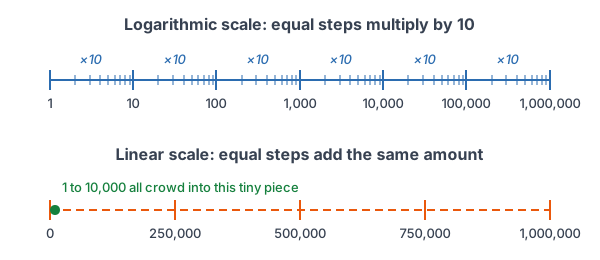
A logarithmic scale spaces numbers by powers of 10, so each equal step on the scale multiplies the quantity by 10. pH, decibels and earthquake magnitude all use log scales. A difference of d units on a base-10 log scale means one quantity is 10^d times the other, so pH 3 is 10^3 = 1000 times more acidic than pH 6.
Before this lesson: You should know Logarithms, Properties of Logarithms and Scientific Notation.
Why Use a Logarithmic Scale?
Some quantities cover a huge range. The sound of a whisper and the sound of a jet engine differ in intensity by a factor of about 100 billion. On an ordinary (linear) scale, the small values would crowd into a spot too tiny to see.
A log scale fixes that. It records the exponent instead of the number, so 10 becomes 1, 1,000 becomes 3 and 1,000,000 becomes 6. Each step of 1 on the scale means “10 times as much.”
Common Logarithmic Scales
| Scale | Formula | What one unit means |
|---|---|---|
| pH (acidity) | \text{pH} = -\log[\text{H}^+] | One pH unit lower is 10 times more acidic |
| Decibels (sound) | L = 10 \log \frac{I}{I_0}, with I_0 = 10^{-12} W/m² | 10 dB louder is 10 times the intensity |
| Richter magnitude (earthquakes) | M = \log \frac{A}{A_0} | One unit higher is 10 times the wave amplitude |
Here [\text{H}^+] is the hydrogen ion concentration in moles per liter, I is sound intensity, and A is the amplitude of the seismic wave. I_0 and A_0 are reference values.
The comparison rule
\text{If two values differ by } d \text{ on a base-10 log scale, their quantities differ by a factor of } 10^d.For decibels, divide the difference by 10 first, because of the 10 in front of the log: a difference of d dB is a factor of 10^{d/10}.
Worked Examples
Use a calculator for logs that are not whole numbers. Round to the nearest hundredth.
Example 1: Find a pH
Black coffee has [\text{H}^+] = 3.2 \times 10^{-5} moles per liter. Find its pH.
\text{pH} = -\log(3.2 \times 10^{-5})Write the formula.
\log(3.2 \times 10^{-5}) = \log 3.2 + \log 10^{-5}Use the product rule (see properties of logarithms)
Simplify: \log 10^{-5} = -5 and \log 3.2 \approx 0.505, so the log is about 0.505 - 5 = -4.495
\text{pH} \approx 4.49Change the sign.
Answer: about 4.49, so coffee is acidic (below 7).
Example 2: Compare two pH values
Lemon juice has a pH of about 2. Milk has a pH of about 6. How many times more acidic is lemon juice?
6 - 2 = 4
Find the difference on the scale.
Each pH unit is a factor of 10, so the factor is 10^4
10^4 = 10{,}000Evaluate.
Answer: lemon juice is about 10,000 times more acidic. A small-looking difference of 4 hides a huge ratio.
Example 3: Find a decibel level
A busy street has sound intensity I = 10^{-5} W/m². Find its loudness in decibels.
L = 10 \log \frac{10^{-5}}{10^{-12}}Write the formula.
\frac{10^{-5}}{10^{-12}} = 10^{-5 - (-12)} = 10^{7}Divide the powers by subtracting exponents (see exponent rules)
\log 10^7 = 7
Take the log.
L = 10 \cdot 7 = 70
Multiply by 10.
Answer: 70 dB
Example 4: Compare two sounds
A concert is 95 dB, and a vacuum cleaner is 75 dB. How many times more intense is the concert?
95 - 75 = 20
Find the difference in decibels.
\frac{20}{10} = 2Divide by 10 for decibels.
The factor is 10^2 = 100
Answer: the concert is 100 times as intense, even though 95 is not much bigger than 75.
Example 5: Word problem with earthquakes
An earthquake of magnitude 7.2 hit one region, and an earthquake of magnitude 5.4 hit another. How many times larger was the seismic wave amplitude of the bigger quake?
7.2 - 5.4 = 1.8
Find the difference in magnitude.
Each unit is a factor of 10 in amplitude: the factor is 10^{1.8}
10^{1.8} \approx 63.10Evaluate with a calculator.
Answer: about 63 times larger. The released energy differs by even more, since energy grows faster than amplitude.
Common Mistakes
| Mistake | Example of the error | Fix |
|---|---|---|
| Treating the scale as linear | pH 2 is “3 times” as acidic as pH 6 | A difference of 4 means a factor of 10^4 = 10{,}000. |
| Forgetting the 10 in decibels | A 20 dB difference is a factor of 10^{20} | Divide by 10 first: 10^{20/10} = 100. |
| Dropping the minus sign in pH | \text{pH} = \log(3.2 \times 10^{-5}) \approx -4.49 | pH uses -\log, so the answer is positive: 4.49. |
| Getting the direction wrong | Thinking a higher pH is more acidic | Lower pH means more \text{H}^+, so more acidic. |
| Using ln instead of log | -\ln(10^{-7}) \approx 16.1 | These scales use base-10 logs: -\log(10^{-7}) = 7. |
Related Methods
Going backward
To find the quantity from a scale value, undo the log with a power of 10. For pH 8.3, [\text{H}^+] = 10^{-8.3} \approx 5.01 \times 10^{-9} moles per liter. This is the same skill as in solving logarithmic equations.
Log axes on graphs
Graphs can use a log scale on one axis. Then exponential data looks like a straight line, which is the idea behind semi-log plots.
Other bases
Musical octaves use a base-2 scale: each octave up doubles the frequency. The comparison rule is the same, with 2 in place of 10.
Practice Problems
Round answers to the nearest hundredth when needed.
- Find the pH when [\text{H}^+] = 10^{-7}.
- Find the pH when [\text{H}^+] = 4.5 \times 10^{-3}.
- A solution has pH 9.2. Find [\text{H}^+].
- How many times more acidic is a solution with pH 2 than one with pH 5?
- Find the decibel level of a sound with I = 10^{-3} W/m².
- Find the decibel level of a sound with I = 5 \times 10^{-6} W/m².
- How many times more intense is an 80 dB sound than a 50 dB sound?
- If a sound’s intensity doubles, by how many decibels does its level go up?
- How many times larger is the amplitude of a magnitude 6.0 earthquake than a magnitude 4.0 earthquake?
- An earthquake’s wave amplitude is 500 times that of a magnitude 3.1 quake. What is its magnitude?
Show answers
1.
\text{pH} = -\log 10^{-7} = -(-7) = 7Substitute into the pH formula.
Answer: 7 (neutral)
2.
\text{pH} = -\log(4.5 \times 10^{-3}) = -(\log 4.5 - 3)Substitute into the pH formula.
\log 4.5 \approx 0.653, so \text{pH} \approx -(0.653 - 3) = 2.347
Answer: about 2.35
3.
[\text{H}^+] = 10^{-9.2}Undo the log.
10^{-9.2} \approx 6.31 \times 10^{-10}Evaluate.
Answer: about 6.31 \times 10^{-10} moles per liter
4.
5 - 2 = 3
Find the difference in pH.
10^3 = 1000
Factor.
Answer: 1,000 times more acidic
5.
L = 10 \log \frac{10^{-3}}{10^{-12}} = 10 \log 10^{9}Substitute into the decibel formula.
= 10 \cdot 9 = 90
Multiply.
Answer: 90 dB
6.
L = 10 \log \frac{5 \times 10^{-6}}{10^{-12}} = 10 \log(5 \times 10^{6})Substitute into the decibel formula.
\log(5 \times 10^6) = \log 5 + 6 \approx 0.699 + 6 = 6.699
Split the log of the product.
L \approx 10 \cdot 6.699 = 66.99
Multiply.
Answer: about 66.99 dB
7.
80 - 50 = 30
Find the difference in decibels.
10^{30/10} = 10^3 = 1000Factor.
Answer: 1,000 times as intense
8.
10 \log \frac{2I}{I_0} - 10 \log \frac{I}{I_0} = 10 \log 2New level minus old level.
10 \log 2 \approx 10(0.301) = 3.01
Evaluate.
Answer: about 3.01 dB
9.
6.0 - 4.0 = 2
Find the difference in magnitude.
10^2 = 100
Factor.
Answer: 100 times larger
10.
The magnitudes differ by \log 500
\log 500 \approx 2.699
Use a calculator to find the log.
3.1 + 2.699 = 5.799
Add.
Answer: about 5.80
FAQ
What is a logarithmic scale?
It is a scale where each equal step multiplies the quantity by the same factor, usually 10. It records the exponent instead of the number itself.
How much stronger is a magnitude 6 earthquake than a magnitude 5?
Its wave amplitude is 10 times larger. The energy it releases is about 32 times larger, because energy grows faster than amplitude.
Why is pH negative log?
Hydrogen ion concentrations are tiny numbers like 10^{-7}. Their logs are negative, so the minus sign turns them into easy positive numbers like 7.
Is 60 dB twice as loud as 30 dB?
No. 60 dB is 10^{30/10} = 1000 times the intensity of 30 dB. People hear it as about 8 times as loud, but the physical intensity is 1,000 times greater.
Summary
- On a base-10 log scale, each step of 1 multiplies the quantity by 10.
- pH: -\log[\text{H}^+]; lower pH is more acidic.
- Decibels: 10 \log \frac{I}{I_0}; every 10 dB is a factor of 10 in intensity.
- Richter magnitude: \log \frac{A}{A_0}; each unit is 10 times the amplitude.
- A difference of d units means a factor of 10^d (or 10^{d/10} for decibels).
Previous lesson: Partial Fraction Decomposition
Next lesson: Semi-Log Plots
Back to the Precalculus Index