
Partial Fraction Decomposition
Partial fraction decomposition splits a rational expression into a sum of simpler fractions, the reverse of adding fractions with a common denominator. For example, \frac{5x - 1}{x^2 - 1} = \frac{2}{x - 1} + \frac{3}{x + 1}. Factor the denominator, write one fraction for each factor with unknown numerators, then solve for those numerators.
Before this lesson: You should know Adding and Subtracting Rational Expressions, Factoring Trinomials and Systems of Equations.
What Partial Fractions Do
When you add \frac{2}{x - 1} + \frac{3}{x + 1}, you get one fraction with a common denominator: \frac{5x - 1}{x^2 - 1}. Partial fraction decomposition runs that process backward.
Why undo addition? Simpler pieces are easier to work with. In calculus, each piece can be integrated on its own. In series, the pieces can cancel in a chain, which makes long sums easy to add.
How to Set Up Partial Fractions
First make sure the fraction is proper: the numerator’s degree must be less than the denominator’s. If not, use polynomial long division first. Then factor the denominator and use this table:
| Factor in the denominator | Terms to write |
|---|---|
| Distinct linear factor (x - a) | \frac{A}{x - a} |
| Repeated linear factor (x - a)^2 | \frac{A}{x - a} + \frac{B}{(x - a)^2} |
| Irreducible quadratic x^2 + bx + c | \frac{Bx + C}{x^2 + bx + c} |
- Multiply both sides by the full denominator to clear the fractions.
- Substitute the zeros of the linear factors for x. Each one makes all but one term vanish.
- If unknowns remain, match the coefficients of like powers of x on both sides.
- Write the decomposition, and check by adding the pieces back together.
Worked Examples
Example 1: Two distinct linear factors
Decompose \frac{5x - 1}{x^2 - 1}.
x^2 - 1 = (x - 1)(x + 1)
Factor the denominator (see factoring the difference of squares)
\frac{5x - 1}{(x - 1)(x + 1)} = \frac{A}{x - 1} + \frac{B}{x + 1}Set up.
5x - 1 = A(x + 1) + B(x - 1)
Multiply both sides by (x - 1)(x + 1).
Let x = 1: 5(1) - 1 = A(2) + B(0), so 4 = 2A and A = 2
Let x = -1: 5(-1) - 1 = A(0) + B(-2), so -6 = -2B and B = 3
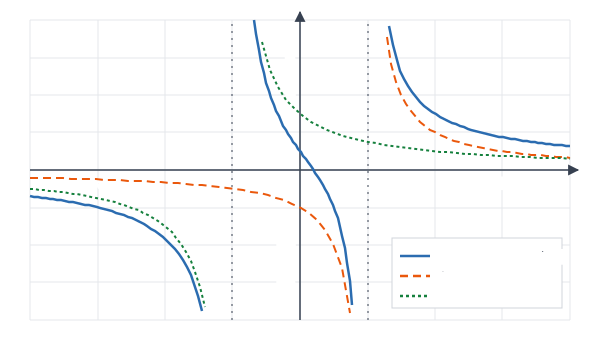
Answer: \frac{2}{x - 1} + \frac{3}{x + 1}, the two pieces graphed above.
Example 2: Three linear factors
Decompose \frac{x^2 + 2x - 1}{x(x - 1)(x + 1)}.
\frac{A}{x} + \frac{B}{x - 1} + \frac{C}{x + 1}Set up.
x^2 + 2x - 1 = A(x - 1)(x + 1) + Bx(x + 1) + Cx(x - 1)
Multiply by the denominator.
-1 = A(-1)(1)
Let x = 0.
A = 1
Solve for A.
Let x = 1: 1 + 2 - 1 = B(1)(2), so 2 = 2B and B = 1
Let x = -1: 1 - 2 - 1 = C(-1)(-2), so -2 = 2C and C = -1
Answer: \frac{1}{x} + \frac{1}{x - 1} - \frac{1}{x + 1}
Example 3: A repeated factor
Decompose \frac{3x + 5}{(x + 1)^2}.
\frac{A}{x + 1} + \frac{B}{(x + 1)^2}Set up with one term for each power.
3x + 5 = A(x + 1) + B
Multiply by (x + 1)^2.
3(-1) + 5 = A(0) + B
Let x = -1.
B = 2
Solve for B.
Match the x coefficients: on the left it is 3, on the right it is A, so A = 3
Check the constants: A + B = 3 + 2 = 5, which matches
Answer: \frac{3}{x + 1} + \frac{2}{(x + 1)^2}
Example 4: An irreducible quadratic factor
Decompose \frac{2x^2 + x + 3}{(x - 1)(x^2 + 1)}.
\frac{A}{x - 1} + \frac{Bx + C}{x^2 + 1}x^2 + 1 has no real zeros, so it gets a linear numerator.
2x^2 + x + 3 = A(x^2 + 1) + (Bx + C)(x - 1)
Multiply by the denominator.
Let x = 1: 2 + 1 + 3 = A(2), so 6 = 2A and A = 3
Ax^2 + A + Bx^2 - Bx + Cx - C = (A + B)x^2 + (C - B)x + (A - C)
Expand the right side.
Match x^2 terms: A + B = 2, so 3 + B = 2 and B = -1
Match constants: A - C = 3, so 3 - C = 3 and C = 0
Check the x terms: C - B = 0 - (-1) = 1, which matches
Answer: \frac{3}{x - 1} - \frac{x}{x^2 + 1}
Example 5: Word problem with a stack of plates
A designer stacks 50 thin plates. Plate number n is \frac{2}{n(n + 2)} millimeters thick. How thick is the whole stack?
\frac{2}{n(n + 2)} = \frac{A}{n} + \frac{B}{n + 2}Decompose one term.
2 = A(n + 2) + Bn
Multiply both sides by n(n + 2).
Let n = 0: 2 = 2A, so A = 1. Let n = -2: 2 = -2B, so B = -1. Each plate is \frac{1}{n} - \frac{1}{n + 2}
(1 - \frac{1}{3}) + (\frac{1}{2} - \frac{1}{4}) + (\frac{1}{3} - \frac{1}{5}) + \cdots + (\frac{1}{50} - \frac{1}{52})Write out the sum.
Most terms cancel in pairs. Only 1, \frac{1}{2}, -\frac{1}{51} and -\frac{1}{52} are left
\frac{2652}{2652} + \frac{1326}{2652} - \frac{52}{2652} - \frac{51}{2652} = \frac{3875}{2652}Add them over the common denominator 2652.
Answer: \frac{3875}{2652} \approx 1.461 millimeters. A sum like this, where the pieces cancel, is called a telescoping sum.
Common Mistakes
| Mistake | Example of the error | Fix |
|---|---|---|
| Skipping long division | Decomposing \frac{x^2 + 2}{x^2 - 1} directly | The degrees are equal, so divide first: 1 + \frac{3}{x^2 - 1}. |
| Only one term for a repeated factor | Writing just \frac{A}{(x + 1)^2} | Use \frac{A}{x + 1} + \frac{B}{(x + 1)^2}. |
| A constant over a quadratic | Writing \frac{B}{x^2 + 1} | An irreducible quadratic needs \frac{Bx + C}{x^2 + 1}. |
| Not factoring completely | Using x^2 - 1 as one factor | Factor to (x - 1)(x + 1) first. |
| Sign slips when substituting | x = -1 in B(x - 1) gives 0 | -1 - 1 = -2, so the term is -2B. |
Related Methods
Matching coefficients
Instead of plugging in zeros, expand the right side and set the coefficients of each power of x equal. This gives a system of equations in A, B and C. It always works, but plugging in zeros is usually faster.
Check by adding
Add your pieces with a common denominator. You should get the original fraction, as in adding rational expressions.
In calculus
In Calculus 2, integration by partial fractions turns hard integrals into easy ones, because each simple piece has a known antiderivative.
Practice Problems
- Decompose \frac{x + 7}{x^2 - x - 6}.
- Decompose \frac{6}{x^2 - 9}.
- Decompose \frac{4x + 1}{x(x + 1)}.
- Decompose \frac{3x - 7}{(x - 2)(x - 3)}.
- Decompose \frac{x + 4}{(x + 2)^2}.
- Decompose \frac{x^2 + 3x + 4}{x(x + 2)^2}.
- Decompose \frac{x^2 + x + 2}{(x + 1)(x^2 + 1)}.
- Decompose \frac{x^2 + 2}{x^2 - 1}.
- Decompose \frac{1}{n(n + 1)}, then find \frac{1}{1 \cdot 2} + \frac{1}{2 \cdot 3} + \cdots + \frac{1}{20 \cdot 21}.
- A runner adds \frac{1}{n(n + 1)} kilometers to her route on day n. How many extra kilometers has she added in total after 99 days?
Show answers
1.
Factor: (x - 3)(x + 2), so x + 7 = A(x + 2) + B(x - 3)
x = 3: 10 = 5A, so A = 2
x = -2: 5 = -5B, so B = -1
Answer: \frac{2}{x - 3} - \frac{1}{x + 2}
2.
Factor: (x - 3)(x + 3), so 6 = A(x + 3) + B(x - 3)
x = 3: 6 = 6A, so A = 1
x = -3: 6 = -6B, so B = -1
Answer: \frac{1}{x - 3} - \frac{1}{x + 3}
3.
4x + 1 = A(x + 1) + Bx
Multiply both sides by the common denominator.
x = 0: 1 = A
x = -1: -3 = -B, so B = 3
Answer: \frac{1}{x} + \frac{3}{x + 1}
4.
3x - 7 = A(x - 3) + B(x - 2)
Multiply both sides by the common denominator.
x = 2: -1 = -A, so A = 1
x = 3: 2 = B
Answer: \frac{1}{x - 2} + \frac{2}{x - 3}
5.
x + 4 = A(x + 2) + B
Multiply both sides by the common denominator.
x = -2: 2 = B
A = 1
Match x terms.
Answer: \frac{1}{x + 2} + \frac{2}{(x + 2)^2}
6.
x^2 + 3x + 4 = A(x + 2)^2 + Bx(x + 2) + Cx
Set up \frac{A}{x} + \frac{B}{x + 2} + \frac{C}{(x + 2)^2}.
x = 0: 4 = 4A, so A = 1
x = -2: 4 - 6 + 4 = -2C, so 2 = -2C and C = -1
1 = A + B
Match x^2 terms.
B = 0
Solve for B.
Answer: \frac{1}{x} - \frac{1}{(x + 2)^2}
7.
x^2 + x + 2 = A(x^2 + 1) + (Bx + C)(x + 1)
Multiply both sides by the common denominator.
x = -1: 2 = 2A, so A = 1
Match x^2: 1 = A + B, so B = 0; match constants: 2 = A + C, so C = 1
Check x terms: B + C = 1, which matches
Answer: \frac{1}{x + 1} + \frac{1}{x^2 + 1}
8.
\frac{x^2 + 2}{x^2 - 1} = 1 + \frac{3}{x^2 - 1}Divide first.
3 = A(x + 1) + B(x - 1); x = 1: A = \frac{3}{2}; x = -1: B = -\frac{3}{2}
Answer: 1 + \frac{3}{2(x - 1)} - \frac{3}{2(x + 1)}
9.
1 = A(n + 1) + Bn; n = 0: A = 1; n = -1: B = -1, so \frac{1}{n(n + 1)} = \frac{1}{n} - \frac{1}{n + 1}
Sum: (1 - \frac{1}{2}) + (\frac{1}{2} - \frac{1}{3}) + \cdots + (\frac{1}{20} - \frac{1}{21}); the middle terms cancel
1 - \frac{1}{21} = \frac{20}{21}Most terms cancel. Subtract the last leftover term from the first.
Answer: \frac{20}{21}
10.
Same decomposition: each day adds \frac{1}{n} - \frac{1}{n + 1}
The sum telescopes to 1 - \frac{1}{100}
1 - \frac{1}{100} = \frac{99}{100}Subtract.
Answer: 0.99 km
FAQ
What is partial fraction decomposition used for?
It breaks a complicated rational expression into simple fractions. That makes integrals in calculus and long telescoping sums much easier.
How do you know which terms to write?
Each distinct linear factor gets \frac{A}{x - a}. A repeated factor gets one term for each power. An irreducible quadratic gets a linear numerator, \frac{Bx + C}{x^2 + bx + c}.
What if the numerator’s degree is too big?
If the numerator’s degree is equal to or greater than the denominator’s, divide first. Then decompose only the remainder fraction.
How can I check my answer?
Add the partial fractions back together with a common denominator. If you get the original fraction, your decomposition is right.
Summary
- Make the fraction proper (divide if needed), then factor the denominator.
- Write one term per linear factor, one per power of a repeated factor, and a linear numerator over each irreducible quadratic.
- Multiply by the denominator, then substitute zeros and match coefficients.
- Check by adding the pieces back together.
- Telescoping sums and calculus integrals both use this method.
Previous lesson: Rational Inequalities
Next lesson: Logarithmic Scales
Back to the Precalculus Index