
Polynomial Long Division
Polynomial long division divides one polynomial by another using the same steps as long division with numbers: divide, multiply, subtract and bring down. You repeat those steps until the remainder has a smaller degree than the divisor. The result is a quotient plus a remainder over the divisor.
Before this lesson: You should know Polynomials, Adding and Subtracting Polynomials, Multiplying Polynomials and Exponent Rules.
Long Division, Now with Variables
Think of 845 \div 6. You ask how many 6s fit into 8, multiply, subtract, bring down the next digit, and repeat. The answer is 140 with a remainder of 5.
Polynomials work the same way. Instead of asking how many 6s fit, you ask, “What times the first term of the divisor gives the first term of what’s left?” Each answer becomes one term of the quotient.
The names are the same as with numbers. The dividend is what you divide, the divisor is what you divide by, the quotient is the answer, and the remainder is what is left over.
The Steps and the Result
- Write both polynomials in standard form. Fill any missing powers in the dividend with 0 terms, like 0x^2.
- Divide the first term of the dividend by the first term of the divisor. Write the result in the quotient.
- Multiply that result by the whole divisor.
- Subtract the product. Change every sign, then add.
- Bring down the next term, and repeat steps 2–4.
- Stop when the remainder’s degree is less than the divisor’s degree.
Write the answer as the quotient plus the remainder over the divisor:
\frac{P(x)}{D(x)} = Q(x) + \frac{R(x)}{D(x)}You can check by multiplying back: P(x) = D(x) \cdot Q(x) + R(x).
Worked Examples
Example 1: No remainder
Divide (x^2 + 7x + 12) \div (x + 3).
- Divide the first terms (see exponent rules): x^2 \div x = x. Write x in the quotient.
- Multiply x by the divisor (see distributive property): x(x + 3) = x^2 + 3x
- Subtract (see subtracting polynomials): (x^2 + 7x) - (x^2 + 3x) = 4x
- Bring down +12: 4x + 12
- Divide the first terms: 4x \div x = 4. Write +4 in the quotient.
- Multiply: 4(x + 3) = 4x + 12
- Subtract: (4x + 12) - (4x + 12) = 0
Answer: x + 4. The remainder is 0, so x + 3 is a factor: x^2 + 7x + 12 = (x + 3)(x + 4).
Example 2: A remainder
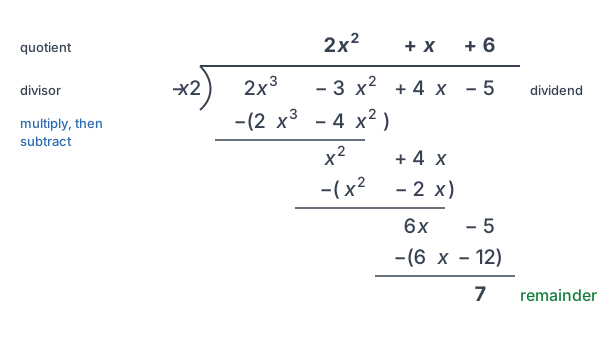
Divide (2x^3 - 3x^2 + 4x - 5) \div (x - 2). This is the division in the diagram.
- Divide the first terms: 2x^3 \div x = 2x^2
- Multiply: 2x^2(x - 2) = 2x^3 - 4x^2
- Subtract: (2x^3 - 3x^2) - (2x^3 - 4x^2) = x^2
- Bring down +4x: x^2 + 4x
- Divide: x^2 \div x = x
- Multiply: x(x - 2) = x^2 - 2x
- Subtract: (x^2 + 4x) - (x^2 - 2x) = 6x
- Bring down -5: 6x - 5
- Divide: 6x \div x = 6
- Multiply: 6(x - 2) = 6x - 12
- Subtract: (6x - 5) - (6x - 12) = 7. The remainder 7 has degree 0, so stop.
Answer: 2x^2 + x + 6 + \frac{7}{x - 2}
Check by multiplying back (see multiplying polynomials):
- Multiply the divisor and quotient: (x - 2)(2x^2 + x + 6) = 2x^3 + x^2 + 6x - 4x^2 - 2x - 12
- Combine like terms: 2x^3 - 3x^2 + 4x - 12
- Add the remainder: 2x^3 - 3x^2 + 4x - 12 + 7 = 2x^3 - 3x^2 + 4x - 5. It matches the dividend.
Example 3: A missing term
Divide (x^3 - 8x + 3) \div (x + 3).
- The dividend has no x^2 term. Write it with a placeholder: x^3 + 0x^2 - 8x + 3
- Divide: x^3 \div x = x^2
- Multiply: x^2(x + 3) = x^3 + 3x^2
- Subtract: (x^3 + 0x^2) - (x^3 + 3x^2) = -3x^2
- Bring down -8x: -3x^2 - 8x
- Divide: -3x^2 \div x = -3x
- Multiply: -3x(x + 3) = -3x^2 - 9x
- Subtract: (-3x^2 - 8x) - (-3x^2 - 9x) = x
- Bring down +3: x + 3
- Divide: x \div x = 1
- Multiply: 1(x + 3) = x + 3
- Subtract: (x + 3) - (x + 3) = 0
Answer: x^2 - 3x + 1
Example 4: A quadratic divisor
Divide (x^4 + 2x^3 - x^2 + 5x - 1) \div (x^2 + x - 1).
- Divide: x^4 \div x^2 = x^2
- Multiply: x^2(x^2 + x - 1) = x^4 + x^3 - x^2
- Subtract: (x^4 + 2x^3 - x^2) - (x^4 + x^3 - x^2) = x^3
- Bring down +5x: x^3 + 5x
- Divide: x^3 \div x^2 = x
- Multiply: x(x^2 + x - 1) = x^3 + x^2 - x
- Subtract: (x^3 + 5x) - (x^3 + x^2 - x) = -x^2 + 6x
- Bring down -1: -x^2 + 6x - 1
- Divide: -x^2 \div x^2 = -1
- Multiply: -1(x^2 + x - 1) = -x^2 - x + 1
- Subtract: (-x^2 + 6x - 1) - (-x^2 - x + 1) = 7x - 2. Its degree, 1, is less than 2, so stop.
Answer: x^2 + x - 1 + \frac{7x - 2}{x^2 + x - 1}
Example 5: Word problem with area
A rectangle has an area of 6x^2 + 7x - 20 square feet. Its width is 2x + 5 feet. Find its length.
- Length is area divided by width: (6x^2 + 7x - 20) \div (2x + 5)
- Divide: 6x^2 \div 2x = 3x
- Multiply: 3x(2x + 5) = 6x^2 + 15x
- Subtract: (6x^2 + 7x) - (6x^2 + 15x) = -8x
- Bring down -20: -8x - 20
- Divide: -8x \div 2x = -4
- Multiply: -4(2x + 5) = -8x - 20
- Subtract: (-8x - 20) - (-8x - 20) = 0
Answer: The length is 3x - 4 feet.
Check with x = 4: the area is 6(16) + 28 - 20 = 104, the width is 13 and the length is 8. Since 13 \cdot 8 = 104, it works.
Common Mistakes
| Mistake | Example of the error | Fix |
|---|---|---|
| Subtracting only the first term | (2x^3 - 3x^2) - (2x^3 - 4x^2) = -7x^2 | Change both signs: -3x^2 + 4x^2 = x^2. |
| Skipping a placeholder | Dividing x^3 - 8x + 3 without 0x^2 | Write x^3 + 0x^2 - 8x + 3 so terms line up. |
| Stopping too early | Stopping at 6x - 5 when dividing by x - 2 | Keep going until the remainder’s degree is less than the divisor’s. |
| Writing the remainder alone | 2x^2 + x + 6 R 7 | Write it over the divisor: 2x^2 + x + 6 + \frac{7}{x - 2}. |
| Dividing by the wrong term | 6x^2 \div 5 = \frac{6}{5}x^2 | Always divide by the first term of the divisor: 6x^2 \div 2x = 3x. |
Practice Problems
- Divide (x^2 + 9x + 20) \div (x + 4).
- Divide (x^2 - 2x - 10) \div (x - 5).
- Divide (3x^2 + 10x - 8) \div (3x - 2).
- Divide (2x^3 + x^2 - 13x + 6) \div (x - 2).
- Divide (x^3 - 27) \div (x - 3).
- Divide (4x^3 - 5x + 2) \div (2x + 1).
- Divide (x^4 - 1) \div (x^2 + 1).
- Divide (x^3 + 2x^2 - 5x + 4) \div (x^2 - x + 1).
- Is x + 2 a factor of x^3 + 3x^2 - 4? Use long division.
- A box has a volume of x^3 + 7x^2 + 14x + 8 cubic inches and a height of x + 1 inches. Find the area of its base.
Show answers
- Divide: x^2 \div x = x
Multiply: x(x + 4) = x^2 + 4x
Subtract: 5x
Bring down: 5x + 20
Divide: 5
Multiply: 5(x + 4) = 5x + 20
Subtract: 0
Answer: x + 5 - Divide: x
Multiply: x(x - 5) = x^2 - 5x
Subtract: 3x
Bring down: 3x - 10
Divide: 3
Multiply: 3(x - 5) = 3x - 15
Subtract: (3x - 10) - (3x - 15) = 5
Answer: x + 3 + \frac{5}{x - 5} - Divide: 3x^2 \div 3x = x
Multiply: x(3x - 2) = 3x^2 - 2x
Subtract: 12x
Bring down: 12x - 8
Divide: 4
Multiply: 4(3x - 2) = 12x - 8
Subtract: 0
Answer: x + 4 - Divide: 2x^2
Multiply: 2x^3 - 4x^2
Subtract: 5x^2
Bring down: 5x^2 - 13x
Divide: 5x
Multiply: 5x^2 - 10x
Subtract: -3x
Bring down: -3x + 6
Divide: -3
Multiply: -3x + 6
Subtract: 0
Answer: 2x^2 + 5x - 3 - Placeholders: x^3 + 0x^2 + 0x - 27
Divide: x^2
Multiply: x^3 - 3x^2
Subtract: 3x^2
Bring down: 3x^2 + 0x
Divide: 3x
Multiply: 3x^2 - 9x
Subtract: 9x
Bring down: 9x - 27
Divide: 9
Multiply: 9x - 27
Subtract: 0
Answer: x^2 + 3x + 9 - Placeholder: 4x^3 + 0x^2 - 5x + 2
Divide: 4x^3 \div 2x = 2x^2
Multiply: 4x^3 + 2x^2
Subtract: -2x^2
Bring down: -2x^2 - 5x
Divide: -x
Multiply: -2x^2 - x
Subtract: -4x
Bring down: -4x + 2
Divide: -2
Multiply: -4x - 2
Subtract: 4
Answer: 2x^2 - x - 2 + \frac{4}{2x + 1} - Placeholders: x^4 + 0x^3 + 0x^2 + 0x - 1
Divide: x^4 \div x^2 = x^2
Multiply: x^4 + x^2
Subtract: -x^2
Bring down: -x^2 + 0x - 1
Divide: -1
Multiply: -x^2 - 1
Subtract: 0
Answer: x^2 - 1 - Divide: x^3 \div x^2 = x
Multiply: x^3 - x^2 + x
Subtract: 3x^2 - 6x
Bring down: 3x^2 - 6x + 4
Divide: 3
Multiply: 3x^2 - 3x + 3
Subtract: -3x + 1, which has degree 1, so stop
Answer: x + 3 + \frac{-3x + 1}{x^2 - x + 1} - Placeholder: x^3 + 3x^2 + 0x - 4
Divide: x^2
Multiply: x^3 + 2x^2
Subtract: x^2
Bring down: x^2 + 0x
Divide: x
Multiply: x^2 + 2x
Subtract: -2x
Bring down: -2x - 4
Divide: -2
Multiply: -2x - 4
Subtract: 0
Answer: yes. The remainder is 0, so x^3 + 3x^2 - 4 = (x + 2)(x^2 + x - 2). - Base area is volume divided by height: (x^3 + 7x^2 + 14x + 8) \div (x + 1)
Divide: x^2
Multiply: x^3 + x^2
Subtract: 6x^2
Bring down: 6x^2 + 14x
Divide: 6x
Multiply: 6x^2 + 6x
Subtract: 8x
Bring down: 8x + 8
Divide: 8
Multiply: 8x + 8
Subtract: 0
Answer: the base area is x^2 + 6x + 8 square inches
FAQ
How do you do polynomial long division?
Divide the first terms, multiply the result by the whole divisor, subtract, and bring down the next term. Repeat until the remainder’s degree is less than the divisor’s degree.
How do you write the remainder?
Put the remainder over the divisor and add it to the quotient. For example, a quotient of 2x^2 + x + 6 with remainder 7 and divisor x - 2 is written 2x^2 + x + 6 + \frac{7}{x - 2}.
Why do you need 0 placeholders?
They keep each power of x in its own column, just like a 0 digit in 305. Without them, you can subtract unlike terms by mistake.
When can you use synthetic division instead?
Synthetic division is a shortcut that works when the divisor is x - c, like x - 2 or x + 3. For divisors like x^2 + 1 or 2x + 1, long division always works.
Summary
- Polynomial long division repeats four steps: divide, multiply, subtract, bring down.
- Write the dividend in standard form with 0 placeholders for missing powers.
- When subtracting, change every sign of the product.
- Stop when the remainder’s degree is less than the divisor’s degree.
- Write the answer as quotient plus remainder over divisor, and check by multiplying back.
Previous lesson: End Behavior of Polynomials
Next lesson: Synthetic Division
Back to the Algebra 2 Index