
Synthetic Division
Synthetic division is a shortcut for dividing a polynomial by x - c. You work only with the coefficients: bring down the first one, multiply by c, add it to the next coefficient, and repeat. The last number is the remainder, and the others are the coefficients of the quotient.
Before this lesson: You should know Polynomial Long Division, Polynomials and Multiplying and Dividing Integers.
Why the Shortcut Works
In long division by x - 2, the variables just sit in their columns. Every step is really “multiply by 2 and combine.” Synthetic division keeps only the numbers, so there is far less to write.
There is one more trick. Long division subtracts. Synthetic division uses +2 instead of -2, so it can add instead. Adding is easier and leads to fewer sign errors.
The Steps
- Write the divisor as x - c and find c. For x - 2, c = 2. For x + 3, c = -3.
- Write the coefficients of the dividend in order. Put 0 for any missing power.
- Bring down the first coefficient.
- Multiply it by c and write the product under the next coefficient.
- Add that column. Repeat the multiply-and-add steps to the end.
- The last number is the remainder. The other numbers are the quotient’s coefficients, starting one degree lower than the dividend.
Worked Examples
Example 1: A quadratic with no remainder
Divide (x^2 + 5x + 6) \div (x + 2).
- The divisor x + 2 is x - (-2), so c = -2. The coefficients are 1, 5, 6.
- Bring down 1.
- Multiply (see multiplying integers): 1(-2) = -2. Write it under 5.
- Add (see adding integers): 5 + (-2) = 3
- Multiply: 3(-2) = -6. Write it under 6.
- Add: 6 + (-6) = 0. This is the remainder.
- The bottom row is 1, 3, 0. The dividend has degree 2, so the quotient has degree 1: 1x + 3.
| c | x^2 | x | constant |
|---|---|---|---|
| −2 | 1 | 5 | 6 |
| −2 | −6 | ||
| Sums | 1 | 3 | 0 (remainder) |
Answer: x + 3
Example 2: A remainder
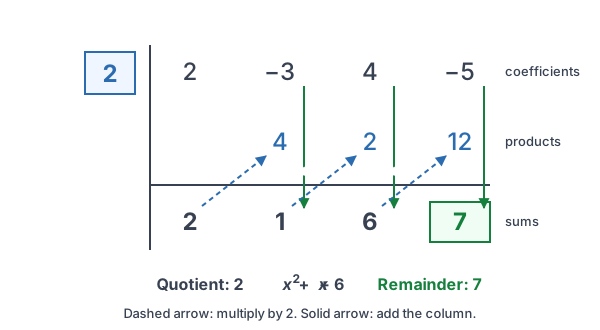
Divide (2x^3 - 3x^2 + 4x - 5) \div (x - 2). This is the table in the diagram. You may have done it with polynomial long division.
- The divisor is x - 2, so c = 2. The coefficients are 2, −3, 4, −5.
- Bring down 2.
- Multiply: 2(2) = 4
- Add: -3 + 4 = 1
- Multiply: 1(2) = 2
- Add: 4 + 2 = 6
- Multiply: 6(2) = 12
- Add: -5 + 12 = 7. This is the remainder.
- The bottom row is 2, 1, 6 and remainder 7. The quotient has degree 2.
Answer: 2x^2 + x + 6 + \frac{7}{x - 2}. Long division gives the same result.
Example 3: Missing terms
Divide (x^4 - 5x^2 + 10) \div (x + 2).
- c = -2. Fill in 0 for the missing x^3 and x terms. The coefficients are 1, 0, −5, 0, 10.
- Bring down 1.
- Multiply: 1(-2) = -2
- Add: 0 + (-2) = -2
- Multiply: -2(-2) = 4
- Add: -5 + 4 = -1
- Multiply: -1(-2) = 2
- Add: 0 + 2 = 2
- Multiply: 2(-2) = -4
- Add: 10 + (-4) = 6. This is the remainder.
- The bottom row is 1, −2, −1, 2 and remainder 6. The quotient has degree 3.
Answer: x^3 - 2x^2 - x + 2 + \frac{6}{x + 2}
Example 4: A divisor like 2x − 1
Divide (2x^3 + 3x^2 - 4x + 1) \div (2x - 1).
Synthetic division needs x - c. Factor out the 2: 2x - 1 = 2\left(x - \frac{1}{2}\right). Divide by x - \frac{1}{2} first, then divide the quotient by 2.
- c = \frac{1}{2}. The coefficients are 2, 3, −4, 1.
- Bring down 2.
- Multiply (see multiplying fractions): 2 \cdot \frac{1}{2} = 1
- Add: 3 + 1 = 4
- Multiply: 4 \cdot \frac{1}{2} = 2
- Add: -4 + 2 = -2
- Multiply: -2 \cdot \frac{1}{2} = -1
- Add: 1 + (-1) = 0. The remainder is 0.
- The quotient for x - \frac{1}{2} is 2x^2 + 4x - 2.
- Divide each term by 2: x^2 + 2x - 1
Answer: x^2 + 2x - 1. Check: (2x - 1)(x^2 + 2x - 1) = 2x^3 + 4x^2 - 2x - x^2 - 2x + 1 = 2x^3 + 3x^2 - 4x + 1.
Example 5: Word problem with a box
A box has a volume of x^3 + 9x^2 + 26x + 24 cubic inches. One edge is x + 2 inches. Find the other two edges.
- Divide the volume by x + 2, so c = -2. The coefficients are 1, 9, 26, 24.
- Bring down 1.
- Multiply: 1(-2) = -2
- Add: 9 + (-2) = 7
- Multiply: 7(-2) = -14
- Add: 26 + (-14) = 12
- Multiply: 12(-2) = -24
- Add: 24 + (-24) = 0
- The quotient is x^2 + 7x + 12. This is the area of the face formed by the other two edges.
- Factor the trinomial (see factoring trinomials): (x + 3)(x + 4)
Answer: The other edges are x + 3 and x + 4 inches.
A Bonus: The Remainder Is f(c)
In Example 2, the remainder was 7. Now evaluate f(x) = 2x^3 - 3x^2 + 4x - 5 at x = 2: f(2) = 16 - 12 + 8 - 5 = 7. That is the same number.
This always happens. When you divide f(x) by x - c, the remainder equals f(c). The next lesson, on the remainder and factor theorems, uses this to evaluate polynomials and test factors quickly.
Common Mistakes
| Mistake | Example of the error | Fix |
|---|---|---|
| Using the wrong sign for c | Using -2 for x - 2 | x - c means c is the opposite of the number shown: x - 2 gives c = 2. |
| Skipping a placeholder | Coefficients 1, −5, 10 for x^4 - 5x^2 + 10 | Use 1, 0, −5, 0, 10. |
| Subtracting instead of adding | -3 - 4 = -7 in the second column | Synthetic division always adds: -3 + 4 = 1. |
| Quotient degree too high | Reading 2, 1, 6 as 2x^3 + x^2 + 6x | The quotient starts one degree lower: 2x^2 + x + 6. |
| Using it with the wrong divisor | Using c = 1 for 2x - 1, or trying x^2 + 1 | For 2x - 1, use c = \frac{1}{2}, then divide by 2. Use long division for x^2 + 1. |
Practice Problems
- Divide (x^2 + 7x + 10) \div (x + 5).
- Use synthetic division to find f(3) for f(x) = 2x^3 - 5x^2 + x - 4.
- Divide (x^3 - 4x^2 + x + 6) \div (x - 2).
- Divide (2x^3 + 7x^2 - 5) \div (x + 3).
- Divide (x^3 + 8) \div (x + 2).
- Divide (3x^4 - 2x^3 + x - 7) \div (x - 1).
- Divide (x^4 - 16) \div (x - 2).
- Divide (4x^3 - 6x^2 + 2x + 3) \div (2x - 1).
- Is x - 3 a factor of x^3 - 2x^2 - 5x + 6?
- A box has a volume of x^3 + 10x^2 + 31x + 30 cubic feet and a height of x + 5 feet. Find the area of its base.
Show answers
- c = -5; coefficients 1, 7, 10
Bring down 1
Multiply: 1(-5) = -5
Add: 7 + (-5) = 2
Multiply: 2(-5) = -10
Add: 10 + (-10) = 0
Answer: x + 2 - c = 3; coefficients 2, −5, 1, −4
Bring down 2
Multiply: 2(3) = 6
Add: -5 + 6 = 1
Multiply: 1(3) = 3
Add: 1 + 3 = 4
Multiply: 4(3) = 12
Add: -4 + 12 = 8
Answer: the remainder is 8, so f(3) = 8. (Check: 54 - 45 + 3 - 4 = 8.) - c = 2; coefficients 1, −4, 1, 6
Bring down 1
Multiply: 1(2) = 2
Add: -4 + 2 = -2
Multiply: -2(2) = -4
Add: 1 + (-4) = -3
Multiply: -3(2) = -6
Add: 6 + (-6) = 0
Answer: x^2 - 2x - 3 - c = -3; coefficients 2, 7, 0, −5
Bring down 2
Multiply: 2(-3) = -6
Add: 7 + (-6) = 1
Multiply: 1(-3) = -3
Add: 0 + (-3) = -3
Multiply: -3(-3) = 9
Add: -5 + 9 = 4
Answer: 2x^2 + x - 3 + \frac{4}{x + 3} - c = -2; coefficients 1, 0, 0, 8
Bring down 1
Multiply: 1(-2) = -2
Add: 0 + (-2) = -2
Multiply: -2(-2) = 4
Add: 0 + 4 = 4
Multiply: 4(-2) = -8
Add: 8 + (-8) = 0
Answer: x^2 - 2x + 4 - c = 1; coefficients 3, −2, 0, 1, −7
Bring down 3
Multiply: 3(1) = 3
Add: -2 + 3 = 1
Multiply: 1(1) = 1
Add: 0 + 1 = 1
Multiply: 1(1) = 1
Add: 1 + 1 = 2
Multiply: 2(1) = 2
Add: -7 + 2 = -5
Answer: 3x^3 + x^2 + x + 2 - \frac{5}{x - 1} - c = 2; coefficients 1, 0, 0, 0, −16
Bring down 1
Multiply: 1(2) = 2
Add: 0 + 2 = 2
Multiply: 2(2) = 4
Add: 0 + 4 = 4
Multiply: 4(2) = 8
Add: 0 + 8 = 8
Multiply: 8(2) = 16
Add: -16 + 16 = 0
Answer: x^3 + 2x^2 + 4x + 8 - Use c = \frac{1}{2}; coefficients 4, −6, 2, 3
Bring down 4
Multiply: 4 \cdot \frac{1}{2} = 2
Add: -6 + 2 = -4
Multiply: -4 \cdot \frac{1}{2} = -2
Add: 2 + (-2) = 0
Multiply: 0 \cdot \frac{1}{2} = 0
Add: 3 + 0 = 3
Quotient for x - \frac{1}{2}: 4x^2 - 4x, remainder 3
Divide the quotient by 2: 2x^2 - 2x
Answer: 2x^2 - 2x + \frac{3}{2x - 1} - c = 3; coefficients 1, −2, −5, 6
Bring down 1
Multiply: 1(3) = 3
Add: -2 + 3 = 1
Multiply: 1(3) = 3
Add: -5 + 3 = -2
Multiply: -2(3) = -6
Add: 6 + (-6) = 0
Answer: yes. The remainder is 0, and x^3 - 2x^2 - 5x + 6 = (x - 3)(x^2 + x - 2). - c = -5; coefficients 1, 10, 31, 30
Bring down 1
Multiply: 1(-5) = -5
Add: 10 + (-5) = 5
Multiply: 5(-5) = -25
Add: 31 + (-25) = 6
Multiply: 6(-5) = -30
Add: 30 + (-30) = 0
Answer: the base area is x^2 + 5x + 6 square feet
FAQ
When can you use synthetic division?
Use it when the divisor is linear, like x - 4 or x + 1. For a divisor like 2x - 1, divide by x - \frac{1}{2} and then divide the quotient by 2. For divisors of degree 2 or more, use long division.
How do you find c for synthetic division?
Set the divisor equal to zero and solve. For x + 3 = 0, x = -3, so c = -3.
How do you read the answer?
The last number in the bottom row is the remainder. The other numbers are the quotient’s coefficients, and the quotient’s degree is one less than the dividend’s degree.
Is synthetic division the same as long division?
It gives the same quotient and remainder. It just skips writing the variables and adds instead of subtracting.
Summary
- Synthetic division divides a polynomial by x - c using only coefficients.
- Use 0 for missing powers, and use c, not -c.
- Bring down, multiply by c, add, and repeat.
- The last number is the remainder; the rest are quotient coefficients, one degree lower.
- The remainder equals f(c).
Previous lesson: Polynomial Long Division
Next lesson: Remainder and Factor Theorems
Back to the Algebra 2 Index