
Remainder and Factor Theorems
The remainder and factor theorems connect dividing a polynomial with evaluating it. The remainder theorem says that when f(x) is divided by x - c, the remainder is f(c). The factor theorem says that x - c is a factor of f(x) exactly when f(c) = 0. Together they let you test factors without long division.
Before this lesson: You should know Synthetic Division, Polynomial Long Division, Function Notation and Factoring Trinomials.
Why the Remainder Equals f(c)
Any division can be written as dividend = divisor · quotient + remainder. For numbers, 17 = 5 \cdot 3 + 2. For a polynomial divided by x - c, it looks like this:
f(x) = (x - c) \cdot q(x) + r
Now put x = c into both sides. The factor x - c becomes c - c = 0, so the whole product becomes 0. All that is left is f(c) = r. The remainder is the value of the function at c.
The Two Theorems
| Theorem | What it says | Use it to |
|---|---|---|
| Remainder theorem | When f(x) is divided by x - c, the remainder is f(c). | Find a remainder by plugging in, or find f(c) by synthetic division |
| Factor theorem | x - c is a factor of f(x) if and only if f(c) = 0. | Test whether x - c is a factor, and find factors from known zeros |
The factor theorem is a special case of the remainder theorem. A factor divides evenly, so its remainder is 0.
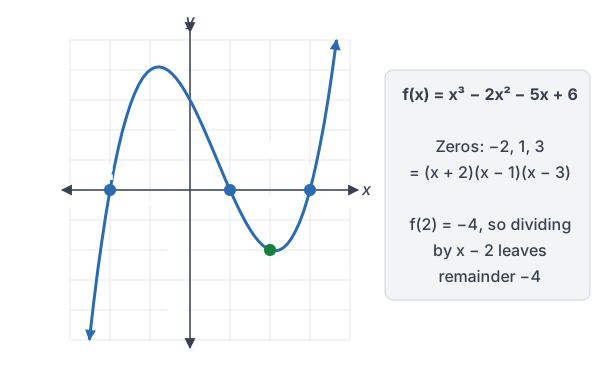
On a graph, f(c) = 0 means the graph crosses or touches the x-axis at x = c. So every x-intercept c gives a factor x - c (see key features of functions).
Worked Examples
Example 1: Find a remainder by plugging in
Find the remainder when x^3 - 4x^2 + 2x + 5 is divided by x - 3.
- The divisor is x - 3, so c = 3. By the remainder theorem, the remainder is f(3).
- Substitute 3 (see function notation): f(3) = 3^3 - 4(3)^2 + 2(3) + 5
- Evaluate the powers: 27 - 4(9) + 2(3) + 5
- Multiply: 27 - 36 + 6 + 5
- Add from left to right: 2
Answer: The remainder is 2.
Example 2: Find f(c) with synthetic division
Find f(3) for f(x) = 2x^4 - 5x^3 + x - 8.
Plugging in works, but big powers get messy. Synthetic division by x - 3 gives the same number as its remainder (see synthetic division). This is called synthetic substitution.
- c = 3. The coefficients are 2, −5, 0, 1, −8 (0 for the missing x^2 term).
- Bring down 2.
- Multiply: 2(3) = 6
- Add: -5 + 6 = 1
- Multiply: 1(3) = 3
- Add: 0 + 3 = 3
- Multiply: 3(3) = 9
- Add: 1 + 9 = 10
- Multiply: 10(3) = 30
- Add: -8 + 30 = 22. This is the remainder.
Answer: f(3) = 22. Check: 2(81) - 5(27) + 3 - 8 = 162 - 135 + 3 - 8 = 22.
Example 3: Test a factor, then factor completely
Is x + 2 a factor of f(x) = x^3 - 2x^2 - 5x + 6? If so, factor f(x) completely.
- Write x + 2 as x - (-2), so c = -2. Find f(-2): (-2)^3 - 2(-2)^2 - 5(-2) + 6
- Evaluate the powers (see multiplying integers): -8 - 2(4) - 5(-2) + 6
- Multiply: -8 - 8 + 10 + 6
- Add: 0. By the factor theorem, x + 2 is a factor.
- Divide by x + 2 with synthetic division. Coefficients 1, −2, −5, 6 and c = -2. Bring down 1.
- Multiply: 1(-2) = -2
- Add: -2 + (-2) = -4
- Multiply: -4(-2) = 8
- Add: -5 + 8 = 3
- Multiply: 3(-2) = -6
- Add: 6 + (-6) = 0. The quotient is x^2 - 4x + 3.
- Factor the trinomial (see factoring trinomials): x^2 - 4x + 3 = (x - 1)(x - 3)
Answer: Yes. f(x) = (x + 2)(x - 1)(x - 3). These factors match the x-intercepts −2, 1 and 3 on the graph above.
Example 4: Find a missing coefficient
Find k so that x - 2 is a factor of x^3 + kx^2 - 4x + 12.
- By the factor theorem, f(2) must equal 0: 2^3 + k(2)^2 - 4(2) + 12 = 0
- Evaluate the powers: 8 + 4k - 4(2) + 12 = 0
- Multiply: 8 + 4k - 8 + 12 = 0
- Combine the numbers: 4k + 12 = 0
- Subtract 12 from both sides: 4k = -12
- Divide both sides by 4: k = -3
Answer: k = -3. Check: 8 - 12 - 8 + 12 = 0.
Example 5: Word problem with break-even points
A company’s profit, in thousands of dollars, is P(x) = x^3 - 12x^2 + 44x - 48, where x is the number of items made, in hundreds. The company breaks even (profit 0) at x = 2. Find the other break-even points.
- Check x = 2: P(2) = 8 - 12(4) + 44(2) - 48
- Multiply: 8 - 48 + 88 - 48
- Add: 0. So x - 2 is a factor.
- Divide by x - 2. Coefficients 1, −12, 44, −48 and c = 2. Bring down 1.
- Multiply: 1(2) = 2
- Add: -12 + 2 = -10
- Multiply: -10(2) = -20
- Add: 44 + (-20) = 24
- Multiply: 24(2) = 48
- Add: -48 + 48 = 0. The quotient is x^2 - 10x + 24.
- Factor the trinomial: (x - 4)(x - 6)
- So P(x) = (x - 2)(x - 4)(x - 6), which is 0 at x = 2, 4 and 6.
Answer: The company also breaks even at 400 items and 600 items.
Common Mistakes
| Mistake | Example of the error | Fix |
|---|---|---|
| Using the wrong sign for c | Testing x + 2 with f(2) | x + 2 = x - (-2), so test f(-2). |
| Sign errors with negative powers | (-2)^3 = 8 or -2^2 = 4 when substituting | (-2)^3 = -8 and (-2)^2 = 4. Keep the parentheses. |
| Mixing up the zero and the factor | f(3) = 0, so x + 3 is a factor | A zero at 3 gives the factor x - 3. |
| Calling a nonzero remainder a factor | f(-3) = 9, so x + 3 is a factor | A factor needs remainder 0. Since 9 is not 0, x + 3 is not a factor. |
| Using it with a divisor like 2x - 1 | Remainder is f(1) | 2x - 1 = 0 at x = \frac{1}{2}, so the remainder is f\left(\frac{1}{2}\right). |
Practice Problems
- Find the remainder when x^3 + 2x^2 - x + 4 is divided by x - 2.
- Find the remainder when 2x^3 - x^2 + 3 is divided by x + 1.
- Find the remainder when x^4 - 3x^3 + 5 is divided by x - 3.
- Is x - 4 a factor of x^3 - 5x^2 + 2x + 8?
- Is x + 3 a factor of x^3 + 4x^2 - 2x - 6?
- x + 1 is a factor of x^3 - 7x - 6. Factor it completely.
- x = 1 is a zero of x^3 + 2x^2 - 13x + 10. Factor it completely.
- Find k so that x - 1 is a factor of 2x^3 - x^2 + kx + 4.
- Use synthetic substitution to find f(-2) for f(x) = x^4 + 3x^3 - x + 2.
- A box has a volume of x^3 + 6x^2 + 11x + 6 cubic inches. Show that x + 1 is a factor, then find the other two edges.
Show answers
- Substitute 2: 2^3 + 2(2)^2 - 2 + 4
Powers: 8 + 2(4) - 2 + 4
Multiply: 8 + 8 - 2 + 4
Add: 18
Answer: the remainder is 18 - c = -1. Substitute: 2(-1)^3 - (-1)^2 + 3
Powers: 2(-1) - 1 + 3
Multiply: -2 - 1 + 3
Add: 0
Answer: the remainder is 0 (so x + 1 is a factor) - Substitute 3: 3^4 - 3(3)^3 + 5
Powers: 81 - 3(27) + 5
Multiply: 81 - 81 + 5
Add: 5
Answer: the remainder is 5 - Substitute 4: 4^3 - 5(4)^2 + 2(4) + 8
Powers: 64 - 5(16) + 2(4) + 8
Multiply: 64 - 80 + 8 + 8
Add: 0
Answer: yes, x - 4 is a factor - c = -3. Substitute: (-3)^3 + 4(-3)^2 - 2(-3) - 6
Powers: -27 + 4(9) - 2(-3) - 6
Multiply: -27 + 36 + 6 - 6
Add: 9
Answer: no. The remainder is 9, not 0 - Synthetic division with c = -1 and coefficients 1, 0, −7, −6. Bring down 1
Multiply: 1(-1) = -1
Add: 0 + (-1) = -1
Multiply: -1(-1) = 1
Add: -7 + 1 = -6
Multiply: -6(-1) = 6
Add: -6 + 6 = 0
Quotient: x^2 - x - 6
Factor: (x - 3)(x + 2)
Answer: (x + 1)(x - 3)(x + 2) - Synthetic division with c = 1 and coefficients 1, 2, −13, 10. Bring down 1
Multiply: 1(1) = 1
Add: 2 + 1 = 3
Multiply: 3(1) = 3
Add: -13 + 3 = -10
Multiply: -10(1) = -10
Add: 10 + (-10) = 0
Quotient: x^2 + 3x - 10
Factor: (x + 5)(x - 2)
Answer: (x - 1)(x + 5)(x - 2) - Set f(1) = 0: 2(1)^3 - (1)^2 + k(1) + 4 = 0
Simplify: 2 - 1 + k + 4 = 0
Combine: k + 5 = 0
Subtract 5: k = -5 - c = -2; coefficients 1, 3, 0, −1, 2. Bring down 1
Multiply: 1(-2) = -2
Add: 3 + (-2) = 1
Multiply: 1(-2) = -2
Add: 0 + (-2) = -2
Multiply: -2(-2) = 4
Add: -1 + 4 = 3
Multiply: 3(-2) = -6
Add: 2 + (-6) = -4
Answer: f(-2) = -4 - Test c = -1: (-1)^3 + 6(-1)^2 + 11(-1) + 6
Powers: -1 + 6(1) + 11(-1) + 6
Multiply: -1 + 6 - 11 + 6
Add: 0, so x + 1 is a factor
Synthetic division, coefficients 1, 6, 11, 6. Bring down 1
Multiply: 1(-1) = -1
Add: 6 + (-1) = 5
Multiply: 5(-1) = -5
Add: 11 + (-5) = 6
Multiply: 6(-1) = -6
Add: 6 + (-6) = 0
Quotient: x^2 + 5x + 6
Factor: (x + 2)(x + 3)
Answer: the other edges are x + 2 and x + 3 inches
FAQ
What is the remainder theorem?
When a polynomial f(x) is divided by x - c, the remainder is f(c). For example, dividing x^2 + 1 by x - 2 leaves a remainder of f(2) = 5.
What is the factor theorem?
x - c is a factor of f(x) if and only if f(c) = 0. In other words, c is a zero of the polynomial exactly when x - c divides it evenly.
How do you use the factor theorem to factor a polynomial?
Find a number c with f(c) = 0, then divide by x - c with synthetic division. Factor the quotient, often a quadratic, to finish.
What is the difference between a zero and a factor?
A zero is a number, like 3, where f(3) = 0. A factor is an expression, like x - 3, that divides the polynomial evenly. Each zero c gives the factor x - c.
Summary
- Remainder theorem: dividing f(x) by x - c leaves remainder f(c).
- Factor theorem: x - c is a factor exactly when f(c) = 0.
- For x + a, use c = -a.
- Synthetic substitution finds f(c) quickly for big powers.
- Each x-intercept c of the graph gives a factor x - c.
Previous lesson: Synthetic Division
Next lesson: Sum and Difference of Cubes
Back to the Algebra 2 Index