
End Behavior of Polynomials
The end behavior of polynomials describes what a graph does at its far left and far right ends. It depends only on the leading term. The degree tells you whether the two ends point the same way or opposite ways. The sign of the leading coefficient tells you which way the right end points.
Before this lesson: You should know Polynomials, Parent Functions, Key Features of Functions and Exponent Rules.
What End Behavior Means
Picture walking along a graph to the far right, where x gets huge. Does the graph shoot up or dive down? Now walk to the far left, where x is a huge negative number. That is the end behavior.
We write it with arrows. “As x \to \infty, f(x) \to \infty” means “as x grows without bound, f(x) grows without bound,” so the right end points up.
Only the leading term matters. It is the term with the highest power of x. Its exponent is the degree, and its number is the leading coefficient (see polynomials). For huge x, that term is so big that it outweighs all the others.
For example, take f(x) = x^3 - 50x^2. At x = 1000, the leading term is 1000^3 = 1{,}000{,}000{,}000. The other term is -50(1000)^2 = -50{,}000{,}000. The leading term wins, so f(1000) is positive.
The Four Cases
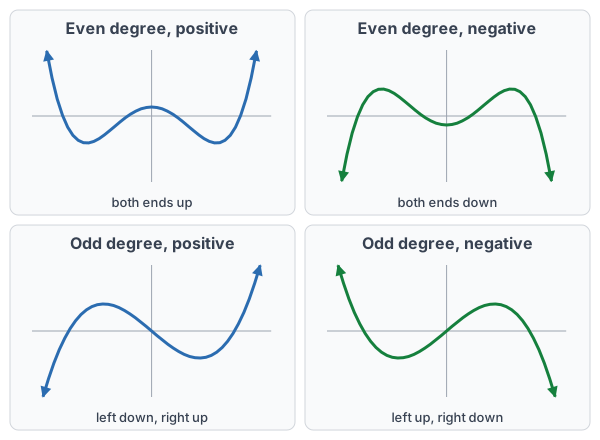
| Degree | Leading coefficient | Left end (x \to -\infty) | Right end (x \to \infty) | Like |
|---|---|---|---|---|
| Even | Positive | Up: f(x) \to \infty | Up: f(x) \to \infty | y = x^2 |
| Even | Negative | Down: f(x) \to -\infty | Down: f(x) \to -\infty | y = -x^2 |
| Odd | Positive | Down: f(x) \to -\infty | Up: f(x) \to \infty | y = x^3 |
| Odd | Negative | Up: f(x) \to \infty | Down: f(x) \to -\infty | y = -x^3 |
Here is a quick way to remember it. Even degree: both ends point the same way, like a parabola. Odd degree: the ends point opposite ways, like a line. A positive leading coefficient makes the right end point up.
Worked Examples
Example 1: Even degree, positive
Describe the end behavior of f(x) = 2x^4 - 3x + 1.
- Find the leading term: 2x^4
- The degree is 4, which is even, so both ends point the same way.
- The leading coefficient is 2, which is positive, so the right end points up.
- So the left end points up too.
Answer: As x \to -\infty, f(x) \to \infty. As x \to \infty, f(x) \to \infty. Both ends rise.
Example 2: Odd degree, negative
Describe the end behavior of g(x) = -x^3 + 4x^2 + 5.
- Find the leading term: -x^3
- The degree is 3, which is odd, so the ends point opposite ways.
- The leading coefficient is −1, which is negative, so the right end points down.
- So the left end points up.
Answer: As x \to -\infty, g(x) \to \infty. As x \to \infty, g(x) \to -\infty. The graph rises on the left and falls on the right.
Example 3: Not in standard form
Describe the end behavior of h(x) = 5x - 3x^4 + x^2 + 7.
- Write the terms from highest to lowest power: h(x) = -3x^4 + x^2 + 5x + 7
- Find the leading term: -3x^4. It is not the first term written in the problem.
- The degree is 4, which is even, so both ends point the same way.
- The leading coefficient is −3, which is negative, so the right end points down.
Answer: As x \to -\infty, h(x) \to -\infty. As x \to \infty, h(x) \to -\infty. Both ends fall.
Example 4: Factored form
Describe the end behavior of p(x) = -2(x - 1)(x + 3)^2.
You don’t need to multiply everything out. Multiply only the highest-power term from each factor (see multiplying polynomials).
- Highest-power term of (x - 1): x
- Highest-power term of (x + 3)^2: x^2
- Multiply them with the constant (see exponent rules): -2 \cdot x \cdot x^2 = -2x^3
- The degree is 3, which is odd, so the ends point opposite ways.
- The leading coefficient is −2, which is negative, so the right end points down.
Answer: As x \to -\infty, p(x) \to \infty. As x \to \infty, p(x) \to -\infty.
Example 5: Word problem with a profit model
A small company models its yearly profit, in thousands of dollars, as P(t) = -2t^3 + 30t^2 + 50, where t is years since it opened. What does the end behavior say about the far future? Is the model reasonable there?
- Find the leading term: -2t^3
- The degree is 3 (odd) and the leading coefficient is −2 (negative).
- So as t \to \infty, P(t) \to -\infty.
- Test a large value to see it. Substitute t = 20: P(20) = -2(20)^3 + 30(20)^2 + 50
- Evaluate the powers: -2(8000) + 30(400) + 50
- Multiply: -16{,}000 + 12{,}000 + 50
- Add: -3950
Answer: The model predicts that profit eventually drops without limit, to a loss of about $3.95 million in year 20 and worse after that. Real companies change over time, so this model is only useful for the first several years.
Reading End Behavior from a Graph
You can also work backward from a graph to the leading term.
- Both ends up: even degree, positive leading coefficient.
- Both ends down: even degree, negative leading coefficient.
- Left down, right up: odd degree, positive leading coefficient.
- Left up, right down: odd degree, negative leading coefficient.
The end behavior can’t tell you the exact degree. A graph with both ends up could be degree 2, 4, 6 or any even number. Turning points and zeros give more clues (see key features of functions).
Common Mistakes
| Mistake | Example of the error | Fix |
|---|---|---|
| Using the first term written | In 5x - 3x^4 + 7, using 5x | Use the term with the highest power, -3x^4. |
| Saying “negative means both ends down” | -x^3 falls on both ends | For odd degree, a negative leading coefficient means up on the left, down on the right. |
| Missing the exponent on a factor | (x - 1)(x + 3)^2 has degree 2 | (x + 3)^2 adds 2 to the degree. The total is 3. |
| Forgetting the sign of a factor | Leading term of x^2(1 - x)^3 is x^5 | The highest term of (1 - x) is -x, so the leading term is x^2(-x)^3 = -x^5. |
| Mixing up which end is which | “As x \to -\infty” describes the right end | x \to -\infty is the far left. x \to \infty is the far right. |
Practice Problems
- Describe the end behavior of f(x) = x^6 - 4x^3 + 2.
- Describe the end behavior of f(x) = -4x^5 + x^2 - 9.
- Describe the end behavior of f(x) = 3x^3 - 7x^4.
- Describe the end behavior of f(x) = 7 - x + 2x^5.
- Describe the end behavior of f(x) = (x - 2)(x + 1)(x + 5).
- Describe the end behavior of f(x) = -(x + 4)^2(x - 1)^2.
- Describe the end behavior of f(x) = 3x^2(1 - x)^3.
- A polynomial’s graph rises on both the left and the right. What can you say about its degree and leading coefficient?
- A graph falls to the left and rises to the right. Which could be its equation: (a) y = -x^4 + 3, (b) y = 2x^3 - x, or (c) y = -5x^3 + x^2?
- An open box is made from a 12-inch square sheet by cutting x-inch squares from the corners. Its volume is V(x) = x(12 - 2x)^2. Find the leading term and the end behavior. Why doesn’t the end behavior describe a real box?
Show answers
- Leading term: x^6
Degree 6 is even, so the ends match
Leading coefficient 1 is positive, so the right end rises
Answer: as x \to \pm\infty, f(x) \to \infty (both ends up) - Leading term: -4x^5
Degree 5 is odd, so the ends are opposite
Leading coefficient −4 is negative, so the right end falls
Answer: as x \to -\infty, f(x) \to \infty; as x \to \infty, f(x) \to -\infty - Leading term (highest power): -7x^4
Degree 4 is even, so the ends match
Leading coefficient −7 is negative
Answer: as x \to \pm\infty, f(x) \to -\infty (both ends down) - Leading term: 2x^5
Degree 5 is odd, so the ends are opposite
Leading coefficient 2 is positive, so the right end rises
Answer: as x \to -\infty, f(x) \to -\infty; as x \to \infty, f(x) \to \infty - Highest terms of the factors: x, x and x
Multiply: x \cdot x \cdot x = x^3
Degree 3 is odd and the leading coefficient 1 is positive
Answer: as x \to -\infty, f(x) \to -\infty; as x \to \infty, f(x) \to \infty - Highest terms: x^2 and x^2
Multiply with the −1: -1 \cdot x^2 \cdot x^2 = -x^4
Degree 4 is even and the leading coefficient is negative
Answer: as x \to \pm\infty, f(x) \to -\infty - Highest term of (1 - x) is -x, so (1 - x)^3 gives (-x)^3 = -x^3
Multiply: 3x^2 \cdot (-x^3) = -3x^5
Degree 5 is odd and the leading coefficient −3 is negative
Answer: as x \to -\infty, f(x) \to \infty; as x \to \infty, f(x) \to -\infty - Both ends match, so the degree is even
The right end rises, so the leading coefficient is positive
Answer: even degree, positive leading coefficient - Left down and right up means odd degree with a positive leading coefficient
(a) has even degree. (c) has a negative leading coefficient
Answer: (b) y = 2x^3 - x - Highest terms: x and (-2x)^2 = 4x^2
Multiply: x \cdot 4x^2 = 4x^3
Degree 3 is odd and 4 is positive: as x \to -\infty, V \to -\infty; as x \to \infty, V \to \infty
A real cut must be between 0 and 6 inches, so the ends of the graph don’t describe any real box
FAQ
How do you find the end behavior of a polynomial?
Find the leading term, the term with the highest power. Use its degree (even or odd) and the sign of its coefficient. Even degree means the ends match; a positive coefficient means the right end rises.
What is the end behavior of an odd-degree polynomial?
The two ends go in opposite directions. With a positive leading coefficient, the graph falls on the left and rises on the right. With a negative one, it rises on the left and falls on the right.
How do you write end behavior in limit notation?
Write “as x \to \infty, f(x) \to \infty” for a right end that rises. In calculus this becomes \lim_{x \to \infty} f(x) = \infty. Do the same for x \to -\infty.
Do the other terms ever change the end behavior?
No. They can change the middle of the graph, such as its zeros and turning points. For very large positive or negative x, the leading term always wins.
Summary
- End behavior is what the graph does as x \to -\infty and x \to \infty.
- Only the leading term matters: its degree and the sign of its coefficient.
- Even degree: both ends point the same way. Odd degree: they point opposite ways.
- A positive leading coefficient makes the right end rise; a negative one makes it fall.
- For factored form, multiply the highest-power terms of the factors.
Previous lesson: Nonlinear Systems of Equations
Next lesson: Polynomial Long Division
Back to the Algebra 2 Index