
Nonlinear Systems of Equations
Nonlinear systems of equations are systems where at least one equation is not a line, such as a circle or a parabola. The solutions are the points where the graphs cross. You solve them by substitution or elimination, just like linear systems, but you usually end up solving a quadratic equation.
Before this lesson: You should know Linear-Quadratic Systems, Substitution Method, Elimination Method, Equation of a Circle and Quadratic Inequalities.
What Makes a System Nonlinear
A system is a set of equations that share the same variables. In a nonlinear system, at least one equation has a squared variable, a product like xy, or another term that does not make a line.
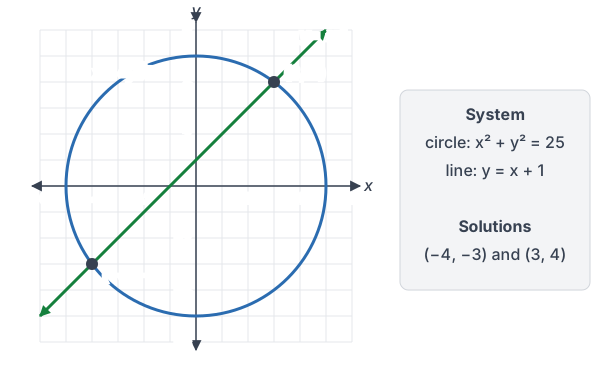
Each solution is an ordered pair (x, y) that makes every equation true. On a graph, it is a point where the curves meet. A line and a circle can meet at 0, 1 or 2 points. Two curves like circles and parabolas can meet at up to 4 points.
How to Solve a Nonlinear System
Substitution works best when one equation is easy to solve for a variable, such as y = x + 1 or y = x^2.
- Solve one equation for one variable (it may already be solved).
- Substitute that expression into the other equation.
- Solve the new equation. It is often a quadratic.
- Put each value back into the simpler equation to find the other coordinate.
- Check each pair in both original equations.
Elimination works best when both equations have the same squared terms, such as x^2 and y^2 in each. Add or subtract the equations to cancel one of them.
Worked Examples
Example 1: A line and a circle
Solve the system x^2 + y^2 = 25 and y = x + 1.
- Substitute x + 1 for y in the circle (see substitution method): x^2 + (x + 1)^2 = 25
- Square the binomial (see special products of binomials): x^2 + x^2 + 2x + 1 = 25
- Combine like terms: 2x^2 + 2x + 1 = 25
- Subtract 25 from both sides: 2x^2 + 2x - 24 = 0
- Divide every term by 2: x^2 + x - 12 = 0
- Factor the trinomial (see factoring trinomials): (x + 4)(x - 3) = 0
- Set each factor equal to zero (see solving quadratic equations by factoring): x = -4 or x = 3
- Find y with the line. For x = -4: y = -4 + 1 = -3
- For x = 3: y = 3 + 1 = 4
Answer: (-4, -3) and (3, 4)
Check (3, 4): 3^2 + 4^2 = 9 + 16 = 25, and 4 = 3 + 1. Both are true. These are the two points on the graph above.
Example 2: Two parabolas
Solve the system y = x^2 - 4 and y = -x^2 + 2x + 8.
- Both right sides equal y, so set them equal: x^2 - 4 = -x^2 + 2x + 8
- Add x^2 to both sides: 2x^2 - 4 = 2x + 8
- Subtract 2x from both sides: 2x^2 - 2x - 4 = 8
- Subtract 8 from both sides: 2x^2 - 2x - 12 = 0
- Divide every term by 2: x^2 - x - 6 = 0
- Factor the trinomial: (x - 3)(x + 2) = 0
- Solve each factor: x = 3 or x = -2
- Find y with the first equation. For x = 3: y = 3^2 - 4 = 5
- For x = -2: y = (-2)^2 - 4 = 0
Answer: (3, 5) and (-2, 0)
Check (3, 5) in the second equation: -9 + 6 + 8 = 5. True.
Example 3: Elimination with four solutions
Solve the system x^2 + y^2 = 13 and x^2 - y^2 = 5.
- Add the equations to eliminate y^2 (see elimination method): 2x^2 = 18
- Divide both sides by 2: x^2 = 9
- Take the square root of both sides (see solving quadratics with square roots): x = \pm 3
- Substitute x^2 = 9 into the first equation: 9 + y^2 = 13
- Subtract 9 from both sides: y^2 = 4
- Take the square root of both sides: y = \pm 2
- Pair every x with every y. Each pair works, because only the squares appear.
Answer: (3, 2), (3, -2), (-3, 2) and (-3, -2)
The graphs are a circle and a hyperbola, and they cross in four places.
Example 4: A circle and a parabola
Solve the system x^2 + y^2 = 20 and y = x^2.
- The second equation says x^2 = y. Substitute y for x^2 in the first: y + y^2 = 20
- Subtract 20 and write in standard form: y^2 + y - 20 = 0
- Factor the trinomial: (y + 5)(y - 4) = 0
- Solve each factor: y = -5 or y = 4
- Reject y = -5, because x^2 = -5 has no real solution.
- Use y = 4: x^2 = 4
- Take the square root of both sides: x = \pm 2
Answer: (2, 4) and (-2, 4)
Check (2, 4): 2^2 + 4^2 = 4 + 16 = 20, and 4 = 2^2. True.
Example 5: Word problem with a rectangle
A rectangle has a perimeter of 28 inches and a diagonal of 10 inches. Find its length and width.
- Let the sides be x and y. Half the perimeter is the sum of the sides: x + y = 14
- The diagonal makes a right triangle (see Pythagorean theorem): x^2 + y^2 = 100
- Solve the first equation for y: y = 14 - x
- Substitute into the second: x^2 + (14 - x)^2 = 100
- Square the binomial: x^2 + 196 - 28x + x^2 = 100
- Combine like terms: 2x^2 - 28x + 196 = 100
- Subtract 100 from both sides: 2x^2 - 28x + 96 = 0
- Divide every term by 2: x^2 - 14x + 48 = 0
- Factor the trinomial: (x - 6)(x - 8) = 0
- Solve each factor: x = 6 or x = 8
- Find y: if x = 6, then y = 14 - 6 = 8; if x = 8, then y = 6
Answer: The rectangle is 8 inches long and 6 inches wide.
Check: the perimeter is 2(8) + 2(6) = 28, and the diagonal is \sqrt{64 + 36} = \sqrt{100} = 10.
How Many Solutions Can There Be?
After substituting, look at the quadratic you get. Its discriminant tells you how many times a line meets a curve (see the discriminant).
| Discriminant of the new quadratic | Line and circle | Number of solutions |
|---|---|---|
| Positive | Line cuts through the circle | 2 |
| Zero | Line touches the circle once (tangent) | 1 |
| Negative | Line misses the circle | 0 |
For example, x^2 + y^2 = 4 and y = x + 5 give 2x^2 + 10x + 21 = 0. Its discriminant is 100 - 168 = -68, so the line misses the circle and the system has no real solution.
Common Mistakes
| Mistake | Example of the error | Fix |
|---|---|---|
| Squaring a binomial wrong | (x + 1)^2 = x^2 + 1 | (x + 1)^2 = x^2 + 2x + 1 |
| Finding y in the circle instead of the line | x = 3 in x^2 + y^2 = 25 gives y = \pm 4, so (3, -4) is listed | (3, -4) is not on y = x + 1. Use the simpler equation, then check both. |
| Losing the ± | x^2 = 9, so x = 3 | x = \pm 3. Both signs can give solutions. |
| Keeping an impossible value | y = -5 with y = x^2 | x^2 = -5 has no real solution, so drop y = -5. |
| Stopping at the x-values | Answer: x = -4, 3 | A solution is a point. Give (-4, -3) and (3, 4). |
Practice Problems
- Solve y = 2x and x^2 + y^2 = 20.
- Solve x^2 + y^2 = 10 and y = x + 2.
- Solve y = x^2 + 1 and y = -x^2 + 9.
- Solve x^2 + y^2 = 25 and x^2 - y^2 = 7.
- Solve y = x^2 and x + y = 6.
- Solve x^2 + y^2 = 4 and y = x + 4.
- Solve x^2 + y^2 = 9 and y = 3.
- Solve xy = 12 and y = x + 1.
- Solve x^2 + y^2 = 17 and y = x^2 - 5.
- Two numbers add to 11, and the sum of their squares is 61. Find the numbers.
Show answers
- Substitute: x^2 + (2x)^2 = 20
Square: x^2 + 4x^2 = 20
Combine: 5x^2 = 20
Divide by 5: x^2 = 4
Square root: x = \pm 2
Find y = 2x: (2, 4) and (-2, -4) - Substitute: x^2 + (x + 2)^2 = 10
Square: x^2 + x^2 + 4x + 4 = 10
Combine: 2x^2 + 4x + 4 = 10
Subtract 10: 2x^2 + 4x - 6 = 0
Divide by 2: x^2 + 2x - 3 = 0
Factor: (x + 3)(x - 1) = 0
Solve: x = -3 or x = 1
Find y = x + 2: (-3, -1) and (1, 3) - Set equal: x^2 + 1 = -x^2 + 9
Add x^2: 2x^2 + 1 = 9
Subtract 1: 2x^2 = 8
Divide by 2: x^2 = 4
Square root: x = \pm 2
Find y = x^2 + 1 = 5: (2, 5) and (-2, 5) - Add the equations: 2x^2 = 32
Divide by 2: x^2 = 16
Square root: x = \pm 4
Substitute x^2 = 16: 16 + y^2 = 25
Subtract 16: y^2 = 9
Square root: y = \pm 3
Answer: (4, 3), (4, -3), (-4, 3), (-4, -3) - Substitute x^2 for y: x + x^2 = 6
Standard form: x^2 + x - 6 = 0
Factor: (x + 3)(x - 2) = 0
Solve: x = -3 or x = 2
Find y = x^2: (-3, 9) and (2, 4) - Substitute: x^2 + (x + 4)^2 = 4
Square: x^2 + x^2 + 8x + 16 = 4
Combine: 2x^2 + 8x + 16 = 4
Subtract 4: 2x^2 + 8x + 12 = 0
Divide by 2: x^2 + 4x + 6 = 0
Discriminant: 4^2 - 4(1)(6)
Square and multiply: 16 - 24
Subtract: -8, which is negative
Answer: no real solution (the line misses the circle) - Substitute: x^2 + 3^2 = 9
Square: x^2 + 9 = 9
Subtract 9: x^2 = 0
Solve: x = 0
Answer: (0, 3) only. The line is tangent to the circle. - Substitute: x(x + 1) = 12
Distribute: x^2 + x = 12
Subtract 12: x^2 + x - 12 = 0
Factor: (x + 4)(x - 3) = 0
Solve: x = -4 or x = 3
Find y = x + 1: (-4, -3) and (3, 4) - Rewrite the parabola: x^2 = y + 5
Substitute: y + 5 + y^2 = 17
Standard form: y^2 + y - 12 = 0
Factor: (y + 4)(y - 3) = 0
Solve: y = -4 or y = 3
If y = 3: x^2 = 8, so x = \pm 2\sqrt{2} (see simplifying square roots)
If y = -4: x^2 = 1, so x = \pm 1
Answer: (2\sqrt{2}, 3), (-2\sqrt{2}, 3), (1, -4), (-1, -4) - Write the system: x + y = 11 and x^2 + y^2 = 61
Solve for y: y = 11 - x
Substitute: x^2 + (11 - x)^2 = 61
Square: x^2 + 121 - 22x + x^2 = 61
Combine: 2x^2 - 22x + 121 = 61
Subtract 61: 2x^2 - 22x + 60 = 0
Divide by 2: x^2 - 11x + 30 = 0
Factor: (x - 5)(x - 6) = 0
Solve: x = 5 or x = 6
Answer: the numbers are 5 and 6
FAQ
What is a nonlinear system of equations?
It is a system where at least one equation is not linear, such as a circle, parabola or xy = k. Its solutions are the points where the graphs intersect.
How do you solve a nonlinear system of equations?
Use substitution when one equation is solved for a variable, or elimination when both equations have the same squared terms. Then solve the resulting quadratic and find the matching coordinates.
How many solutions can a nonlinear system have?
A line and a circle or parabola can have 0, 1 or 2 solutions. Two circles, parabolas or other conic sections can have up to 4.
Can you solve a nonlinear system by graphing?
Yes. Graph both equations and read the intersection points. Graphs give estimates, so check each point in both equations or solve algebraically for exact answers.
Summary
- A nonlinear system has at least one equation that is not a line.
- Its solutions are the intersection points of the graphs.
- Substitute when one equation is solved for a variable; eliminate when the squared terms match.
- Find both coordinates of every solution, and check each one in both equations.
- Drop values that are impossible, like x^2 = -5.
Previous lesson: Quadratic Inequalities
Next lesson: End Behavior of Polynomials
Back to the Algebra 2 Index