
Quadratic Inequalities
Quadratic inequalities like x^2 - x - 6 \lt 0 ask where a parabola is above or below the x-axis. To solve one, find where the quadratic equals zero. Those x-values split the number line into intervals. Test one number in each interval, and keep the intervals that make the inequality true.
Before this lesson: You should know Solving Quadratic Equations by Factoring, Quadratic Formula, Compound Inequalities and Graphing Quadratic Functions.
What a Quadratic Inequality Asks
A quadratic inequality has an x^2 term and one of the signs \lt, \gt, \le or \ge. An example is x^2 - x - 6 \lt 0.
Think about the graph of y = x^2 - x - 6. The inequality asks, “Where is y less than 0?” That means, “Where is the parabola below the x-axis?”
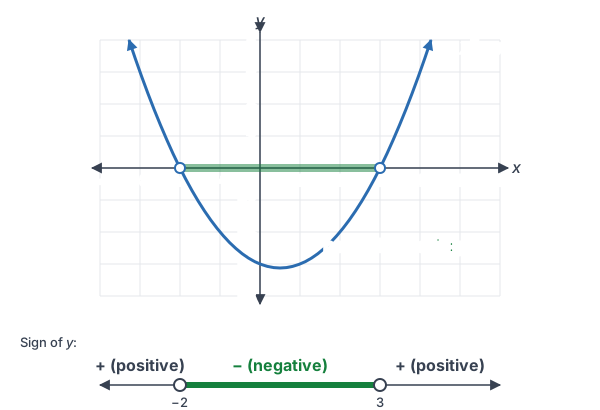
The curve crosses the x-axis at x = -2 and x = 3. Those are the critical values. Between them, the curve is below the axis. Outside them, it is above. So the answer is -2 \lt x \lt 3.
How to Solve a Quadratic Inequality
- Move every term to one side, so the other side is 0.
- Solve the related equation to find the critical values.
- Mark the critical values on a number line. They split it into intervals.
- Test one number from each interval in the inequality.
- Keep the intervals that work. Include the critical values only for \le or \ge.
Write the answer as an inequality and in interval notation. Use parentheses ( ) for an endpoint that is not included and brackets [ ] for one that is. The symbol \cup means “or” and joins two intervals.
| Inequality | Interval notation | Meaning |
|---|---|---|
| -2 \lt x \lt 3 | (-2, 3) | Between −2 and 3, not including either |
| -5 \le x \le 2 | [-5, 2] | Between −5 and 2, including both |
| x \le -5 or x \ge 3 | (-\infty, -5] \cup [3, \infty) | −5 or less, or 3 or more |
Worked Examples
Example 1: A “less than” inequality
Solve x^2 - x - 6 \lt 0.
- Write the related equation: x^2 - x - 6 = 0
- Factor the trinomial (see factoring trinomials): (x - 3)(x + 2) = 0
- Set each factor equal to zero: x - 3 = 0 or x + 2 = 0
- Solve each one: x = 3 or x = -2
- The critical values split the line into three intervals: x \lt -2, -2 \lt x \lt 3 and x \gt 3
- Test a number in each interval, using the table below.
| Interval | Test point | (x - 3)(x + 2) | Less than 0? |
|---|---|---|---|
| x \lt -2 | x = -3 | (-6)(-1) = 6 | No |
| -2 \lt x \lt 3 | x = 0 | (-3)(2) = -6 | Yes |
| x \gt 3 | x = 4 | (1)(6) = 6 | No |
Only the middle interval works. The sign is \lt, not \le, so the endpoints are not included.
Answer: -2 \lt x \lt 3, or (-2, 3) in interval notation. This matches the graph above.
Example 2: Move the terms first
Solve x^2 + 2x \ge 15.
- Subtract 15 from both sides: x^2 + 2x - 15 \ge 0
- Write the related equation: x^2 + 2x - 15 = 0
- Factor the trinomial: (x + 5)(x - 3) = 0
- Solve each factor: x = -5 or x = 3
- Test x = -6: (-1)(-9) = 9, and 9 \ge 0 is true
- Test x = 0: (5)(-3) = -15, and -15 \ge 0 is false
- Test x = 4: (9)(1) = 9, and 9 \ge 0 is true
- Keep the outer intervals. The sign is \ge, so include the endpoints.
Answer: x \le -5 or x \ge 3, which is (-\infty, -5] \cup [3, \infty).
Example 3: A negative leading coefficient
Solve -x^2 + 4x + 5 \gt 0.
- Multiply both sides by −1 and flip the inequality sign (see multi-step inequalities): x^2 - 4x - 5 \lt 0
- Write the related equation: x^2 - 4x - 5 = 0
- Factor the trinomial: (x - 5)(x + 1) = 0
- Solve each factor: x = 5 or x = -1
- Test x = -2: (-7)(-1) = 7, and 7 \lt 0 is false
- Test x = 0: (-5)(1) = -5, and -5 \lt 0 is true
- Test x = 6: (1)(7) = 7, and 7 \lt 0 is false
- Keep the middle interval, without the endpoints.
Answer: -1 \lt x \lt 5, or (-1, 5)
You can skip the flip and test the original inequality instead. You get the same answer. Flipping just makes the factoring easier.
Example 4: Critical values from the quadratic formula
Solve x^2 - 4x + 1 \le 0.
- Name the coefficients of x^2 - 4x + 1 = 0: a = 1, b = -4, c = 1
- Write the discriminant: (-4)^2 - 4(1)(1)
- Square and multiply: 16 - 4
- Subtract: 12
- Substitute into the quadratic formula (see quadratic formula): x = \frac{4 \pm \sqrt{12}}{2}
- Simplify the radical (see simplifying square roots): x = \frac{4 \pm 2\sqrt{3}}{2}
- Divide both parts by 2: x = 2 \pm \sqrt{3}
- These are about 0.27 and 3.73. Test x = 0: 0 - 0 + 1 = 1, and 1 \le 0 is false
- Test x = 2: 4 - 8 + 1 = -3, and -3 \le 0 is true
- Test x = 4: 16 - 16 + 1 = 1, and 1 \le 0 is false
- Keep the middle interval. The sign is \le, so include the endpoints.
Answer: 2 - \sqrt{3} \le x \le 2 + \sqrt{3}, or [2 - \sqrt{3}, 2 + \sqrt{3}]
Example 5: Word problem with a launched ball
A ball is launched upward from a 6-foot platform. Its height after t seconds is h = -16t^2 + 64t + 6 feet. For what times is the ball higher than 54 feet?
- Write the inequality: -16t^2 + 64t + 6 \gt 54
- Subtract 54 from both sides: -16t^2 + 64t - 48 \gt 0
- Divide every term by −16 and flip the sign: t^2 - 4t + 3 \lt 0
- Write the related equation: t^2 - 4t + 3 = 0
- Factor the trinomial: (t - 1)(t - 3) = 0
- Solve each factor: t = 1 or t = 3
- Test t = 0: (-1)(-3) = 3, and 3 \lt 0 is false
- Test t = 2: (1)(-1) = -1, and -1 \lt 0 is true
- Test t = 4: (3)(1) = 3, and 3 \lt 0 is false
Answer: The ball is higher than 54 feet when 1 \lt t \lt 3, that is, between 1 and 3 seconds after launch.
Check: at t = 2, h = -16(4) + 64(2) + 6 = -64 + 128 + 6 = 70, and 70 feet is higher than 54 feet.
Special Cases
Sometimes the related equation has no real solutions. Then the parabola never crosses the x-axis, so it is all above or all below. This happens when the solutions are complex (see complex solutions of quadratic equations).
- x^2 + 2x + 5 \gt 0 is true for every real number. The discriminant is 4 - 20 = -16, and the parabola opens up, so it stays above the x-axis.
- x^2 + 2x + 5 \lt 0 has no solution, for the same reason.
- (x - 3)^2 \le 0 has only one solution, x = 3. A square is never negative, so it can only equal 0.
Common Mistakes
| Mistake | Example of the error | Fix |
|---|---|---|
| Solving it like an equation | x^2 \lt 9, so x \lt \pm 3 | Find the critical values −3 and 3, then test. The answer is -3 \lt x \lt 3. |
| Not flipping the sign | -x^2 + 4x + 5 \gt 0 becomes x^2 - 4x - 5 \gt 0 | Multiplying or dividing by a negative flips the sign: x^2 - 4x - 5 \lt 0. |
| Not getting 0 on one side | x(x - 2) \lt 3, so x \lt 3 or x - 2 \lt 3 | Rewrite as x^2 - 2x - 3 \lt 0 first, then factor. |
| Wrong brackets | x \ge 3 written as (3, \infty) | Use a bracket for an included endpoint: [3, \infty). |
| Joining an “or” answer into one | -5 \ge x \ge 3 | No number is both −5 or less and 3 or more. Write x \le -5 or x \ge 3. |
Practice Problems
- Solve x^2 - 9 \lt 0.
- Solve x^2 - 5x + 4 \gt 0.
- Solve x^2 + 3x - 10 \le 0.
- Solve x^2 \ge 4x.
- Solve 2x^2 + x - 6 \lt 0.
- Solve -x^2 + 2x + 8 \ge 0.
- Solve x^2 + 6x + 7 \gt 0.
- Solve x^2 + 4x + 9 \lt 0.
- Solve x^2 - 10x + 25 \le 0.
- A rectangular garden is 4 feet longer than it is wide. Its area must be at least 60 square feet. What widths work?
Show answers
- Factor the difference of squares (see factoring the difference of squares): (x - 3)(x + 3) \lt 0
Critical values: x = 3 and x = -3
Test x = 0: (-3)(3) = -9 \lt 0, true
Test x = \pm 4: (1)(7) = 7 and (-7)(-1) = 7, both false
Answer: -3 \lt x \lt 3, or (-3, 3) - Factor: (x - 1)(x - 4) \gt 0
Critical values: x = 1 and x = 4
Test x = 0: (-1)(-4) = 4 \gt 0, true
Test x = 2: (1)(-2) = -2, false
Test x = 5: (4)(1) = 4 \gt 0, true
Answer: x \lt 1 or x \gt 4, or (-\infty, 1) \cup (4, \infty) - Factor: (x + 5)(x - 2) \le 0
Critical values: x = -5 and x = 2
Test x = -6: (-1)(-8) = 8, false
Test x = 0: (5)(-2) = -10 \le 0, true
Test x = 3: (8)(1) = 8, false
Answer: -5 \le x \le 2, or [-5, 2] - Subtract 4x: x^2 - 4x \ge 0
Factor out the GCF (see factoring out the GCF): x(x - 4) \ge 0
Critical values: x = 0 and x = 4
Test x = -1: (-1)(-5) = 5 \ge 0, true
Test x = 1: (1)(-3) = -3, false
Test x = 5: (5)(1) = 5 \ge 0, true
Answer: x \le 0 or x \ge 4, or (-\infty, 0] \cup [4, \infty) - Factor (see factoring trinomials when a is not 1): (2x - 3)(x + 2) \lt 0
Critical values: x = \frac{3}{2} and x = -2
Test x = -3: (-9)(-1) = 9, false
Test x = 0: (-3)(2) = -6 \lt 0, true
Test x = 2: (1)(4) = 4, false
Answer: -2 \lt x \lt \frac{3}{2}, or (-2, \frac{3}{2}) - Multiply by −1 and flip: x^2 - 2x - 8 \le 0
Factor: (x - 4)(x + 2) \le 0
Critical values: x = 4 and x = -2
Test x = -3: (-7)(-1) = 7, false
Test x = 0: (-4)(2) = -8 \le 0, true
Test x = 5: (1)(7) = 7, false
Answer: -2 \le x \le 4, or [-2, 4] - Discriminant: 6^2 - 4(1)(7)
Square and multiply: 36 - 28
Subtract: 8
Quadratic formula: x = \frac{-6 \pm \sqrt{8}}{2}
Simplify the radical: x = \frac{-6 \pm 2\sqrt{2}}{2}
Divide both parts by 2: x = -3 \pm \sqrt{2} (about −4.41 and −1.59)
Test x = -3: 9 - 18 + 7 = -2, false
Test x = 0: 0 + 0 + 7 = 7 \gt 0, true
Test x = -5: 25 - 30 + 7 = 2 \gt 0, true
Answer: x \lt -3 - \sqrt{2} or x \gt -3 + \sqrt{2} - Discriminant: 4^2 - 4(1)(9)
Square and multiply: 16 - 36
Subtract: -20
It is negative, so the parabola never crosses the x-axis
It opens up, so x^2 + 4x + 9 is always positive
Answer: no solution - Factor the perfect square (see perfect square trinomials): (x - 5)^2 \le 0
A square is never negative, so it must equal 0: x - 5 = 0
Answer: x = 5 only - Let the width be x. The length is x + 4
Write the inequality: x(x + 4) \ge 60
Distribute: x^2 + 4x \ge 60
Subtract 60: x^2 + 4x - 60 \ge 0
Factor: (x + 10)(x - 6) \ge 0
Critical values: x = -10 and x = 6
Test x = 0: (10)(-6) = -60, false
Test x = 7: (17)(1) = 17 \ge 0, true
A width can’t be negative, so ignore x \le -10
Answer: the width must be at least 6 feet, x \ge 6
FAQ
How do you solve a quadratic inequality?
Move every term to one side and solve the related equation to get the critical values. Test a number in each interval they create. Keep the intervals where the inequality is true.
How do you write the answer in interval notation?
Use parentheses for endpoints that are not included and brackets for endpoints that are. Join two separate intervals with \cup, as in (-\infty, -5] \cup [3, \infty).
How can a graph help solve a quadratic inequality?
Graph y equal to the quadratic. For \gt 0, keep the x-values where the parabola is above the x-axis. For \lt 0, keep the x-values where it is below.
What if the quadratic has no real zeros?
Then the parabola is entirely above or below the x-axis. The inequality is either true for every real number or has no solution.
Summary
- Get 0 on one side, then find the critical values by solving the related equation.
- The critical values split the number line into intervals. Test one number in each.
- Include the endpoints for \le and \ge, but not for \lt and \gt.
- Flip the sign when you multiply or divide by a negative number.
- “Between” answers look like (-2, 3); “outside” answers use \cup.
Previous lesson: Complex Solutions of Quadratic Equations
Next lesson: Nonlinear Systems of Equations
Back to the Algebra 2 Index