
Complex Solutions of Quadratic Equations
Complex solutions of quadratic equations appear when the parabola never crosses the x-axis. Then the discriminant b^2 - 4ac is negative, and the solutions contain i. You find them with the same methods you use for real solutions: square roots, completing the square or the quadratic formula. They come in pairs, like 2 \pm 3i.
Before this lesson: You should know Complex Numbers, Dividing Complex Numbers, Quadratic Formula, Completing the Square and The Discriminant.
What Complex Solutions Mean
A solution of ax^2 + bx + c = 0 is an x-value that makes the left side zero. On the graph of y = ax^2 + bx + c, real solutions are the x-intercepts. You saw this in solving quadratics by graphing.
Some parabolas never touch the x-axis. The graph of y = x^2 - 4x + 13 stays above it, so no real number makes it zero. In Algebra 1 you would say “no real solutions.” In Algebra 2 you keep going, because complex numbers fill the gap.
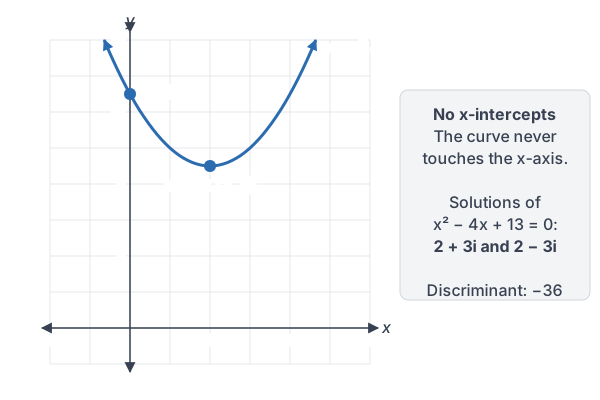
The equation still has two solutions. They are just not on the real number line, so the graph can’t show them as intercepts.
How to Find Complex Solutions
Start with the discriminant, b^2 - 4ac. Its sign tells you what kind of solutions to expect.
| Discriminant | Solutions | Graph |
|---|---|---|
| Positive | Two real solutions | Crosses the x-axis twice |
| Zero | One real solution | Touches the x-axis at the vertex |
| Negative | Two complex solutions | Never touches the x-axis |
When the discriminant is negative, use the quadratic formula and write the square root of the negative number with i.
x = \frac{-b \pm \sqrt{b^2 - 4ac}}{2a}The \pm gives one solution with a plus sign and one with a minus sign. So complex solutions come as a pair of complex conjugates, p + qi and p - qi, whenever a, b and c are real numbers.
If the equation has no x term, or it is already a square like (x + 2)^2 = -9, taking square roots is faster.
Worked Examples
Example 1: Use square roots
Solve x^2 + 25 = 0.
- Subtract 25 from both sides: x^2 = -25
- Take the square root of both sides (see solving quadratics with square roots): x = \pm\sqrt{-25}
- Split off the square root of −1 (see complex numbers): x = \pm\sqrt{25} \cdot \sqrt{-1}
- Simplify, using \sqrt{-1} = i: x = \pm 5i
Answer: x = 5i or x = -5i
Check: (5i)^2 + 25 = 25i^2 + 25 = -25 + 25 = 0. The same works for -5i.
Example 2: Square roots with a shift
Solve (x + 2)^2 + 9 = 0.
- Subtract 9 from both sides: (x + 2)^2 = -9
- Take the square root of both sides: x + 2 = \pm\sqrt{-9}
- Write the root with i: x + 2 = \pm 3i
- Subtract 2 from both sides: x = -2 \pm 3i
Answer: x = -2 + 3i or x = -2 - 3i
Example 3: Use the quadratic formula
Solve x^2 - 4x + 13 = 0. This is the equation of the graph above.
- Name the coefficients: a = 1, b = -4, c = 13
- Write the discriminant (see the discriminant): b^2 - 4ac = (-4)^2 - 4(1)(13)
- Square and multiply: 16 - 52
- Subtract: -36, which is negative, so expect complex solutions
- Write the quadratic formula (see quadratic formula): x = \frac{-b \pm \sqrt{b^2 - 4ac}}{2a}
- Substitute: x = \frac{-(-4) \pm \sqrt{-36}}{2(1)}
- Simplify the top and bottom: x = \frac{4 \pm \sqrt{-36}}{2}
- Write the root with i: x = \frac{4 \pm 6i}{2}
- Divide both parts by 2: x = 2 \pm 3i
Answer: x = 2 + 3i or x = 2 - 3i
Check x = 2 + 3i by putting it back into the equation:
- Substitute: (2 + 3i)^2 - 4(2 + 3i) + 13
- Square the binomial (see special products of binomials): (4 + 12i + 9i^2) - 4(2 + 3i) + 13
- Replace i^2 with −1 (see operations with complex numbers): (4 + 12i - 9) - 4(2 + 3i) + 13
- Distribute the −4: 4 + 12i - 9 - 8 - 12i + 13
- Combine like terms: 0
Example 4: Complete the square
Solve x^2 + 6x + 14 = 0 by completing the square.
- Subtract 14 from both sides: x^2 + 6x = -14
- Half of 6 is 3, and 3^2 = 9. Add 9 to both sides (see completing the square): x^2 + 6x + 9 = -14 + 9
- Add on the right: x^2 + 6x + 9 = -5
- Factor the left side (see perfect square trinomials): (x + 3)^2 = -5
- Take the square root of both sides: x + 3 = \pm\sqrt{-5}
- Write the root with i: x + 3 = \pm i\sqrt{5}
- Subtract 3 from both sides: x = -3 \pm i\sqrt{5}
Answer: x = -3 + i\sqrt{5} or x = -3 - i\sqrt{5}
We write i\sqrt{5} instead of \sqrt{5}i, so the i isn’t mistaken for part of the radical.
Example 5: Word problem with a thrown ball
A ball is thrown upward from 4 feet above the ground. Its height after t seconds is h = -16t^2 + 32t + 4 feet. Does the ball ever reach 30 feet?
- Set the height equal to 30: -16t^2 + 32t + 4 = 30
- Subtract 30 from both sides: -16t^2 + 32t - 26 = 0
- Divide every term by −2: 8t^2 - 16t + 13 = 0
- Name the coefficients: a = 8, b = -16, c = 13
- Write the discriminant: (-16)^2 - 4(8)(13)
- Square and multiply: 256 - 416
- Subtract: -160
- Substitute into the quadratic formula: t = \frac{16 \pm \sqrt{-160}}{16}
- Write the root with i: t = \frac{16 \pm i\sqrt{160}}{16}
- Simplify the radical (see simplifying square roots), since 160 = 16 \cdot 10: t = \frac{16 \pm 4i\sqrt{10}}{16}
- Divide both parts by 16: t = 1 \pm \frac{\sqrt{10}}{4}i
Answer: No. The solutions are complex, not real, so no real time gives a height of 30 feet. The ball never gets that high.
You can see why. The vertex is at t = 1, and h = -16(1)^2 + 32(1) + 4 = 20. The ball tops out at 20 feet.
Common Mistakes
| Mistake | Example of the error | Fix |
|---|---|---|
| Taking the root of a negative as a negative | \sqrt{-36} = -6 | \sqrt{-36} = \sqrt{36} \cdot \sqrt{-1} = 6i |
| Stopping at “no solution” | x^2 + 25 = 0 has no solution | It has no real solution. It has two complex solutions, \pm 5i. |
| Dividing only part of the top by the bottom | \frac{4 \pm 6i}{2} = 2 \pm 6i | Divide both parts: \frac{4}{2} \pm \frac{6i}{2} = 2 \pm 3i |
| Squaring a negative b wrong | (-4)^2 - 52 = -16 - 52 | (-4)^2 = 16, so the discriminant is 16 - 52 = -36. |
| Giving only one solution | x = 2 + 3i | Keep the \pm. The conjugate 2 - 3i is also a solution. |
Writing a Quadratic from Complex Solutions
You can also work backward. Suppose the solutions are 2 \pm 3i. Undo each step to rebuild the equation.
- Start with the solutions: x = 2 \pm 3i
- Subtract 2 from both sides: x - 2 = \pm 3i
- Square both sides: (x - 2)^2 = 9i^2
- Replace i^2 with −1: (x - 2)^2 = -9
- Expand the left side: x^2 - 4x + 4 = -9
- Add 9 to both sides: x^2 - 4x + 13 = 0
This is the equation from Example 3, so the steps check each other. You can also multiply (x - (2 + 3i))(x - (2 - 3i)) and get the same result.
Practice Problems
- Solve x^2 + 49 = 0.
- Solve 3x^2 + 36 = 0.
- Solve (x - 5)^2 = -36.
- Solve (x + 1)^2 + 8 = 0.
- Solve x^2 + 2x + 5 = 0 with the quadratic formula.
- Solve x^2 - 6x + 10 = 0 with the quadratic formula.
- Solve 2x^2 - 2x + 5 = 0 with the quadratic formula.
- Solve x^2 + 10x + 29 = 0 by completing the square.
- A rock is launched upward from the ground. Its height after t seconds is h = -16t^2 + 48t feet. Does it ever reach 40 feet? Use the discriminant and the quadratic formula.
- Write a quadratic equation whose solutions are 1 \pm 4i.
Show answers
- Subtract 49: x^2 = -49
Take the square root: x = \pm\sqrt{-49}
Write with i: x = \pm 7i - Subtract 36: 3x^2 = -36
Divide by 3: x^2 = -12
Take the square root: x = \pm\sqrt{-12}
Write with i: x = \pm i\sqrt{12}
Simplify the radical: x = \pm 2i\sqrt{3} - Take the square root: x - 5 = \pm\sqrt{-36}
Write with i: x - 5 = \pm 6i
Add 5: x = 5 \pm 6i - Subtract 8: (x + 1)^2 = -8
Take the square root: x + 1 = \pm\sqrt{-8}
Write with i: x + 1 = \pm i\sqrt{8}
Simplify the radical: x + 1 = \pm 2i\sqrt{2}
Subtract 1: x = -1 \pm 2i\sqrt{2} - Coefficients: a = 1, b = 2, c = 5
Discriminant: 2^2 - 4(1)(5)
Square and multiply: 4 - 20
Subtract: -16
Substitute: x = \frac{-2 \pm \sqrt{-16}}{2}
Write with i: x = \frac{-2 \pm 4i}{2}
Divide both parts by 2: x = -1 \pm 2i - Coefficients: a = 1, b = -6, c = 10
Discriminant: (-6)^2 - 4(1)(10)
Square and multiply: 36 - 40
Subtract: -4
Substitute: x = \frac{6 \pm \sqrt{-4}}{2}
Write with i: x = \frac{6 \pm 2i}{2}
Divide both parts by 2: x = 3 \pm i - Coefficients: a = 2, b = -2, c = 5
Discriminant: (-2)^2 - 4(2)(5)
Square and multiply: 4 - 40
Subtract: -36
Substitute: x = \frac{2 \pm \sqrt{-36}}{4}
Write with i: x = \frac{2 \pm 6i}{4}
Divide both parts by 4: x = \frac{1}{2} \pm \frac{3}{2}i - Subtract 29: x^2 + 10x = -29
Half of 10 is 5, and 5^2 = 25. Add 25: x^2 + 10x + 25 = -29 + 25
Add on the right: x^2 + 10x + 25 = -4
Factor: (x + 5)^2 = -4
Take the square root: x + 5 = \pm\sqrt{-4}
Write with i: x + 5 = \pm 2i
Subtract 5: x = -5 \pm 2i - Set the height to 40: -16t^2 + 48t = 40
Subtract 40: -16t^2 + 48t - 40 = 0
Divide by −8: 2t^2 - 6t + 5 = 0
Discriminant: (-6)^2 - 4(2)(5)
Square and multiply: 36 - 40
Subtract: -4
Substitute: t = \frac{6 \pm \sqrt{-4}}{4}
Write with i: t = \frac{6 \pm 2i}{4}
Divide both parts by 4: t = \frac{3}{2} \pm \frac{1}{2}i
Answer: No. The solutions are not real, so the rock never reaches 40 feet. (It tops out at 36 feet when t = 1.5.) - Start: x = 1 \pm 4i
Subtract 1: x - 1 = \pm 4i
Square both sides: (x - 1)^2 = 16i^2
Replace i^2 with −1: (x - 1)^2 = -16
Expand: x^2 - 2x + 1 = -16
Add 16: x^2 - 2x + 17 = 0
FAQ
Can a quadratic equation have complex solutions?
Yes. When the discriminant b^2 - 4ac is negative, the equation has two complex solutions and no real ones. For example, x^2 + 25 = 0 has the solutions \pm 5i.
How do you know if a quadratic has complex solutions?
Find the discriminant, b^2 - 4ac. If it is negative, the solutions are complex. On a graph, the parabola never touches the x-axis.
Why do complex solutions come in conjugate pairs?
The quadratic formula has a \pm in front of the square root. When the root is imaginary, the plus and minus give p + qi and p - qi. This is true whenever the coefficients are real.
Is “no real solutions” the same as “no solution”?
No. “No real solutions” means no x-intercepts. The equation still has two complex solutions. Only say “no solution” when a problem asks for real solutions only.
Summary
- A quadratic has complex solutions when its discriminant b^2 - 4ac is negative.
- Its graph never crosses or touches the x-axis.
- Use square roots, completing the square or the quadratic formula, then write \sqrt{-k} as i\sqrt{k}.
- Divide both the real part and the imaginary part by the bottom of the fraction.
- Complex solutions come in conjugate pairs, p \pm qi.
Previous lesson: Dividing Complex Numbers
Next lesson: Quadratic Inequalities
Back to the Algebra 2 Index