
Dividing Complex Numbers
Dividing complex numbers means writing a quotient like \dfrac{3 + 2i}{1 - i} in standard form, a + bi. To do it, multiply the top and bottom by the complex conjugate of the denominator. The bottom becomes a real number. Then you can split the fraction into a real part and an imaginary part.
Before this lesson: You should know Complex Numbers, Operations with Complex Numbers, Multiplying Binomials and Rationalizing the Denominator.
Why Division Needs a Trick
Standard form a + bi has no i in a denominator. So an answer like \dfrac{3 + 2i}{1 - i} is not finished. You need a way to get rid of the i on the bottom.
The trick is the complex conjugate. The conjugate of c + di is c - di. Only the sign of the imaginary part changes. When you multiply a number by its conjugate, the i terms cancel and the result is real.
(c + di)(c - di) = c^2 + d^2
This is the same idea as rationalizing a denominator like \dfrac{1}{3 - \sqrt{2}}. There you multiply by 3 + \sqrt{2} to clear the square root. Here you multiply by the conjugate to clear the i.
How to Divide Complex Numbers
To find \dfrac{a + bi}{c + di}, follow these steps.
- Find the conjugate of the denominator, c - di.
- Multiply the top and the bottom by that conjugate. This is the same as multiplying by 1, so the value does not change.
- Multiply out the top with FOIL. Replace i^2 with −1.
- Multiply out the bottom. It always comes out to c^2 + d^2, a real number.
- Split the fraction into a real part and an imaginary part. Simplify each fraction.
Here is the whole process in one line:
\frac{a + bi}{c + di} \cdot \frac{c - di}{c - di} = \frac{(ac + bd) + (bc - ad)i}{c^2 + d^2}You don’t need to memorize this formula. The steps above give the same result every time.
Two quick special cases
- Dividing by a real number: divide each part. For example, \dfrac{8 - 6i}{2} = 4 - 3i.
- Dividing by a pure imaginary number like 2i: multiply the top and bottom by i. Then i \cdot i = i^2 = -1, so the bottom becomes real.
Worked Examples
Example 1: Divide by a real number
Simplify \dfrac{10 - 15i}{5}.
- Split the fraction into two parts: \dfrac{10}{5} - \dfrac{15}{5}i
- Divide the real part: \dfrac{10}{5} = 2
- Divide the imaginary part: \dfrac{15}{5} = 3
- Write in standard form: 2 - 3i
Example 2: Divide by a pure imaginary number
Simplify \dfrac{6 + 4i}{2i}.
- Multiply the top and bottom by i: \dfrac{(6 + 4i) \cdot i}{2i \cdot i}
- Distribute on the top (see distributive property): 6i + 4i^2
- Replace i^2 with −1 on the top: 6i - 4, which is -4 + 6i
- Multiply the bottom: 2i \cdot i = 2i^2
- Replace i^2 with −1 on the bottom: 2(-1) = -2
- Now the quotient is \dfrac{-4 + 6i}{-2}
- Divide each part by −2 (see multiplying and dividing integers): \dfrac{-4}{-2} + \dfrac{6}{-2}i
- Simplify: 2 - 3i
- Check: (2 - 3i)(2i) = 4i - 6i^2 = 4i + 6, which is 6 + 4i. ✓
Example 3: Use the conjugate
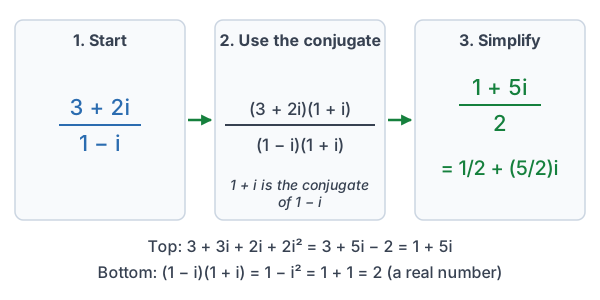
Simplify \dfrac{3 + 2i}{1 - i}. This is the example in the diagram.
- The denominator is 1 - i, so its conjugate is 1 + i
- Multiply the top and bottom by the conjugate: \dfrac{(3 + 2i)(1 + i)}{(1 - i)(1 + i)}
- FOIL the top (see multiplying binomials): 3 + 3i + 2i + 2i^2
- Combine the i terms (see combining like terms): 3 + 5i + 2i^2
- Replace i^2 with −1: 3 + 5i - 2
- Combine the real parts: 1 + 5i
- FOIL the bottom: 1 + i - i - i^2
- The i terms cancel: 1 - i^2
- Replace i^2 with −1: 1 - (-1)
- Simplify: 1 + 1 = 2
- Now the quotient is \dfrac{1 + 5i}{2}
- Split into two parts: \dfrac{1}{2} + \dfrac{5}{2}i
Example 4: An answer with fractions
Simplify \dfrac{5 + i}{3 - 4i}.
- The conjugate of 3 - 4i is 3 + 4i
- Multiply the top and bottom by the conjugate: \dfrac{(5 + i)(3 + 4i)}{(3 - 4i)(3 + 4i)}
- FOIL the top: 15 + 20i + 3i + 4i^2
- Combine the i terms: 15 + 23i + 4i^2
- Replace i^2 with −1: 15 + 23i - 4
- Combine the real parts: 11 + 23i
- Use the conjugate rule on the bottom: 3^2 + 4^2
- Square each number: 9 + 16
- Add: 25
- Now the quotient is \dfrac{11 + 23i}{25}
- Split into two parts: \dfrac{11}{25} + \dfrac{23}{25}i
- Neither fraction can be reduced, so the answer is \dfrac{11}{25} + \dfrac{23}{25}i
Example 5: Word problem (electric current)
In AC circuits, engineers use complex numbers. Current equals voltage divided by impedance, I = \dfrac{V}{Z}. A circuit has voltage V = 10 + 5i volts and impedance Z = 3 + 4i ohms. Find the current.
- Set up the division: I = \dfrac{10 + 5i}{3 + 4i}
- The conjugate of 3 + 4i is 3 - 4i
- Multiply the top and bottom by the conjugate: \dfrac{(10 + 5i)(3 - 4i)}{(3 + 4i)(3 - 4i)}
- FOIL the top: 30 - 40i + 15i - 20i^2
- Combine the i terms: 30 - 25i - 20i^2
- Replace i^2 with −1: 30 - 25i + 20
- Combine the real parts: 50 - 25i
- Use the conjugate rule on the bottom: 3^2 + 4^2 = 9 + 16 = 25
- Now the quotient is \dfrac{50 - 25i}{25}
- Divide each part by 25: \dfrac{50}{25} - \dfrac{25}{25}i
- Simplify: 2 - i
- Answer: the current is 2 - i amps.
- Check: (2 - i)(3 + 4i) = 6 + 8i - 3i - 4i^2 = 6 + 5i + 4 = 10 + 5i. ✓
Common Mistakes
| Mistake | Example of the error | Fix |
|---|---|---|
| Multiplying only the bottom by the conjugate | \dfrac{3 + 2i}{1 - i} = \dfrac{3 + 2i}{2} | Multiply the top and the bottom by the same conjugate. Otherwise you change the value. |
| Using the conjugate of the top instead of the bottom | Multiplying \dfrac{3 + 2i}{1 - i} by \dfrac{3 - 2i}{3 - 2i} | Always use the conjugate of the denominator. That is what makes the bottom real. |
| Getting c^2 - d^2 on the bottom | (3 - 4i)(3 + 4i) = 9 - 16 = -7 | The last term is -16i^2 = +16, so the bottom is 9 + 16 = 25. |
| Saying \dfrac{1}{i} = i | \dfrac{5}{i} = 5i | Multiply by \dfrac{i}{i}: \dfrac{5i}{i^2} = \dfrac{5i}{-1} = -5i. |
| Leaving one fraction over the whole answer | \dfrac{11 + 23i}{25} | Split it into \dfrac{11}{25} + \dfrac{23}{25}i so it is in a + bi form. |
Checking Your Answer and Other Shortcuts
- Check by multiplying. Division undoes multiplication. If \dfrac{p}{q} = r, then r \cdot q = p. Examples 2 and 5 show this check.
- Reciprocal of a complex number: \dfrac{1}{c + di} = \dfrac{c - di}{c^2 + d^2}. For example, \dfrac{1}{2 + i} = \dfrac{2 - i}{5}.
- Dividing by i: since \dfrac{1}{i} = -i, dividing by i is the same as multiplying by -i.
- Square roots of negatives: write \sqrt{-9} as 3i before you divide (see complex numbers).
Practice Problems
Write each answer in standard form, a + bi.
- Simplify \dfrac{18 - 6i}{6}.
- Simplify \dfrac{8 + 12i}{4i}.
- Simplify \dfrac{5}{i}.
- Simplify \dfrac{2 + 3i}{1 + i}.
- Simplify \dfrac{4 - 7i}{2 + 3i}.
- Find the reciprocal of 2 + i. That is, simplify \dfrac{1}{2 + i}.
- Simplify \dfrac{7 + i}{1 - 2i}.
- Simplify \dfrac{6 - 2i}{3 + 4i}.
- Simplify \dfrac{-3 + 5i}{-2 - i}.
- A circuit has voltage V = 17 + i volts and current I = 3 - i amps. Impedance is Z = \dfrac{V}{I}. Find the impedance.
Show answers
- Split into two parts: \dfrac{18}{6} - \dfrac{6}{6}i
Divide each part: 3 - 1i
Answer: 3 - i - Multiply the top and bottom by i: \dfrac{(8 + 12i) \cdot i}{4i \cdot i}
Distribute on the top: 8i + 12i^2
Replace i^2 with −1: 8i - 12, which is -12 + 8i
Multiply the bottom: 4i^2
Replace i^2 with −1: -4
Divide each part by −4: \dfrac{-12}{-4} + \dfrac{8}{-4}i
Answer: 3 - 2i - Multiply the top and bottom by i: \dfrac{5i}{i \cdot i}
Multiply the bottom: i^2
Replace i^2 with −1: \dfrac{5i}{-1}
Answer: -5i - The conjugate of 1 + i is 1 - i
Multiply top and bottom: \dfrac{(2 + 3i)(1 - i)}{(1 + i)(1 - i)}
FOIL the top: 2 - 2i + 3i - 3i^2
Combine the i terms: 2 + i - 3i^2
Replace i^2 with −1: 2 + i + 3
Combine the real parts: 5 + i
Bottom: 1^2 + 1^2 = 1 + 1 = 2
Split: \dfrac{5}{2} + \dfrac{1}{2}i - The conjugate of 2 + 3i is 2 - 3i
Multiply top and bottom: \dfrac{(4 - 7i)(2 - 3i)}{(2 + 3i)(2 - 3i)}
FOIL the top: 8 - 12i - 14i + 21i^2
Combine the i terms: 8 - 26i + 21i^2
Replace i^2 with −1: 8 - 26i - 21
Combine the real parts: -13 - 26i
Bottom: 2^2 + 3^2 = 4 + 9 = 13
Divide each part by 13: \dfrac{-13}{13} - \dfrac{26}{13}i
Answer: -1 - 2i - The conjugate of 2 + i is 2 - i
Multiply top and bottom: \dfrac{1(2 - i)}{(2 + i)(2 - i)}
Top: 2 - i
Bottom: 2^2 + 1^2 = 4 + 1 = 5
Split: \dfrac{2}{5} - \dfrac{1}{5}i - The conjugate of 1 - 2i is 1 + 2i
Multiply top and bottom: \dfrac{(7 + i)(1 + 2i)}{(1 - 2i)(1 + 2i)}
FOIL the top: 7 + 14i + i + 2i^2
Combine the i terms: 7 + 15i + 2i^2
Replace i^2 with −1: 7 + 15i - 2
Combine the real parts: 5 + 15i
Bottom: 1^2 + 2^2 = 1 + 4 = 5
Divide each part by 5: \dfrac{5}{5} + \dfrac{15}{5}i
Answer: 1 + 3i - The conjugate of 3 + 4i is 3 - 4i
Multiply top and bottom: \dfrac{(6 - 2i)(3 - 4i)}{(3 + 4i)(3 - 4i)}
FOIL the top: 18 - 24i - 6i + 8i^2
Combine the i terms: 18 - 30i + 8i^2
Replace i^2 with −1: 18 - 30i - 8
Combine the real parts: 10 - 30i
Bottom: 3^2 + 4^2 = 9 + 16 = 25
Split: \dfrac{10}{25} - \dfrac{30}{25}i
Reduce each fraction by 5 (see fractions): \dfrac{2}{5} - \dfrac{6}{5}i - The conjugate of -2 - i is -2 + i
Multiply top and bottom: \dfrac{(-3 + 5i)(-2 + i)}{(-2 - i)(-2 + i)}
FOIL the top: 6 - 3i - 10i + 5i^2
Combine the i terms: 6 - 13i + 5i^2
Replace i^2 with −1: 6 - 13i - 5
Combine the real parts: 1 - 13i
Bottom: (-2)^2 + 1^2 = 4 + 1 = 5
Split: \dfrac{1}{5} - \dfrac{13}{5}i - Set up: Z = \dfrac{17 + i}{3 - i}
The conjugate of 3 - i is 3 + i
Multiply top and bottom: \dfrac{(17 + i)(3 + i)}{(3 - i)(3 + i)}
FOIL the top: 51 + 17i + 3i + i^2
Combine the i terms: 51 + 20i + i^2
Replace i^2 with −1: 51 + 20i - 1
Combine the real parts: 50 + 20i
Bottom: 3^2 + 1^2 = 9 + 1 = 10
Divide each part by 10: \dfrac{50}{10} + \dfrac{20}{10}i
Answer: Z = 5 + 2i ohms
FAQ
How do you divide complex numbers?
Multiply the top and bottom by the conjugate of the denominator. Then simplify the top, simplify the bottom to a real number, and split the result into a + bi form.
Why do you multiply by the conjugate when dividing complex numbers?
A number times its conjugate is always real: (c + di)(c - di) = c^2 + d^2. Multiplying by the conjugate removes i from the denominator without changing the value.
What is 1 divided by i?
It is -i. Multiply the top and bottom by i to get \dfrac{i}{i^2} = \dfrac{i}{-1} = -i.
How do you check a complex division answer?
Multiply your answer by the denominator. If you get the numerator back, the answer is right.
Summary
- To divide complex numbers, multiply the top and bottom by the conjugate of the denominator.
- The conjugate of c + di is c - di, and their product is c^2 + d^2, a real number.
- Use FOIL on the top and replace i^2 with −1.
- To divide by a pure imaginary number like 2i, multiply the top and bottom by i.
- Split the result into a real part and an imaginary part, so the answer is in a + bi form.
- Next, you will use complex numbers to solve quadratic equations that have no real solutions, starting from the quadratic formula.
Previous lesson: Operations with Complex Numbers
Next lesson: Complex Solutions of Quadratic Equations
Back to the Algebra 2 Index