
Operations with Complex Numbers
Operations with complex numbers work like operations with binomials. To add or subtract, combine the real parts and combine the imaginary parts. To multiply, use the distributive property or FOIL, then replace i^2 with −1. Always write the answer in standard form, a + bi.
Before this lesson: You should know Complex Numbers, Combining Like Terms, Multiplying Binomials and Special Products of Binomials.
Treat i Like a Variable, Then Simplify
Think of i as a variable, like x. Then 3 + 5i works like 3 + 5x. You combine like terms and multiply binomials the same way.
There is one extra step. Whenever i^2 appears, replace it with −1. That turns the i^2 term into a real number.
Rules for Adding, Subtracting and Multiplying
Adding and subtracting
(a + bi) + (c + di) = (a + c) + (b + d)i
(a + bi) - (c + di) = (a - c) + (b - d)i
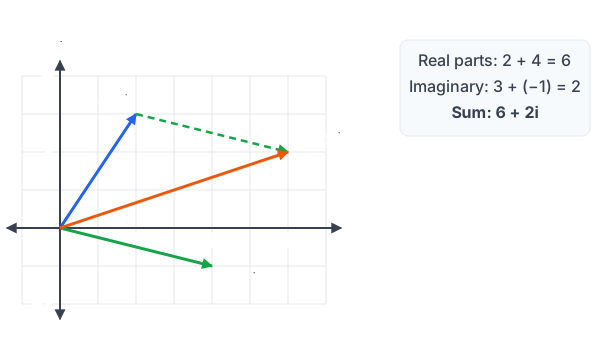
Adding complex numbers looks like adding arrows in the complex plane. Place the second arrow at the tip of the first. The sum is where you end up.
Multiplying
(a + bi)(c + di) = (ac - bd) + (ad + bc)i
You don’t need to memorize this formula. Just use FOIL and replace i^2 with −1.
Complex conjugates
The complex conjugate of a + bi is a - bi. Only the sign of the imaginary part changes. A number times its conjugate is always a real number.
(a + bi)(a - bi) = a^2 + b^2
Worked Examples
Example 1: Add and subtract
Simplify (a) (3 + 5i) + (2 - 8i) and (b) (7 - 2i) - (4 - 6i).
- (a) Group the real parts and the imaginary parts (see combining like terms): (3 + 2) + (5 - 8)i
- Add: 5 - 3i
- (b) Distribute the minus sign to both parts: 7 - 2i - 4 + 6i
- Group the real parts and the imaginary parts: (7 - 4) + (-2 + 6)i
- Simplify: 3 + 4i
Answer: (a) 5 - 3i (b) 3 + 4i
Example 2: Multiply by an imaginary number
Simplify 3i(4 - 2i).
- Distribute 3i (see distributive property): 3i \cdot 4 - 3i \cdot 2i
- Multiply: 12i - 6i^2
- Replace i^2 with −1: 12i - 6(-1)
- Simplify: 12i + 6
- Write in standard form: 6 + 12i
Answer: 6 + 12i
Example 3: Multiply two complex numbers
Simplify (2 + 3i)(4 - i).
- Use FOIL (see multiplying binomials): 2 \cdot 4 + 2(-i) + 3i \cdot 4 + 3i(-i)
- Multiply each pair: 8 - 2i + 12i - 3i^2
- Combine the i terms: 8 + 10i - 3i^2
- Replace i^2 with −1: 8 + 10i - 3(-1)
- Simplify: 8 + 10i + 3
- Combine the real parts: 11 + 10i
Answer: 11 + 10i
Example 4: Conjugates and squares
Simplify (a) (5 + 2i)(5 - 2i) and (b) (3 - 4i)^2.
- (a) The two numbers are conjugates. FOIL: 25 - 10i + 10i - 4i^2
- The i terms cancel: 25 - 4i^2
- Replace i^2 with −1: 25 - 4(-1)
- Simplify: 25 + 4 = 29
- (b) Write the square as a product: (3 - 4i)(3 - 4i)
- FOIL: 9 - 12i - 12i + 16i^2
- Combine the i terms: 9 - 24i + 16i^2
- Replace i^2 with −1: 9 - 24i - 16
- Combine the real parts: -7 - 24i
Answer: (a) 29 (b) -7 - 24i
Part (a) checks the conjugate rule: 5^2 + 2^2 = 25 + 4 = 29.
Example 5: Word problem with an electric circuit
In an AC circuit, two parts in a row (in series) have impedances Z_1 = 4 + 3i ohms and Z_2 = 6 - 8i ohms. The total impedance is their sum. The voltage is V = IZ, where I is the current. If the current is I = 2 - i amps, find the total impedance and the voltage.
- Add the impedances: Z = (4 + 3i) + (6 - 8i)
- Group the parts: (4 + 6) + (3 - 8)i
- Simplify: Z = 10 - 5i ohms
- Write the voltage formula: V = (2 - i)(10 - 5i)
- FOIL: 20 - 10i - 10i + 5i^2
- Combine the i terms: 20 - 20i + 5i^2
- Replace i^2 with −1: 20 - 20i - 5
- Combine the real parts: 15 - 20i
Answer: The total impedance is 10 - 5i ohms, and the voltage is 15 - 20i volts.
Common Mistakes
| Mistake | Example of the error | Fix |
|---|---|---|
| Not distributing the minus sign | (7 - 2i) - (4 - 6i) = 3 - 8i | Subtract both parts: -(4 - 6i) = -4 + 6i, so the answer is 3 + 4i. |
| Leaving i^2 in the answer | 8 + 10i - 3i^2 | Replace i^2 with −1 and combine: 11 + 10i. |
| Replacing i^2 with 1 | -3i^2 = -3 | -3i^2 = -3(-1) = 3 |
| Squaring each part separately | (3 + 4i)^2 = 9 + 16i^2 = -7 | Use FOIL. The middle term 24i is missing: (3 + 4i)^2 = -7 + 24i. |
| Combining real and imaginary parts | 5 - 3i = 2i | Real and imaginary parts are unlike terms. 5 - 3i is already simplified. |
Practice Problems
- Simplify (6 + 2i) + (-1 + 7i).
- Simplify (8 - 3i) - (2 + 5i).
- Simplify (-4 + i) - (-9 - 6i).
- Simplify 2i(5 + 3i).
- Simplify (1 + 4i)(3 - 2i).
- Simplify (6 - i)(2 + 5i).
- Simplify (4 + 7i)(4 - 7i).
- Simplify (2 + 5i)^2.
- Simplify \sqrt{-9} \cdot \sqrt{-16}.
- Two circuit parts in series have impedances 3 + 2i and 5 - 7i ohms. The current is 1 + 2i amps. Find the total impedance and the voltage V = IZ.
Show answers
- Group: (6 - 1) + (2 + 7)i
Answer: 5 + 9i - Distribute the minus sign: 8 - 3i - 2 - 5i
Group: (8 - 2) + (-3 - 5)i
Answer: 6 - 8i - Distribute the minus sign: -4 + i + 9 + 6i
Group: (-4 + 9) + (1 + 6)i
Answer: 5 + 7i - Distribute: 10i + 6i^2
Replace i^2: 10i - 6
Answer: -6 + 10i - FOIL: 3 - 2i + 12i - 8i^2
Combine i terms: 3 + 10i - 8i^2
Replace i^2: 3 + 10i + 8
Answer: 11 + 10i - FOIL: 12 + 30i - 2i - 5i^2
Combine i terms: 12 + 28i - 5i^2
Replace i^2: 12 + 28i + 5
Answer: 17 + 28i - FOIL: 16 - 28i + 28i - 49i^2
The i terms cancel: 16 - 49i^2
Replace i^2: 16 + 49
Answer: 65 - Write as a product: (2 + 5i)(2 + 5i)
FOIL: 4 + 10i + 10i + 25i^2
Combine i terms: 4 + 20i + 25i^2
Replace i^2: 4 + 20i - 25
Answer: -21 + 20i - Write each root with i first: \sqrt{-9} = 3i and \sqrt{-16} = 4i
Multiply: 3i \cdot 4i = 12i^2
Replace i^2: 12(-1) = -12 - Add: (3 + 5) + (2 - 7)i = 8 - 5i ohms
Voltage: V = (1 + 2i)(8 - 5i)
FOIL: 8 - 5i + 16i - 10i^2
Combine i terms: 8 + 11i - 10i^2
Replace i^2: 8 + 11i + 10
Answer: 18 + 11i volts
FAQ
How do you add complex numbers?
Add the real parts together and add the imaginary parts together. For example, (2 + 3i) + (4 - i) = 6 + 2i.
How do you multiply complex numbers?
Multiply them like binomials, using FOIL. Then replace i^2 with −1 and combine like terms.
What is the conjugate of a complex number?
The conjugate of a + bi is a - bi. Their product, a^2 + b^2, is always a real number. The next lesson, Dividing Complex Numbers, uses this to divide complex numbers.
Why does i squared equal −1?
That is how i is defined. It is the number whose square is −1, so i^2 = -1 by definition.
Summary
- To add or subtract complex numbers, combine the real parts and combine the imaginary parts.
- Distribute the minus sign to both parts when you subtract.
- To multiply, use the distributive property or FOIL, then replace i^2 with −1.
- The conjugate of a + bi is a - bi, and (a + bi)(a - bi) = a^2 + b^2.
- Write every answer in standard form, a + bi.
Previous lesson: Complex Numbers
Next lesson: Dividing Complex Numbers
Back to the Algebra 2 Index