
Rational Inequalities
To solve rational inequalities like \frac{x - 3}{x + 2} \gt 0, get 0 on one side and write the other side as a single fraction. Find the critical values, where the numerator is 0 or the denominator is 0. Test each interval between them on a sign chart, and never include a value that makes the denominator 0.
Before this lesson: You should know Polynomial Inequalities, Adding and Subtracting Rational Expressions and Graphing Rational Functions.
Why Rational Inequalities Need Care
A rational expression can change sign in two ways. It can pass through 0, where the numerator is 0. Or it can jump across a vertical asymptote, where the denominator is 0. Both kinds of points split the number line.
You might want to multiply both sides by the denominator to clear the fraction. Don’t. You don’t know if the denominator is positive or negative, so you don’t know whether to flip the inequality sign. A sign chart avoids that problem.
Steps for Solving a Rational Inequality
- Move every term to one side so the other side is 0.
- Combine everything into one fraction with a common denominator.
- Factor the numerator and the denominator.
- Find the critical values: zeros of the numerator and zeros of the denominator.
- Test a number in each interval to find the sign of the fraction.
- Pick the intervals you want. Include numerator zeros for \le or \ge. Never include denominator zeros.
Worked Examples
Example 1: A simple quotient
Solve \frac{x - 3}{x + 2} \gt 0.
The numerator is 0 at x = 3, and the denominator is 0 at x = -2
\frac{-6}{-1} = 6Test x = -3 (positive).
\frac{-3}{2} = -1.5Test x = 0 (negative).
\frac{1}{6}Test x = 4 (positive).
Keep the positive intervals. The sign is \gt, so leave out 3, and −2 is never allowed
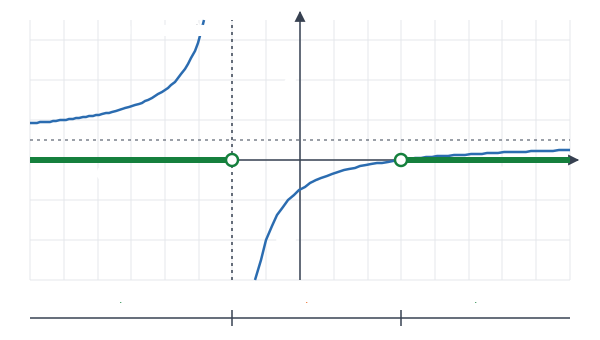
Answer: (-\infty, -2) \cup (3, \infty), matching the green parts of the graph above.
Example 2: Including a numerator zero
Solve \frac{x + 1}{x - 4} \le 0.
Critical values: x = -1 (numerator) and x = 4 (denominator)
\frac{-1}{-6} = \frac{1}{6}Test x = -2 (positive).
\frac{1}{-4} = -\frac{1}{4}Test x = 0 (negative).
\frac{6}{1} = 6Test x = 5 (positive).
Keep the negative interval. Include −1, since the fraction is 0 there and the sign is \le. Exclude 4, since the fraction is undefined there
Answer: [-1, 4)
Example 3: Get 0 on one side first
Solve \frac{2x}{x - 1} \ge 3.
\frac{2x}{x - 1} - 3 \ge 0Subtract 3 from both sides.
\frac{2x}{x - 1} - \frac{3(x - 1)}{x - 1} \ge 0Write 3 with the common denominator.
\frac{2x - 3x + 3}{x - 1} \ge 0Combine the numerators.
\frac{-x + 3}{x - 1} \ge 0Simplify.
Critical values: x = 3 (numerator) and x = 1 (denominator)
Test x = 0: \frac{3}{-1} = -3, negative. Test x = 2: \frac{1}{1} = 1, positive. Test x = 4: \frac{-1}{3}, negative
Keep the positive interval, include 3, and exclude 1
Answer: (1, 3]. Check x = 2: \frac{4}{1} = 4, and 4 \ge 3 is true.
Example 4: A factored numerator
Solve \frac{x^2 - x - 6}{x - 1} \ge 0.
\frac{(x - 3)(x + 2)}{x - 1} \ge 0Factor the numerator (see factoring trinomials)
Critical values: −2 and 3 (numerator), 1 (denominator)
\frac{(-6)(-1)}{-4} = -1.5Test x = -3 (negative).
\frac{(-3)(2)}{-1} = 6Test x = 0 (positive).
\frac{(-1)(4)}{1} = -4Test x = 2 (negative).
\frac{(1)(6)}{3} = 2Test x = 4 (positive).
Keep the positive intervals, include −2 and 3, and exclude 1
Answer: [-2, 1) \cup [3, \infty)
Example 5: Word problem with average cost
A shop’s cost to make x mugs is 5x + 400 dollars, so the average cost per mug is A(x) = \frac{5x + 400}{x}. How many mugs must it make for the average cost to be at most 9 dollars?
\frac{5x + 400}{x} \le 9Set up the inequality.
\frac{5x + 400}{x} - \frac{9x}{x} \le 0Subtract 9.
\frac{400 - 4x}{x} \le 0Combine.
Critical values: x = 100 (numerator) and x = 0 (denominator)
Only x \gt 0 makes sense. Test x = 50: \frac{200}{50} = 4, positive. Test x = 200: \frac{-400}{200} = -2, negative
Keep the negative part with x \gt 0, and include 100
Answer: at least 100 mugs. Check: A(100) = \frac{900}{100} = 9.
Common Mistakes
| Mistake | Example of the error | Fix |
|---|---|---|
| Multiplying by the denominator | Turning \frac{2x}{x - 1} \ge 3 into 2x \ge 3(x - 1) | The sign of x - 1 is unknown. Subtract 3 and use a sign chart. |
| Including a denominator zero | [-1, 4] for \frac{x + 1}{x - 4} \le 0 | The fraction is undefined at 4, so use [-1, 4). |
| Forgetting denominator zeros as critical values | Testing only around x = 3 in \frac{x - 3}{x + 2} \gt 0 | The sign can also change at x = -2. |
| Subtracting without a common denominator | \frac{2x}{x - 1} - 3 = \frac{2x - 3}{x - 1} | Write 3 as \frac{3(x - 1)}{x - 1} first. |
| Cross-multiplying | \frac{x + 2}{x - 1} \ge 2 becomes x + 2 \ge 2x - 2 | Only safe if you know the denominator is positive. Use a sign chart. |
Related Methods
Read the graph
Graph y = the fraction and look where it is above or below the x-axis. Vertical asymptotes show the denominator zeros, as in the picture above.
Even powers
As with polynomial inequalities, a factor with an even power, like (x - 3)^2, does not change the sign. It only adds a zero, or a break if it is in the denominator.
Rational equations first
Solving the matching equation, as in solving rational equations, gives the numerator zeros. The inequality then asks which intervals between them work.
Practice Problems
- Solve \frac{x + 5}{x - 2} \lt 0.
- Solve \frac{x - 4}{x + 3} \ge 0.
- Solve \frac{x}{x - 6} \le 0.
- Solve \frac{3}{x - 2} \gt 0.
- Solve \frac{x + 2}{x - 1} \ge 2.
- Solve \frac{1}{x} \lt 4.
- Solve \frac{(x - 1)(x + 4)}{x + 2} \le 0.
- Solve \frac{(x - 3)^2}{x + 1} \gt 0.
- Solve \frac{x^2 + 4}{x - 5} \lt 0.
- A tank holds 50 L of water. Adding x liters of brine makes the salt concentration C(x) = \frac{2x}{50 + x} kg per liter. How much brine is needed for a concentration of at least 0.5 kg per liter?
Show answers
1.
Critical values: −5 (top), 2 (bottom)
+, -, +
Signs, testing −6, 0, 3.
Answer: (-5, 2)
2.
Critical values: 4 (top), −3 (bottom)
+, -, +
Signs, testing −4, 0, 5.
Include 4, exclude −3
Answer: (-\infty, -3) \cup [4, \infty)
3.
Critical values: 0 (top), 6 (bottom)
+, -, +
Signs, testing −1, 1, 7.
Answer: [0, 6)
4.
The top, 3, is always positive, so the fraction is positive exactly when x - 2 \gt 0
Answer: (2, \infty)
5.
\frac{x + 2}{x - 1} - \frac{2(x - 1)}{x - 1} \ge 0Subtract 2.
\frac{x + 2 - 2x + 2}{x - 1} = \frac{4 - x}{x - 1} \ge 0Combine.
-, +, -
Critical values: 4 (top), 1 (bottom); signs, testing 0, 2, 5.
Answer: (1, 4]
6.
\frac{1}{x} - \frac{4x}{x} \lt 0Subtract 4.
\frac{1 - 4x}{x} \lt 0Write it as one fraction.
Critical values: \frac{1}{4} (top), 0 (bottom); signs, testing −1, 0.1, 1: -, +, -
Answer: (-\infty, 0) \cup (\frac{1}{4}, \infty)
7.
Critical values: −4 and 1 (top), −2 (bottom)
-, +, -, +
Signs, testing −5, −3, 0, 2.
Include −4 and 1, exclude −2
Answer: (-\infty, -4] \cup (-2, 1]
8.
(x - 3)^2 is positive except at x = 3, where the fraction is 0
So the fraction is positive when x + 1 \gt 0 and x \ne 3
Answer: (-1, 3) \cup (3, \infty)
9.
x^2 + 4 is always positive
So the fraction is negative exactly when x - 5 \lt 0
Answer: (-\infty, 5)
10.
\frac{2x}{50 + x} \ge 0.5Set up.
\frac{2x - 0.5(50 + x)}{50 + x} = \frac{1.5x - 25}{50 + x} \ge 0Subtract 0.5.
1.5x \ge 25
For x \ge 0, the bottom is positive, so the top must be at least 0.
x \ge \frac{50}{3} \approx 16.7Divide by 1.5.
Answer: at least about 16.7 L of brine
FAQ
How do you solve a rational inequality?
Get 0 on one side, combine into one fraction, and find where the top or bottom is 0. Test each interval on a sign chart and keep the ones that work.
Why can’t you multiply both sides by the denominator?
If the denominator is negative, multiplying would require flipping the inequality sign. Since its sign changes with x, a sign chart is safer.
Do you include the zeros of the denominator?
Never. The fraction is undefined there, so those values always get parentheses, even with \le or \ge.
What are critical values?
They are the numbers where the numerator or the denominator equals 0. They are the only places where a rational expression can change sign.
Summary
- Get 0 on one side and combine into a single fraction.
- Critical values are the zeros of the top and the bottom.
- Test one number in each interval on a sign chart.
- Include top zeros for \le and \ge; never include bottom zeros.
- Don’t multiply both sides by an expression whose sign you don’t know.
Previous lesson: Slant Asymptotes
Next lesson: Partial Fraction Decomposition
Back to the Precalculus Index