
Polynomial Inequalities
To solve polynomial inequalities like (x - 1)(x + 2)(x - 4) \gt 0, move every term to one side, factor, and find the zeros. The zeros split the number line into intervals where the polynomial keeps one sign. Test one number in each interval with a sign chart, then keep the intervals that make the inequality true.
Before this lesson: You should know Quadratic Inequalities, Solving Polynomial Equations and Compound Inequalities.
Why a Sign Chart Works
A polynomial’s graph is smooth and unbroken. To go from positive to negative, it has to pass through 0. So between two neighboring zeros, the polynomial can’t change sign.
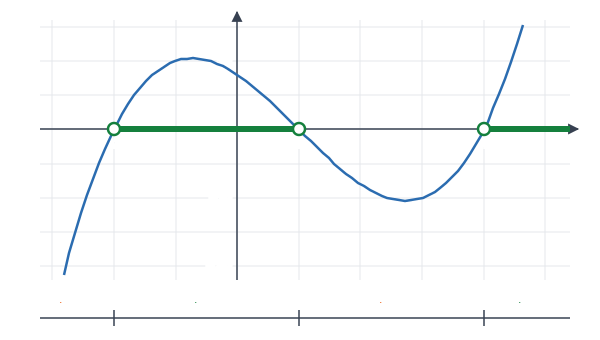
That means you never have to test every number. Find the zeros, then test one number in each interval. Its sign is the sign for the whole interval. The solution of p(x) \gt 0 is where the graph sits above the x-axis, and p(x) \lt 0 is where it sits below.
Steps for Solving a Polynomial Inequality
- Move every term to one side so the other side is 0.
- Factor the polynomial completely (see factoring completely).
- Find the zeros. Put them in order on a number line.
- Pick a test number in each interval and find the sign of each factor, then of the product.
- Choose the intervals with the sign you want. Include the zeros for \le or \ge, and leave them out for \lt or \gt.
- Write the answer in interval notation.
Sign shortcut: at a zero from a factor with an odd power, like (x - 1) or (x - 1)^3, the sign changes. At a zero from an even power, like (x - 2)^2, the sign stays the same.
Worked Examples
Example 1: A factored cubic
Solve (x - 1)(x + 2)(x - 4) \gt 0.
The zeros are x = 1, x = -2 and x = 4. In order: −2, 1, 4
(-4)(-1)(-7) = -28
Test x = -3 (negative).
(-1)(2)(-4) = 8
Test x = 0 (positive).
(1)(4)(-2) = -8
Test x = 2 (negative).
(4)(7)(1) = 28
Test x = 5 (positive).
Keep the positive intervals. The sign is \gt, so leave out the zeros
Answer: (-2, 1) \cup (4, \infty), as shown by the green parts of the graph above.
Example 2: Factor first
Solve x^3 - 9x \le 0.
x(x^2 - 9) \le 0
Factor out x.
x(x - 3)(x + 3) \le 0
Factor the difference of squares (see factoring the difference of squares)
The zeros are −3, 0 and 3
(-4)(-7)(-1) = -28
Test x = -4 (negative).
(-1)(-4)(2) = 8
Test x = -1 (positive).
(1)(-2)(4) = -8
Test x = 1 (negative).
(4)(1)(7) = 28
Test x = 4 (positive).
Keep the negative intervals, and include the zeros because the sign is \le
Answer: (-\infty, -3] \cup [0, 3]
Example 3: Move everything to one side
Solve x^3 + 2x^2 \ge 3x.
x^3 + 2x^2 - 3x \ge 0
Subtract 3x from both sides.
x(x^2 + 2x - 3) \ge 0
Factor out x.
x(x + 3)(x - 1) \ge 0
Factor the trinomial (see factoring trinomials)
The zeros are −3, 0 and 1
-, +, -, +
Signs from left to right, testing −4, −1, 0.5 and 2.
Keep the positive intervals and include the zeros
Answer: [-3, 0] \cup [1, \infty). Don’t divide both sides by x; you don’t know its sign, and you would lose the zero at 0.
Example 4: A repeated factor
Solve (x - 2)^2 (x + 1) \lt 0.
The zeros are x = 2 (from a squared factor) and x = -1
(-4)^2(-1) = 16(-1) = -16
Test x = -2 (negative).
(-2)^2(1) = 4
Test x = 0 (positive).
Test x = 3: (1)^2(4) = 4, positive. The sign does not change at 2, because the factor is squared
Keep the negative interval, and leave out the zeros
Answer: (-\infty, -1). The point x = 2 makes the product 0, not negative, so it is not included.
Example 5: Word problem with a box
Squares of side x inches are cut from the corners of a 12-by-10 inch sheet to make an open box with volume V(x) = 4x^3 - 44x^2 + 120x. The cut must be between 0 and 5 inches. For which cuts is the volume more than 96 cubic inches?
4x^3 - 44x^2 + 120x \gt 96
Set up the inequality.
x^3 - 11x^2 + 30x - 24 \gt 0
Subtract 96 and divide by 4.
(x - 2)(x^2 - 9x + 12) \gt 0
Since x = 2 is a zero, factor with synthetic division.
Solve x^2 - 9x + 12 = 0 with the quadratic formula: x = \frac{9 \pm \sqrt{33}}{2}, about 1.63 and 7.37
V(1) = 1 \cdot 10 \cdot 8 = 80
Inside 0 \lt x \lt 5, the zeros are about 1.63 and 2. Test x = 1 (less than 96).
V(1.8) = 1.8 \cdot 8.4 \cdot 6.4 = 96.768
Test x = 1.8 (more than 96).
V(3) = 3 \cdot 6 \cdot 4 = 72
Test x = 3 (less than 96).
Answer: The volume is more than 96 cubic inches when 1.63 \lt x \lt 2, about. Only cuts in that narrow range work.
Common Mistakes
| Mistake | Example of the error | Fix |
|---|---|---|
| Not getting 0 on one side | Factoring x^3 + 2x^2 \ge 3x as it stands | Subtract 3x first, then factor. |
| Dividing by a variable | Dividing x^3 \ge 9x by x | You don’t know the sign of x. Factor it out instead. |
| Assuming signs always alternate | Writing -, +, - for (x - 2)^2(x + 1) | At a squared factor, the sign stays the same. Test each interval. |
| Wrong brackets at the zeros | [-2, 1] for a strict \gt | Use parentheses for \lt and \gt, brackets for \le and \ge. |
| Bracket at infinity | [4, \infty] | Infinity always gets a parenthesis: [4, \infty). |
Related Methods
Use the graph
Graph y = p(x) and look at where it is above or below the x-axis. The x-intercepts are the zeros, and the graph shows the signs at once, as in the picture above.
End behavior shortcut
The sign on the far right matches the sign of the leading coefficient. For x^3 - 9x, it is positive on the far right. Then use the odd/even power rule to move left across each zero.
Quadratic inequalities
A degree-2 inequality is the simplest case of this method. See quadratic inequalities for more practice.
Practice Problems
- Solve (x + 3)(x - 2)(x - 5) \lt 0.
- Solve x(x - 4)(x + 1) \ge 0.
- Solve x^3 - 4x \gt 0.
- Solve x^3 - x^2 - 6x \le 0.
- Solve (x + 1)^2(x - 3) \ge 0.
- Solve x^4 - 5x^2 + 4 \lt 0.
- Solve x^3 \ge 2x^2 + 8x.
- Solve (x^2 + 1)(x - 5) \lt 0.
- Solve x^3 + 1 \gt 0.
- A company’s profit is P(x) = -x(x - 2)(x - 8) thousand dollars when it makes x thousand units, for 0 \le x \le 10. For which values of x is the profit positive?
Show answers
1.
Zeros: −3, 2, 5
-, +, -, +
Signs from left, testing −4, 0, 3, 6.
Keep the negative intervals, no endpoints
Answer: (-\infty, -3) \cup (2, 5)
2.
Zeros: −1, 0, 4
-, +, -, +
Signs, testing −2, −0.5, 1, 5.
Keep the positive intervals with endpoints
Answer: [-1, 0] \cup [4, \infty)
3.
Factor: x(x - 2)(x + 2) \gt 0; zeros −2, 0, 2
-, +, -, +
Signs, testing −3, −1, 1, 3.
Answer: (-2, 0) \cup (2, \infty)
4.
Factor: x(x^2 - x - 6) = x(x - 3)(x + 2) \le 0; zeros −2, 0, 3
-, +, -, +
Signs, testing −3, −1, 1, 4.
Answer: (-\infty, -2] \cup [0, 3]
5.
Zeros: −1 (squared) and 3
Signs, testing −2, 0, 4: -, -, +. No sign change at −1
Include the zeros because the sign is \ge
Answer: \{-1\} \cup [3, \infty)
6.
(x^2 - 1)(x^2 - 4) = (x - 1)(x + 1)(x - 2)(x + 2) \lt 0
Factor as a quadratic in x^2.
Zeros: −2, −1, 1, 2
+, -, +, -, +
Signs, testing −3, −1.5, 0, 1.5, 3.
Answer: (-2, -1) \cup (1, 2)
7.
x^3 - 2x^2 - 8x \ge 0
Move terms.
Factor: x(x - 4)(x + 2) \ge 0; zeros −2, 0, 4
-, +, -, +
Signs, testing −3, −1, 1, 5.
Answer: [-2, 0] \cup [4, \infty)
8.
x^2 + 1 is always positive, so it never changes the sign
The product is negative exactly when x - 5 \lt 0
Answer: (-\infty, 5)
9.
(x + 1)(x^2 - x + 1) \gt 0
Factor the sum of cubes (see sum and difference of cubes)
x^2 - x + 1 has discriminant 1 - 4 = -3 \lt 0, so it is always positive
So the product is positive when x + 1 \gt 0
Answer: (-1, \infty)
10.
Zeros in [0, 10]: 0, 2, 8
-1(-1)(-7) = -7
Test x = 1 (negative).
-5(3)(-3) = 45
Test x = 5 (positive).
-9(7)(1) = -63
Test x = 9 (negative).
Answer: profit is positive for 2 \lt x \lt 8, between 2,000 and 8,000 units
FAQ
How do you solve a polynomial inequality?
Get 0 on one side, factor, and find the zeros. Test a number in each interval between zeros, then keep the intervals with the sign you need.
When do you include the zeros in the answer?
Include them for \le and \ge, because the polynomial equals 0 there. Leave them out for \lt and \gt.
Why doesn’t the sign change at some zeros?
If a factor is raised to an even power, like (x - 2)^2, it is never negative. The graph touches the x-axis there and bounces back, so the sign stays the same.
What is a sign chart?
It is a number line marked with the zeros, showing whether the polynomial is positive or negative on each interval. It turns the inequality into a quick reading exercise.
Summary
- Get 0 on one side and factor completely.
- The zeros split the number line into intervals with one sign each.
- Test one number per interval, or use the end-behavior and odd/even power shortcut.
- Brackets for \le and \ge; parentheses for \lt, \gt and infinity.
- Never divide by a variable expression; factor it out instead.
Previous lesson: Descartes’ Rule of Signs
Next lesson: Slant Asymptotes
Back to the Precalculus Index