
Slant Asymptotes
A slant asymptote (or oblique asymptote) is a slanted line y = mx + b that the graph of a rational function approaches as x goes to \infty or -\infty. It happens when the numerator’s degree is exactly one more than the denominator’s. To find it, divide the numerator by the denominator; the quotient, without the remainder, is the asymptote.
Before this lesson: You should know Graphing Rational Functions, Polynomial Long Division and Synthetic Division.
Why Some Graphs Have a Slant Asymptote
Division splits a rational function into a polynomial part plus a leftover fraction. For example, \frac{x^2 + 3x + 5}{x + 1} = x + 2 + \frac{3}{x + 1}.
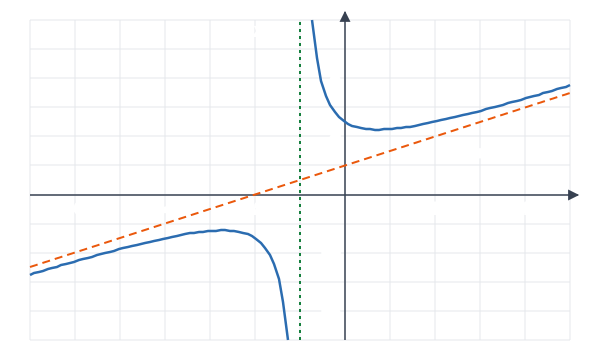
As x gets very large, positive or negative, the leftover fraction \frac{3}{x + 1} shrinks toward 0. So the graph gets closer and closer to the line y = x + 2. That line is the slant asymptote.
If the top’s degree is one more than the bottom’s, the polynomial part is a line, so the asymptote is slanted. If the degrees are equal, the polynomial part is a constant, which gives a horizontal asymptote instead.
How to Find a Slant Asymptote
- Compare degrees. A slant asymptote exists only if the degree of the numerator is exactly 1 more than the degree of the denominator (and the fraction is in lowest terms).
- Divide the numerator by the denominator. Use synthetic division if the denominator is x - c, and long division otherwise.
- Write the result as quotient plus remainder over the denominator.
- The slant asymptote is y = the quotient. Ignore the remainder.
| Degree of top vs. bottom | End behavior |
|---|---|
| Top less than bottom | Horizontal asymptote y = 0 |
| Equal degrees | Horizontal asymptote y = ratio of leading coefficients |
| Top is 1 more | Slant asymptote y = quotient |
| Top is 2 or more more | No line asymptote; the graph follows a curve like a parabola |
Worked Examples
Example 1: Synthetic division
Find the slant asymptote of f(x) = \frac{x^2 + 3x + 5}{x + 1}.
Compare degrees: the top is degree 2 and the bottom is degree 1, so there is a slant asymptote
The bottom is x - (-1), so use synthetic division with -1 and coefficients 1, 3, 5
Bring down 1. Multiply 1 \cdot (-1) = -1; add 3 + (-1) = 2
Multiply 2 \cdot (-1) = -2; add 5 + (-2) = 3, the remainder
f(x) = x + 2 + \frac{3}{x + 1}Write the result.
Answer: y = x + 2. The graph above also has the vertical asymptote x = -1.
Example 2: A steeper slant
Find the slant asymptote of f(x) = \frac{2x^2 - 5x - 1}{x - 3}.
Degrees are 2 and 1, so there is a slant asymptote
Synthetic division with 3 and coefficients 2, -5, -1: bring down 2
Multiply 2 \cdot 3 = 6; add -5 + 6 = 1
Multiply 1 \cdot 3 = 3; add -1 + 3 = 2, the remainder
f(x) = 2x + 1 + \frac{2}{x - 3}Write the result.
Answer: y = 2x + 1
Example 3: Long division
Find the slant asymptote of f(x) = \frac{x^3 - 2x^2 + 4}{x^2 - 1}.
Degrees are 3 and 2, so there is a slant asymptote. The bottom is not x - c, so use long division
Divide the leading terms: \frac{x^3}{x^2} = x. Multiply: x(x^2 - 1) = x^3 - x
(x^3 - 2x^2 + 0x + 4) - (x^3 - x) = -2x^2 + x + 4
Subtract.
Divide the leading terms: \frac{-2x^2}{x^2} = -2. Multiply: -2(x^2 - 1) = -2x^2 + 2
(-2x^2 + x + 4) - (-2x^2 + 2) = x + 2
Subtract (the remainder).
f(x) = x - 2 + \frac{x + 2}{x^2 - 1}Write the result.
Answer: y = x - 2
Example 4: Where the graph crosses its asymptote
Does the graph of f(x) = \frac{x^3 - 2x^2 + 4}{x^2 - 1} from Example 3 ever cross its slant asymptote?
\frac{x + 2}{x^2 - 1} = 0The graph meets y = x - 2 exactly when the remainder part is 0.
x + 2 = 0
A fraction is 0 when its top is 0.
x = -2
Subtract 2 from both sides.
Check that the bottom is not 0 there: (-2)^2 - 1 = 3
y = -2 - 2 = -4
Find the point.
Answer: Yes, once, at (-2, -4). A graph can cross a slant asymptote; it only has to get close to it far out to the left and right.
Example 5: Word problem with average cost
A print shop’s cost to make x posters is C(x) = 0.5x^2 + 3x + 200 dollars, so the average cost per poster is A(x) = \frac{0.5x^2 + 3x + 200}{x}. Find the slant asymptote of A, and compare it with A(100).
A(x) = 0.5x + 3 + \frac{200}{x}Divide each term by x.
y = 0.5x + 3
The polynomial part is the asymptote.
0.5(100) + 3 + \frac{200}{100} = 50 + 3 + 2 = 55Find A(100).
The asymptote at x = 100 gives 0.5(100) + 3 = 53
Answer: y = 0.5x + 3. At 100 posters, the average cost is $55, just $2 above the asymptote, because the fixed $200 is spread over many posters.
Common Mistakes
| Mistake | Example of the error | Fix |
|---|---|---|
| Using the remainder in the asymptote | y = x + 2 + 3 | Drop the remainder: y = x + 2. |
| Looking for a slant asymptote when degrees are equal | Dividing \frac{x^2 + 1}{x^2 - 4} to get a slant line | Equal degrees give a horizontal asymptote, here y = 1. |
| Wrong number in synthetic division | Using +1 for the divisor x + 1 | Use the zero of the divisor: x + 1 = 0 gives -1. |
| Skipping a missing term | Dividing x^3 - 2x^2 + 4 with no 0x place | Write x^3 - 2x^2 + 0x + 4 so the columns line up. |
| Thinking the graph can’t cross it | Saying a slant asymptote is never touched | Set the remainder fraction equal to 0 to find any crossing. |
Related Methods
Holes first
Before dividing, factor and cancel any common factors. A canceled factor makes a hole, not an asymptote, as shown in graphing rational functions.
Other asymptotes
A rational function with a slant asymptote has no horizontal asymptote, but it can still have vertical asymptotes where the denominator is 0.
Quick check with large x
Plug in a large number like x = 1000. The function value should be close to the asymptote’s value. For Example 1, f(1000) \approx 1002.003 and 1000 + 2 = 1002.
Practice Problems
- Find the slant asymptote of f(x) = \frac{x^2 + 5x + 2}{x + 2}.
- Find the slant asymptote of f(x) = \frac{3x^2 - x + 4}{x - 1}.
- Find the slant asymptote of f(x) = \frac{x^2 - 4}{x + 1}.
- Find the slant asymptote of f(x) = \frac{2x^3 + x^2 - 3}{x^2 + 1}.
- Find the slant asymptote of f(x) = \frac{x^2 + 1}{2x - 4}.
- Does f(x) = \frac{x^2 + 1}{x^3 - 8} have a slant asymptote?
- Does f(x) = \frac{x^3 + 2}{x - 1} have a slant asymptote?
- Find all asymptotes of f(x) = \frac{x^2 - x - 6}{x - 1}.
- Where does f(x) = \frac{x^3 + x^2 + 2}{x^2 + 1} cross its slant asymptote?
- A delivery company’s average cost per mile is A(x) = \frac{0.02x^2 + 4x + 300}{x} dollars for an x-mile route. Find the slant asymptote and compare it with A(500).
Show answers
1.
Synthetic division with −2 and 1, 5, 2: bring down 1; 1(-2) = -2, 5 - 2 = 3; 3(-2) = -6, 2 - 6 = -4
x + 3 - \frac{4}{x + 2}Write the result: quotient plus remainder over the divisor.
Answer: y = x + 3
2.
Synthetic division with 1 and 3, -1, 4: bring down 3; 3(1) = 3, -1 + 3 = 2; 2(1) = 2, 4 + 2 = 6
3x + 2 + \frac{6}{x - 1}Write the result: quotient plus remainder over the divisor.
Answer: y = 3x + 2
3.
Synthetic division with −1 and 1, 0, -4: bring down 1; 1(-1) = -1, 0 - 1 = -1; -1(-1) = 1, -4 + 1 = -3
x - 1 - \frac{3}{x + 1}Write the result: quotient plus remainder over the divisor.
Answer: y = x - 1
4.
Long division: \frac{2x^3}{x^2} = 2x; subtract 2x(x^2 + 1) = 2x^3 + 2x to get x^2 - 2x - 3
Next: \frac{x^2}{x^2} = 1; subtract x^2 + 1 to get -2x - 4
2x + 1 + \frac{-2x - 4}{x^2 + 1}Write the result: quotient plus remainder over the divisor.
Answer: y = 2x + 1
5.
Long division: \frac{x^2}{2x} = \frac{x}{2}; subtract \frac{x}{2}(2x - 4) = x^2 - 2x to get 2x + 1
Next: \frac{2x}{2x} = 1; subtract 2x - 4 to get 5
\frac{x}{2} + 1 + \frac{5}{2x - 4}Write the result: quotient plus remainder over the divisor.
Answer: y = \frac{1}{2}x + 1
6.
The top has degree 2 and the bottom has degree 3, so the top is smaller
Answer: no; the horizontal asymptote is y = 0
7.
The top has degree 3 and the bottom has degree 1, a difference of 2
Answer: no; the graph follows a parabola far out instead of a line
8.
Vertical: the bottom is 0 at x = 1, and the top is 1 - 1 - 6 = -6, not 0, so x = 1 is a vertical asymptote
Synthetic division with 1 and 1, -1, -6: bring down 1; 1 - 1 = 0; 0 + (-6) = -6
x - \frac{6}{x - 1}Write the result: quotient plus remainder over the divisor.
Answer: vertical x = 1; slant y = x
9.
Long division: x(x^2 + 1) = x^3 + x; subtract to get x^2 - x + 2; then 1(x^2 + 1); subtract to get -x + 1
So f(x) = x + 1 + \frac{-x + 1}{x^2 + 1}, with slant asymptote y = x + 1
Set the remainder top to 0: -x + 1 = 0, so x = 1, and y = 1 + 1 = 2
Answer: at (1, 2)
10.
Divide each term by x: A(x) = 0.02x + 4 + \frac{300}{x}, so the asymptote is y = 0.02x + 4
A(500) = 0.02(500) + 4 + \frac{300}{500} = 10 + 4 + 0.6 = 14.6Find the average cost for 500 items.
The asymptote gives 0.02(500) + 4 = 14
Answer: y = 0.02x + 4; A(500) is $14.60 per mile, 60 cents above the asymptote
FAQ
How do you know if a function has a slant asymptote?
A rational function in lowest terms has one when the degree of the numerator is exactly 1 more than the degree of the denominator.
How do you find a slant asymptote?
Divide the numerator by the denominator with long or synthetic division. The quotient, without the remainder, is the equation of the slant asymptote.
Can a function have both a horizontal and a slant asymptote?
No. A rational function has at most one of them. Which one depends on comparing the degrees of the top and bottom.
Is an oblique asymptote the same as a slant asymptote?
Yes. “Oblique” and “slant” both mean the asymptote is a line that is neither horizontal nor vertical.
Summary
- A slant asymptote happens when the top’s degree is exactly 1 more than the bottom’s.
- Divide the top by the bottom; the quotient is the asymptote, y = mx + b.
- Use synthetic division for x - c, and long division otherwise.
- Drop the remainder from the asymptote’s equation.
- The graph can cross a slant asymptote where the remainder fraction equals 0.
Previous lesson: Polynomial Inequalities
Next lesson: Rational Inequalities
Back to the Precalculus Index