
Solving Polynomial Equations
Solving polynomial equations of degree 3 or higher works like solving quadratics: get 0 on one side, factor completely, and set each factor equal to zero. Useful tools are the GCF, grouping, quadratic form, the cube patterns and the factor theorem. Solutions may be real or complex.
Before this lesson: You should know Solving Quadratic Equations by Factoring, Factoring by Grouping, Sum and Difference of Cubes and Remainder and Factor Theorems.
The Big Idea: The Zero Product Property
If a product equals zero, at least one factor must be zero. That is the zero product property. It works for any number of factors, not just two.
So the whole job is to turn the polynomial into a product. Once x(x - 7)(x + 2) = 0, you can read the solutions right off: 0, 7 and −2. Each real solution is an x-intercept of the graph.
How to Solve a Polynomial Equation
- Move every term to one side so the other side is 0.
- Factor out the greatest common factor, if there is one.
- Factor what is left. Try grouping (4 terms), quadratic form (like x^4 and x^2), or the cube patterns.
- If nothing works, test possible zeros with the factor theorem and divide with synthetic division.
- Set each factor equal to zero and solve. Use the quadratic formula for any quadratic that won’t factor.
A polynomial equation of degree n has at most n real solutions. Counting complex solutions too, it has exactly n when repeated solutions are counted again.
Worked Examples
Example 1: Factor out the GCF
Solve x^3 - 5x^2 - 14x = 0.
- Factor out the GCF, x (see factoring out the GCF): x(x^2 - 5x - 14) = 0
- Factor the trinomial (see factoring trinomials): x(x - 7)(x + 2) = 0
- Set each factor equal to zero (see solving quadratic equations by factoring): x = 0, x - 7 = 0 or x + 2 = 0
- Solve each one: x = 0, x = 7 or x = -2
Answer: x = -2, 0, 7
Example 2: Factor by grouping
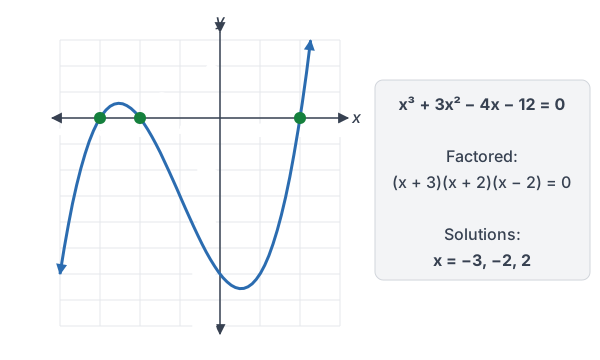
Solve x^3 + 3x^2 - 4x - 12 = 0. This is the graph above.
- Group the first two and last two terms: (x^3 + 3x^2) + (-4x - 12) = 0
- Factor each group (see factoring by grouping): x^2(x + 3) - 4(x + 3) = 0
- Factor out (x + 3): (x^2 - 4)(x + 3) = 0
- Factor the difference of squares (see factoring the difference of squares): (x - 2)(x + 2)(x + 3) = 0
- Set each factor equal to zero: x = 2, x = -2 or x = -3
Answer: x = -3, -2, 2
Example 3: Quadratic form
Solve x^4 - 13x^2 + 36 = 0.
This is in quadratic form: the powers are x^4 = (x^2)^2 and x^2. Let u = x^2.
- Substitute u = x^2: u^2 - 13u + 36 = 0
- Factor the trinomial: (u - 4)(u - 9) = 0
- Solve for u: u = 4 or u = 9
- Replace u with x^2: x^2 = 4 or x^2 = 9
- Take square roots (see solving quadratics with square roots): x = \pm 2 or x = \pm 3
Answer: x = -3, -2, 2, 3. A degree-4 equation, four solutions.
Example 4: Cubes and complex solutions
Solve x^3 - 8 = 0 over the complex numbers.
- Factor the difference of cubes (see sum and difference of cubes): (x - 2)(x^2 + 2x + 4) = 0
- First factor: x - 2 = 0, so x = 2
- Second factor: use the quadratic formula (see quadratic formula): x = \frac{-2 \pm \sqrt{2^2 - 4(1)(4)}}{2(1)}
- Simplify under the root: x = \frac{-2 \pm \sqrt{-12}}{2}
- Write the root with i (see complex numbers): x = \frac{-2 \pm 2i\sqrt{3}}{2}
- Divide both parts by 2: x = -1 \pm i\sqrt{3}
Answer: x = 2, x = -1 + i\sqrt{3} and x = -1 - i\sqrt{3}. Only x = 2 is real, so the graph of y = x^3 - 8 crosses the x-axis once.
Example 5: Word problem with a box
A box has a square base. Its height is 3 inches more than the side of the base. The volume is 20 cubic inches. Find the dimensions.
- Let the base side be x. Write the volume: x^2(x + 3) = 20
- Distribute: x^3 + 3x^2 = 20
- Subtract 20 from both sides: x^3 + 3x^2 - 20 = 0
- Test x = 2 (see remainder and factor theorems): 2^3 + 3(2)^2 - 20
- Evaluate the powers: 8 + 3(4) - 20
- Multiply: 8 + 12 - 20
- Add: 0, so x - 2 is a factor
- Divide by x - 2 with synthetic division (see synthetic division), coefficients 1, 3, 0, −20. Bring down 1.
- Multiply: 1(2) = 2
- Add: 3 + 2 = 5
- Multiply: 5(2) = 10
- Add: 0 + 10 = 10
- Multiply: 10(2) = 20
- Add: -20 + 20 = 0. The quotient is x^2 + 5x + 10.
- Write the discriminant of the quadratic (see the discriminant): 5^2 - 4(1)(10)
- Square and multiply: 25 - 40
- Subtract: -15. It is negative, so there are no other real solutions.
Answer: The base is 2 inches by 2 inches, and the height is 5 inches. Check: 2 \cdot 2 \cdot 5 = 20.
Common Mistakes
| Mistake | Example of the error | Fix |
|---|---|---|
| Dividing both sides by x | x^3 = 4x, so x^2 = 4 | This loses x = 0. Subtract instead: x^3 - 4x = 0, so x(x - 2)(x + 2) = 0. |
| Factoring before getting 0 on one side | x(x^2 - 5) = 6, so x = 6 | The zero product property needs 0 on one side. |
| Forgetting the ± | x^2 = 9, so x = 3 | x = \pm 3. Both signs are solutions. |
| Stopping at u | Answer: u = 4, 9 | Replace u with x^2 and solve for x: \pm 2, \pm 3. |
| Missing complex solutions | x^3 - 8 = 0 has only x = 2 | That is the only real one. Over the complex numbers there are also -1 \pm i\sqrt{3}. |
Practice Problems
- Solve x^3 - 9x = 0.
- Solve 2x^3 + 6x^2 - 20x = 0.
- Solve x^3 = 4x.
- Solve x^3 - 2x^2 - 9x + 18 = 0.
- Solve x^4 - 5x^2 + 4 = 0.
- Solve x^4 - 16 = 0 over the complex numbers.
- Solve x^3 + 27 = 0 over the complex numbers.
- Solve x^4 + 3x^2 - 10 = 0 over the complex numbers.
- Solve x^3 - 3x^2 - 4x + 12 = 0.
- A box has edges x, x + 2 and x + 4 inches. Its volume is 48 cubic inches. Find the edges.
Show answers
- Factor out x: x(x^2 - 9) = 0
Difference of squares: x(x - 3)(x + 3) = 0
Answer: x = -3, 0, 3 - Factor out 2x: 2x(x^2 + 3x - 10) = 0
Factor: 2x(x + 5)(x - 2) = 0
Answer: x = -5, 0, 2 - Subtract 4x: x^3 - 4x = 0
Factor out x: x(x^2 - 4) = 0
Difference of squares: x(x - 2)(x + 2) = 0
Answer: x = -2, 0, 2 - Group: x^2(x - 2) - 9(x - 2) = 0
Factor out (x - 2): (x^2 - 9)(x - 2) = 0
Difference of squares: (x - 3)(x + 3)(x - 2) = 0
Answer: x = -3, 2, 3 - Let u = x^2: u^2 - 5u + 4 = 0
Factor: (u - 1)(u - 4) = 0
So x^2 = 1 or x^2 = 4
Answer: x = \pm 1, \pm 2 - Difference of squares: (x^2 - 4)(x^2 + 4) = 0
First factor: x^2 = 4, so x = \pm 2
Second factor: x^2 = -4, so x = \pm 2i
Answer: x = \pm 2, \pm 2i - Sum of cubes: (x + 3)(x^2 - 3x + 9) = 0
First factor: x = -3
Quadratic formula: x = \frac{3 \pm \sqrt{9 - 36}}{2}
Simplify: x = \frac{3 \pm \sqrt{-27}}{2}
Write with i: x = \frac{3 \pm 3i\sqrt{3}}{2}
Answer: x = -3, x = \frac{3}{2} \pm \frac{3\sqrt{3}}{2}i - Let u = x^2: u^2 + 3u - 10 = 0
Factor: (u + 5)(u - 2) = 0
x^2 = 2, so x = \pm\sqrt{2}
x^2 = -5, so x = \pm i\sqrt{5}
Answer: x = \pm\sqrt{2}, \pm i\sqrt{5} - Group: x^2(x - 3) - 4(x - 3) = 0
Factor out (x - 3): (x^2 - 4)(x - 3) = 0
Difference of squares: (x - 2)(x + 2)(x - 3) = 0
Answer: x = -2, 2, 3 - Volume: x(x + 2)(x + 4) = 48
Multiply the first two factors: (x^2 + 2x)(x + 4) = 48
Multiply again: x^3 + 6x^2 + 8x = 48
Subtract 48: x^3 + 6x^2 + 8x - 48 = 0
Test x = 2: 2^3 + 6(2)^2 + 8(2) - 48
Evaluate: 8 + 24 + 16 - 48
Add: 0, so x - 2 is a factor
Synthetic division with coefficients 1, 6, 8, −48: bring down 1
Multiply: 1(2) = 2
Add: 6 + 2 = 8
Multiply: 8(2) = 16
Add: 8 + 16 = 24
Multiply: 24(2) = 48
Add: -48 + 48 = 0, so the quotient is x^2 + 8x + 24
Discriminant: 8^2 - 4(1)(24)
Square and multiply: 64 - 96
Subtract: -32, so no other real solutions
Answer: the edges are 2, 4 and 6 inches
FAQ
How do you solve a polynomial equation?
Get 0 on one side, factor completely, and set each factor equal to zero. Use the quadratic formula for any quadratic factor that doesn’t factor.
How many solutions does a polynomial equation have?
A degree-n polynomial equation has exactly n complex solutions, counting repeats. At most n of them are real.
What is quadratic form?
An equation is in quadratic form when it looks like a(\text{something})^2 + b(\text{something}) + c = 0, such as x^4 - 13x^2 + 36 = 0. Substitute u for the something, solve the quadratic, then solve for x.
What if I can’t factor the polynomial?
Test possible rational zeros with the factor theorem, then divide with synthetic division to get a smaller polynomial. The next lesson, on the rational root theorem, shows which numbers to test.
Summary
- Get 0 on one side, factor completely, and use the zero product property.
- Look for a GCF, grouping, quadratic form or a cube pattern.
- Never divide both sides by a variable; you can lose a solution.
- Use the factor theorem and synthetic division when a polynomial won’t factor easily.
- A degree-n equation has n complex solutions, counting repeats.
Previous lesson: Sum and Difference of Cubes
Next lesson: Rational Root Theorem
Back to the Algebra 2 Index