
Rational Root Theorem
The rational root theorem lists every possible rational zero of a polynomial with integer coefficients. Each one has the form \frac{p}{q}, where p is a factor of the constant term and q is a factor of the leading coefficient. You test the candidates, divide out each zero you find, and factor what is left.
Before this lesson: You should know Solving Polynomial Equations, Remainder and Factor Theorems, Synthetic Division and Factoring Trinomials When a Is Not 1.
Where the Candidates Come From
Solving a polynomial equation is easy once you know one zero. The hard part is finding that first zero. Guessing at random could take forever.
The rational root theorem shrinks the search to a short list. If a fraction \frac{p}{q} (in lowest terms) is a zero, then p must divide the constant term and q must divide the leading coefficient. So only a few fractions are possible.
The Theorem
If f(x) = a_nx^n + \dots + a_1x + a_0 has integer coefficients, every rational zero has the form
\frac{p}{q} = \frac{\text{factor of } a_0}{\text{factor of } a_n}- List the factors p of the constant term a_0.
- List the factors q of the leading coefficient a_n.
- Write every fraction \pm\frac{p}{q} and remove repeats.
- Test candidates until one gives 0, using substitution or synthetic division.
- Divide by that factor and solve the smaller polynomial.
The theorem only gives candidates. A polynomial can also have irrational or complex zeros, which never appear on the list.
Worked Examples
Example 1: List the candidates
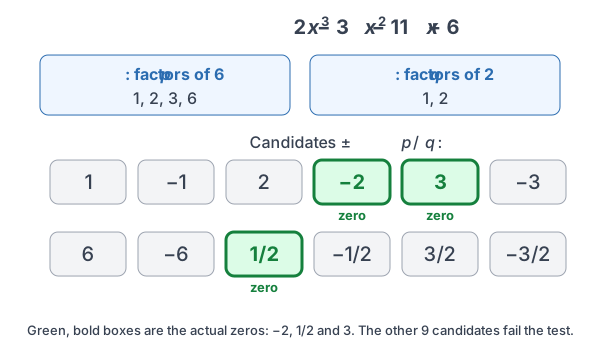
List the possible rational zeros of f(x) = 2x^3 - 3x^2 - 11x + 6.
- Factors of the constant term 6: p = 1, 2, 3, 6
- Factors of the leading coefficient 2: q = 1, 2
- Divide each p by q = 1: \pm 1, \pm 2, \pm 3, \pm 6
- Divide each p by q = 2: \pm \frac{1}{2}, \pm 1, \pm \frac{3}{2}, \pm 3
- Remove the repeats (±1 and ±3 appear twice).
Answer: \pm 1, \pm 2, \pm 3, \pm 6, \pm \frac{1}{2}, \pm \frac{3}{2}, which is 12 candidates.
Example 2: Find all the zeros
Solve 2x^3 - 3x^2 - 11x + 6 = 0.
- Test x = 1 (see remainder and factor theorems): 2 - 3 - 11 + 6 = -6, not 0
- Test x = -1: -2 - 3 + 11 + 6 = 12, not 0
- Test x = 2: 16 - 12 - 22 + 6 = -12, not 0
- Test x = -2: -16 - 12 + 22 + 6 = 0. So x = -2 is a zero.
- Divide by x + 2 with synthetic division (see synthetic division), coefficients 2, −3, −11, 6. Bring down 2.
- Multiply: 2(-2) = -4
- Add: -3 + (-4) = -7
- Multiply: -7(-2) = 14
- Add: -11 + 14 = 3
- Multiply: 3(-2) = -6
- Add: 6 + (-6) = 0. The quotient is 2x^2 - 7x + 3.
- Factor the quadratic (see factoring trinomials when a is not 1): (2x - 1)(x - 3) = 0
- Solve each factor: x = \frac{1}{2} or x = 3
Answer: x = -2, \frac{1}{2}, 3. All three were on the candidate list.
Example 3: Leading coefficient 1
Solve x^3 + 2x^2 - 5x - 6 = 0.
- The leading coefficient is 1, so every rational zero is an integer factor of −6: \pm 1, \pm 2, \pm 3, \pm 6
- Test x = 1: 1 + 2 - 5 - 6 = -8, not 0
- Test x = -1: -1 + 2 + 5 - 6 = 0. So x = -1 is a zero.
- Synthetic division by x + 1, coefficients 1, 2, −5, −6. Bring down 1.
- Multiply: 1(-1) = -1
- Add: 2 + (-1) = 1
- Multiply: 1(-1) = -1
- Add: -5 + (-1) = -6
- Multiply: -6(-1) = 6
- Add: -6 + 6 = 0. The quotient is x^2 + x - 6.
- Factor the trinomial (see factoring trinomials): (x + 3)(x - 2) = 0
Answer: x = -3, -1, 2
Example 4: A rational zero and two irrational zeros
Solve x^3 - 3x^2 - 2x + 4 = 0.
- Candidates: \pm 1, \pm 2, \pm 4
- Test x = 1: 1 - 3 - 2 + 4 = 0. So x = 1 is a zero.
- Synthetic division by x - 1, coefficients 1, −3, −2, 4. Bring down 1.
- Multiply: 1(1) = 1
- Add: -3 + 1 = -2
- Multiply: -2(1) = -2
- Add: -2 + (-2) = -4
- Multiply: -4(1) = -4
- Add: 4 + (-4) = 0. The quotient is x^2 - 2x - 4.
- It doesn’t factor, so use the quadratic formula (see quadratic formula): x = \frac{2 \pm \sqrt{4 + 16}}{2}
- Add under the root: x = \frac{2 \pm \sqrt{20}}{2}
- Simplify the radical (see simplifying square roots): x = \frac{2 \pm 2\sqrt{5}}{2}
- Divide both parts by 2: x = 1 \pm \sqrt{5}
Answer: x = 1, x = 1 + \sqrt{5} and x = 1 - \sqrt{5}. The two irrational zeros were never on the candidate list.
Example 5: Word problem with a box
A box has edges x, x + 1 and x + 4 feet. Its volume is 36 cubic feet. Find the edges.
- Write the volume equation: x(x + 1)(x + 4) = 36
- Multiply the first two factors: (x^2 + x)(x + 4) = 36
- Multiply again: x^3 + 5x^2 + 4x = 36
- Subtract 36: x^3 + 5x^2 + 4x - 36 = 0
- Candidates are the factors of 36. An edge must be positive, so test positive ones first.
- Test x = 1: 1 + 5 + 4 - 36 = -26, not 0
- Test x = 2: 8 + 20 + 8 - 36 = 0. So x = 2 is a zero.
- Synthetic division by x - 2, coefficients 1, 5, 4, −36. Bring down 1.
- Multiply: 1(2) = 2
- Add: 5 + 2 = 7
- Multiply: 7(2) = 14
- Add: 4 + 14 = 18
- Multiply: 18(2) = 36
- Add: -36 + 36 = 0. The quotient is x^2 + 7x + 18.
- Write the discriminant (see the discriminant): 7^2 - 4(1)(18)
- Square and multiply: 49 - 72
- Subtract: -23. It is negative, so there are no other real zeros.
Answer: x = 2, so the edges are 2, 3 and 6 feet. Check: 2 \cdot 3 \cdot 6 = 36.
Common Mistakes
| Mistake | Example of the error | Fix |
|---|---|---|
| Swapping p and q | For 2x^3 + \dots + 6, writing \frac{2}{6} and \frac{2}{3} | p comes from the constant (6), q from the leading coefficient (2): \frac{3}{2}, not \frac{2}{3}. |
| Forgetting the negatives | Testing only 1, 2, 3, 6 | Every candidate has a ±. Test −2 too. |
| Thinking every zero is on the list | “1 + \sqrt{5} isn’t a candidate, so it can’t be a zero” | The list only covers rational zeros. Irrational and complex zeros are found after dividing. |
| Testing the original polynomial again | After finding −2, testing more values in the cubic | Divide first, then work with the smaller quotient. |
| Using it with fraction coefficients | \frac{1}{2}x^3 + x - 3 | Multiply by 2 first so all coefficients are integers: x^3 + 2x - 6. |
Practice Problems
- List the possible rational zeros of x^3 - 4x^2 + x + 6.
- List the possible rational zeros of 3x^3 + 2x^2 - 7x + 2.
- Solve x^3 - 4x^2 + x + 6 = 0.
- Solve 3x^3 + 2x^2 - 7x + 2 = 0.
- Solve x^3 + x^2 - 8x - 12 = 0.
- Solve 2x^3 - 5x^2 - 4x + 3 = 0.
- Solve x^3 - 6x^2 + 7x + 2 = 0.
- Solve x^4 - 5x^3 + 5x^2 + 5x - 6 = 0.
- Show that x^3 + x + 1 = 0 has no rational solutions.
- A box has edges x, x + 3 and x + 4 inches. Its volume is 60 cubic inches. Find the edges.
Show answers
- Factors of 6: p = 1, 2, 3, 6
Factors of 1: q = 1
Answer: \pm 1, \pm 2, \pm 3, \pm 6 - Factors of 2: p = 1, 2
Factors of 3: q = 1, 3
Answer: \pm 1, \pm 2, \pm \frac{1}{3}, \pm \frac{2}{3} - Test x = -1: -1 - 4 - 1 + 6 = 0, a zero
Synthetic division: bring down 1
Multiply: 1(-1) = -1
Add: -4 + (-1) = -5
Multiply: -5(-1) = 5
Add: 1 + 5 = 6
Multiply: 6(-1) = -6
Add: 6 + (-6) = 0
Quotient: x^2 - 5x + 6 = (x - 2)(x - 3)
Answer: x = -1, 2, 3 - Test x = 1: 3 + 2 - 7 + 2 = 0, a zero
Synthetic division: bring down 3
Multiply: 3(1) = 3
Add: 2 + 3 = 5
Multiply: 5(1) = 5
Add: -7 + 5 = -2
Multiply: -2(1) = -2
Add: 2 + (-2) = 0
Quotient: 3x^2 + 5x - 2 = (3x - 1)(x + 2)
Answer: x = -2, \frac{1}{3}, 1 - Test x = -2: -8 + 4 + 16 - 12 = 0, a zero
Synthetic division: bring down 1
Multiply: 1(-2) = -2
Add: 1 + (-2) = -1
Multiply: -1(-2) = 2
Add: -8 + 2 = -6
Multiply: -6(-2) = 12
Add: -12 + 12 = 0
Quotient: x^2 - x - 6 = (x - 3)(x + 2)
Answer: x = -2 (twice) and x = 3 - Candidates: \pm 1, \pm 3, \pm \frac{1}{2}, \pm \frac{3}{2}
Test x = -1: -2 - 5 + 4 + 3 = 0, a zero
Synthetic division: bring down 2
Multiply: 2(-1) = -2
Add: -5 + (-2) = -7
Multiply: -7(-1) = 7
Add: -4 + 7 = 3
Multiply: 3(-1) = -3
Add: 3 + (-3) = 0
Quotient: 2x^2 - 7x + 3 = (2x - 1)(x - 3)
Answer: x = -1, \frac{1}{2}, 3 - Test x = 2: 8 - 24 + 14 + 2 = 0, a zero
Synthetic division: bring down 1
Multiply: 1(2) = 2
Add: -6 + 2 = -4
Multiply: -4(2) = -8
Add: 7 + (-8) = -1
Multiply: -1(2) = -2
Add: 2 + (-2) = 0
Quotient: x^2 - 4x - 1
Quadratic formula: x = \frac{4 \pm \sqrt{16 + 4}}{2}
Add under the root: x = \frac{4 \pm \sqrt{20}}{2}
Simplify the radical: x = \frac{4 \pm 2\sqrt{5}}{2}
Divide by 2: x = 2 \pm \sqrt{5}
Answer: x = 2, 2 + \sqrt{5}, 2 - \sqrt{5} - Test x = 1: 1 - 5 + 5 + 5 - 6 = 0, a zero
Synthetic division: bring down 1
Multiply: 1(1) = 1
Add: -5 + 1 = -4
Multiply: -4(1) = -4
Add: 5 + (-4) = 1
Multiply: 1(1) = 1
Add: 5 + 1 = 6
Multiply: 6(1) = 6
Add: -6 + 6 = 0
Quotient: x^3 - 4x^2 + x + 6, solved in problem 3: zeros −1, 2, 3
Answer: x = -1, 1, 2, 3 - Candidates: \pm 1 only
Test x = 1: 1 + 1 + 1 = 3, not 0
Test x = -1: -1 - 1 + 1 = -1, not 0
No candidate works, so there are no rational solutions - Volume: x(x + 3)(x + 4) = 60
Multiply: (x^2 + 3x)(x + 4) = x^3 + 7x^2 + 12x
Subtract 60: x^3 + 7x^2 + 12x - 60 = 0
Test x = 2: 8 + 28 + 24 - 60 = 0, a zero
Synthetic division: bring down 1
Multiply: 1(2) = 2
Add: 7 + 2 = 9
Multiply: 9(2) = 18
Add: 12 + 18 = 30
Multiply: 30(2) = 60
Add: -60 + 60 = 0
Quotient: x^2 + 9x + 30
Discriminant: 9^2 - 4(1)(30)
Square and multiply: 81 - 120
Subtract: -39, so no other real zeros
Answer: the edges are 2, 5 and 6 inches
FAQ
What does the rational root theorem say?
If a polynomial has integer coefficients, every rational zero is \pm\frac{p}{q}, where p divides the constant term and q divides the leading coefficient.
How do you list the possible rational roots?
Write all factors of the constant term over all factors of the leading coefficient, with a ± on each. Then cross out repeats.
Does the rational root theorem find all the zeros?
No. It only lists possible rational zeros. After you divide out a rational zero, use factoring or the quadratic formula to find irrational and complex zeros.
How can you test candidates faster?
Use synthetic division, since it tests a candidate and divides at the same time. A graph or table can also show which candidates are close to an x-intercept.
Summary
- Rational zeros of an integer-coefficient polynomial have the form \pm\frac{p}{q}.
- p divides the constant term; q divides the leading coefficient.
- Test candidates with synthetic division until the remainder is 0.
- Divide out each zero, then solve the smaller polynomial.
- Irrational and complex zeros are not on the list; find them from the quotient.
Previous lesson: Solving Polynomial Equations
Next lesson: Fundamental Theorem of Algebra
Back to the Algebra 2 Index