
Descartes’ Rule of Signs
Descartes’ rule of signs predicts how many positive and negative real zeros a polynomial can have. Count the sign changes in f(x), written in descending order: the number of positive real zeros equals that count or is less by an even number. Count the sign changes in f(-x) the same way to get the possible number of negative real zeros.
Before this lesson: You should know the Fundamental Theorem of Algebra, the Rational Root Theorem and Even and Odd Functions.
What the Rule Tells You
Before you hunt for zeros, it helps to know how many to expect. The fundamental theorem of algebra says a polynomial of degree n has n zeros, counting multiplicity. Some are positive, some negative, some may be 0, and the rest are nonreal.
Descartes’ rule splits up the real ones. A sign change happens when two neighboring coefficients have opposite signs. Each positive zero forces at least one sign change, so the number of sign changes is the most positive zeros there can be.
Nonreal zeros come in conjugate pairs, like 2 + i and 2 - i. That is why the count drops by 2 at a time, never by 1.
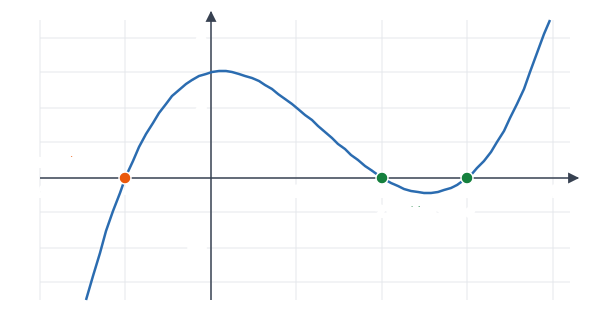
Descartes’ Rule of Signs
- Write f(x) in descending powers. Skip any missing terms; they don’t count.
- Count the sign changes from one coefficient to the next. The number of positive real zeros is that number, or less by 2, 4, and so on.
- Find f(-x): change the sign of every term with an odd power of x.
- Count the sign changes in f(-x). The number of negative real zeros is that number, or less by an even number.
- If the constant term is 0, factor out the power of x first. Zero is neither positive nor negative.
Zeros are counted with multiplicity, so a double zero counts as two.
Worked Examples
Example 1: Count both kinds
Use Descartes’ rule on f(x) = x^3 - 4x^2 + x + 6.
+, -, +, +
List the signs of f(x).
Count the changes: + to - (1), - to + (2), + to + (none). Two sign changes, so 2 or 0 positive zeros
(-x)^3 - 4(-x)^2 + (-x) + 6 = -x^3 - 4x^2 - x + 6
Find f(-x).
List its signs: -, -, -, +. One sign change, so exactly 1 negative zero
Check by factoring: f(x) = (x + 1)(x - 2)(x - 3), with zeros -1, 2, 3
Answer: 2 or 0 positive zeros and exactly 1 negative zero. The actual zeros, 2 and 3 positive and −1 negative, fit.
Example 2: No real zeros
Use Descartes’ rule on f(x) = 2x^4 + 3x^2 + 5.
+, +, +
Write the signs of f(x). No sign changes, so 0 positive zeros.
f(-x) = 2x^4 + 3x^2 + 5
Find f(-x). Every power is even, so nothing changes. No sign changes, so 0 negative zeros.
The constant is 5, not 0, so 0 is not a zero.
Answer: no real zeros. All 4 zeros are nonreal.
Example 3: A table of possibilities
List the possible numbers of positive, negative and nonreal zeros of f(x) = x^5 - 3x^3 + 2x - 7.
Signs of f(x): +, -, +, -. Three changes, so 3 or 1 positive zeros
-x^5 + 3x^3 - 2x - 7
Find f(-x).
Signs of f(-x): -, +, -, -. Two changes, so 2 or 0 negative zeros
The degree is 5, so the nonreal count makes the total 5: with 3 positive and 2 negative, 5 - 3 - 2 = 0 nonreal
Fill in the other rows the same way
| Positive | Negative | Nonreal | Total |
|---|---|---|---|
| 3 | 2 | 0 | 5 |
| 3 | 0 | 2 | 5 |
| 1 | 2 | 2 | 5 |
| 1 | 0 | 4 | 5 |
Answer: four possible combinations, shown in the table. Every row has an even number of nonreal zeros.
Example 4: A zero at the origin
Use Descartes’ rule on f(x) = x^4 - 5x^2 + 4x.
f(x) = x(x^3 - 5x + 4)
The constant term is 0, so factor out x (see factoring out the GCF). One zero is x = 0.
+, -, +
Let g(x) = x^3 - 5x + 4. Write its signs. Two changes, so 2 or 0 positive zeros.
g(-x) = -x^3 + 5x + 4
Find g(-x).
-, +, +
Write its signs. One change, so 1 negative zero.
g(1) = 1 - 5 + 4 = 0
Check x = 1.
g(x) = (x - 1)(x^2 + x - 4)
Use synthetic division to factor.
x = \frac{-1 \pm \sqrt{17}}{2}Solve x^2 + x - 4 = 0 with the quadratic formula. The zeros are about 1.56 and −2.56.
Answer: one zero at 0, 2 positive zeros (1 and about 1.56) and 1 negative zero (about −2.56), just as the rule allowed.
Example 5: Word problem with a box
Squares of side x inches are cut from the corners of a 12-by-10 inch sheet, and the sides are folded up to make an open box. The volume is V(x) = x(12 - 2x)(10 - 2x). How many cut sizes could give a volume of 96 cubic inches?
V(x) = 4x^3 - 44x^2 + 120x
Expand the volume (see multiplying polynomials)
4x^3 - 44x^2 + 120x - 96 = 0
Set it equal to 96 and move 96 over.
x^3 - 11x^2 + 30x - 24 = 0
Divide every term by 4.
Signs: +, -, +, -. Three changes, so 3 or 1 positive solutions
Test x = 2: 8 - 44 + 60 - 24 = 0, so 2 is a solution. Dividing gives (x - 2)(x^2 - 9x + 12) = 0
Solve x^2 - 9x + 12 = 0: x = \frac{9 \pm \sqrt{33}}{2}, about 7.37 and 1.63
A cut must be less than 5 inches, since the sheet is only 10 inches wide, so throw out 7.37
Answer: The rule allowed 3 positive solutions, and there are 3, but only 2 make sense: x = 2 inches or about 1.63 inches.
Common Mistakes
| Mistake | Example of the error | Fix |
|---|---|---|
| Counting a missing term as a sign | Treating the missing x^2 in x^3 - 5x + 4 as a change | Skip missing terms; compare only the coefficients that are there. |
| Not writing descending order | Counting signs in 4 + x^3 - 5x | Rewrite as x^3 - 5x + 4 first. |
| Changing every sign for f(−x) | Using -x^3 + 5x^2 - x - 6 for f(x) = x^3 - 5x^2 + x + 6 | Only odd powers change sign: f(-x) = -x^3 - 5x^2 - x + 6. |
| Subtracting 1 instead of 2 | Saying 3, 2 or 1 positive zeros | Drop by even numbers only: 3 or 1. |
| Counting 0 as positive | Including x = 0 in the positive count | Factor out x first; 0 is neither positive nor negative. |
Related Methods
Rational root theorem
The rule tells you how many zeros to look for and on which side of 0. The rational root theorem lists the candidates, and synthetic division tests them. If there is only 1 negative zero, you can stop looking once you find it.
Check with a graph
A graph shows the real zeros as x-intercepts, like the picture above. Use it to decide which row of the possibilities table is true.
Nonreal zeros
Whatever is left over after the real zeros comes in conjugate pairs, the same way complex solutions of quadratic equations do.
Practice Problems
- Use Descartes’ rule on f(x) = x^3 + 2x^2 - 5x - 6.
- Use Descartes’ rule on f(x) = 3x^4 - 2x^3 + x^2 - 5x + 1.
- Use Descartes’ rule on f(x) = x^4 + x^2 + 1.
- Use Descartes’ rule on f(x) = -x^3 + 4x - 1.
- Use Descartes’ rule on f(x) = x^5 + x^3 + x.
- How many positive, negative and nonreal zeros does f(x) = x^3 - 1 have?
- List every possible combination of positive, negative and nonreal zeros for f(x) = x^4 - 2x^3 - x^2 + 2x + 5.
- Explain why f(x) = x^6 + 3x^2 + 2 has no real zeros.
- Use Descartes’ rule on f(x) = 2x^3 - 5x^2 + 4x - 1, then check with the factored form (x - 1)^2(2x - 1).
- A company’s profit is P(x) = -x^3 + 10x^2 - 21x - 18 thousand dollars when it sells x thousand units. How many break-even points (zeros) with x \gt 0 are possible? Check with P(6).
Show answers
- Signs of f(x): +, +, -, -. One change: 1 positive zero
f(-x) = -x^3 + 2x^2 + 5x - 6. Signs: -, +, +, -. Two changes: 2 or 0 negative zeros
Answer: 1 positive; 2 or 0 negative (actual zeros: 2, −1, −3) - Signs of f(x): +, -, +, -, +. Four changes: 4, 2 or 0 positive
f(-x) = 3x^4 + 2x^3 + x^2 + 5x + 1. No changes: 0 negative
Answer: 4, 2 or 0 positive zeros; no negative zeros - Signs of f(x): +, +, +, no changes. f(-x) is the same, no changes
The constant is 1, so 0 is not a zero
Answer: no real zeros; all 4 are nonreal - Signs of f(x): -, +, -. Two changes: 2 or 0 positive
f(-x) = x^3 - 4x - 1. Signs: +, -, -. One change: 1 negative
Answer: 2 or 0 positive; exactly 1 negative - Factor out x: f(x) = x(x^4 + x^2 + 1), so 0 is a zero
x^4 + x^2 + 1 has no sign changes, and neither does its f(-x)
Answer: the only real zero is 0; the other 4 are nonreal - Signs of f(x): +, -. One change: 1 positive
f(-x) = -x^3 - 1. Signs: -, -. No changes: 0 negative
Degree 3, so 3 - 1 - 0 = 2 nonreal
Answer: 1 positive (x = 1), 0 negative, 2 nonreal - Signs of f(x): +, -, -, +, +. Two changes: 2 or 0 positive
f(-x) = x^4 + 2x^3 - x^2 - 2x + 5. Signs: +, +, -, -, +. Two changes: 2 or 0 negative
Nonreal fills the total of 4
Answer: (2, 2, 0), (2, 0, 2), (0, 2, 2) or (0, 0, 4) as (positive, negative, nonreal) - Signs of f(x): all +, so no positive zeros
f(-x) = x^6 + 3x^2 + 2, all +, so no negative zeros
The constant is 2, so 0 is not a zero
Answer: no real zeros. Also, every term is positive for every x, so f(x) \ge 2 - Signs of f(x): +, -, +, -. Three changes: 3 or 1 positive
f(-x) = -2x^3 - 5x^2 - 4x - 1. No changes: 0 negative
Factored form: zeros 1, 1, \frac{1}{2}, which is 3 positive zeros counting the double zero twice
Answer: 3 or 1 positive, 0 negative; actually 3 positive (with multiplicity) - Signs of P(x): -, +, -, -. Two changes: 2 or 0 positive zeros
Check: P(6) = -216 + 360 - 126 - 18 = 0, so 6 is one
Divide out (x - 6): P(x) = -(x - 6)(x^2 - 4x - 3); the quadratic gives x = 2 \pm \sqrt{7}, and only 2 + \sqrt{7} \approx 4.65 is positive
Answer: 2 or 0 are possible; there are 2, at about 4,650 and 6,000 units
FAQ
How do you use Descartes’ rule of signs?
Count the sign changes in f(x) for the possible positive real zeros. Then count the sign changes in f(-x) for the possible negative real zeros. Each count can drop by any even number.
Why does the number of zeros go down by 2?
Nonreal zeros of a polynomial with real coefficients come in conjugate pairs. Any zeros missing from the count are nonreal, and they come two at a time.
Do zeros with multiplicity count more than once?
Yes. A double zero counts as two zeros in Descartes’ rule, the same way it does in the fundamental theorem of algebra.
Does Descartes’ rule give the exact number of zeros?
Only when the count is 0 or 1. Otherwise, it gives a list of possibilities, and you need more work, like a graph or synthetic division, to decide.
Summary
- Sign changes in f(x) give the most positive real zeros possible.
- Sign changes in f(-x) give the most negative real zeros possible.
- Each count may drop by 2, 4 and so on, because nonreal zeros come in pairs.
- Skip missing terms, and factor out x if the constant is 0.
- Use it with the rational root theorem and a graph to find the zeros.
Previous lesson: Rates of Change of Functions
Next lesson: Polynomial Inequalities
Back to the Precalculus Index