
Even and Odd Functions
An even function satisfies f(-x) = f(x) for every x in its domain, so its graph is symmetric about the y-axis. An odd function satisfies f(-x) = -f(x), so its graph is symmetric about the origin. To test a function, replace x with -x, simplify, and compare the result with f(x) and -f(x).
Before this lesson: You should know Parent Functions, Function Notation and Transformations of Functions.
What Even and Odd Mean
Think of folding a graph along the y-axis. If the two halves match, the function is even. Every point (a, b) on the graph has a partner (-a, b) at the same height.
Now think of spinning the graph half a turn around the origin. If it lands on itself, the function is odd. Every point (a, b) has a partner (-a, -b), on the opposite side and at the opposite height.
Most functions are neither. Being even or odd is a special kind of balance, and it saves work: once you know one half of the graph, you know the other half.
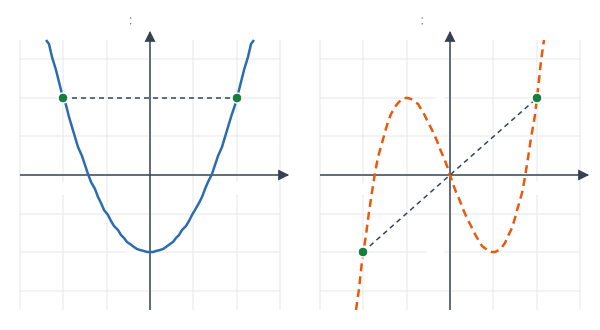
The Test for Even and Odd Functions
| Type | Algebra test | Graph symmetry | Examples |
|---|---|---|---|
| Even | f(-x) = f(x) | About the y-axis | x^2, \lvert x \rvert, \cos x |
| Odd | f(-x) = -f(x) | About the origin | x^3, \frac{1}{x}, \sin x |
| Neither | Neither equation holds for all x | Neither kind | x^2 + x, e^x |
- Find f(-x) by replacing every x with (-x).
- Simplify, using (-x)^n = x^n for even n and (-x)^n = -x^n for odd n.
- If the result equals f(x), the function is even.
- If not, find -f(x) by changing every sign of f(x). If f(-x) equals it, the function is odd.
- If neither matches, the function is neither.
Polynomial shortcut: a polynomial with only even powers of x (a constant counts as x^0) is even. One with only odd powers is odd. A mix of even and odd powers is neither. That is where the names come from.
Worked Examples
Example 1: An even polynomial
Is f(x) = x^4 - 3x^2 + 2 even, odd or neither?
f(-x) = (-x)^4 - 3(-x)^2 + 2
Replace x with -x.
Simplify the powers (see multiplying integers): (-x)^4 = x^4 and (-x)^2 = x^2
f(-x) = x^4 - 3x^2 + 2
Substitute.
Compare: this is exactly f(x)
Answer: even. Every power of x is even, which matches the shortcut.
Example 2: An odd polynomial
Is g(x) = x^3 - 5x even, odd or neither?
g(-x) = (-x)^3 - 5(-x)
Replace x with -x.
Simplify: (-x)^3 = -x^3 and -5(-x) = 5x, so g(-x) = -x^3 + 5x
Compare with g(x) = x^3 - 5x: they are not equal, so g is not even
-g(x) = -x^3 + 5x
Find -g(x) by changing every sign.
g(-x) = -g(x)
Compare.
Answer: odd.
Example 3: Neither
Is h(x) = x^3 + x^2 even, odd or neither?
h(-x) = (-x)^3 + (-x)^2
Replace x with -x.
h(-x) = -x^3 + x^2
Simplify.
Compare with h(x) = x^3 + x^2: the x^3 terms have different signs, so not even
-h(x) = -x^3 - x^2
Find -h(x).
Compare with h(-x) = -x^3 + x^2: the x^2 terms have different signs, so not odd
Answer: neither. A quick check: h(1) = 2 but h(-1) = 0, which is neither 2 nor −2.
Example 4: A rational function
Is f(x) = \frac{2x}{x^2 - 9} even, odd or neither?
f(-x) = \frac{2(-x)}{(-x)^2 - 9}Replace x with -x.
f(-x) = \frac{-2x}{x^2 - 9}Simplify the top and bottom.
f(-x) = -\frac{2x}{x^2 - 9}Move the negative sign in front.
Compare: this is -f(x)
Answer: odd. The top is odd and the bottom is even, and odd divided by even is odd.
Example 5: Word problem with an arch
A stone arch has height h(x) = 30 - \frac{x^2}{30} feet, where x is the distance in feet from the center, left negative and right positive. A light hangs on the arch at x = 12. Show that the arch is symmetric, and find where a matching light should hang and how high it is.
Test for even: h(-x) = 30 - \frac{(-x)^2}{30} = 30 - \frac{x^2}{30} = h(x), so h is even and the arch is symmetric about its center
h(12) = 30 - \frac{144}{30}Find the height at x = 12.
\frac{144}{30} = 4.8Divide.
h(12) = 30 - 4.8 = 25.2
Subtract.
h(-12) = h(12) = 25.2
Since h is even, the matching point is x = -12 with the same height.
Answer: The matching light hangs 12 feet left of center, at x = -12, at a height of 25.2 feet.
Common Mistakes
| Mistake | Example of the error | Fix |
|---|---|---|
| Forgetting parentheses around −x | Writing -x^2 for (-x)^2 | (-x)^2 = x^2, but -x^2 is negative. Always write (-x). |
| Testing only one number | f(2) = f(-2), so you decide f is even | One pair proves nothing. Show f(-x) = f(x) for all x, using algebra. |
| Thinking “not even” means odd | x^3 + x^2 is not even, so you call it odd | Test odd separately. Many functions are neither. |
| Changing only the first sign for −f(x) | -(x^3 - 5x) = -x^3 - 5x | Change every sign: -x^3 + 5x. |
| Calling a constant odd | f(x) = 3 is odd | f(-x) = 3 = f(x), so a constant function is even. |
Related Methods
Even and odd trig functions
Cosine and secant are even, and sine, tangent, cosecant and cotangent are odd. These facts are the even-odd identities, such as \sin(-x) = -\sin x, from fundamental trig identities.
Combining functions
Products follow sign rules: even times even is even, odd times odd is even, and even times odd is odd. Sums of two even functions are even, and sums of two odd functions are odd.
Odd functions at 0
If an odd function is defined at x = 0, then f(0) = -f(0), so f(0) = 0. Its graph must pass through the origin.
Practice Problems
Decide whether each function is even, odd or neither, and show the test.
- f(x) = 5x^2 - 1
- f(x) = 4x^3 + 2x
- f(x) = x^2 + x
- f(x) = x^5 - x^3 + 7x
- f(x) = 3
- f(x) = \lvert x \rvert - x^2
- f(x) = \frac{x^2}{x^4 + 1}
- f(x) = x \sin x
- An odd function has f(4) = -6. Find f(-4) and f(0).
- An even function passes through (1, 3), (2, 5) and (4, 0). Name three more points that must be on its graph.
Show answers
1.
f(-x) = 5(-x)^2 - 1 = 5x^2 - 1
Substitute −x and simplify.
This equals f(x)
Answer: even
2.
f(-x) = 4(-x)^3 + 2(-x) = -4x^3 - 2x
Substitute −x and simplify.
-f(x) = -4x^3 - 2x, so f(-x) = -f(x)
Answer: odd
3.
f(-x) = (-x)^2 + (-x) = x^2 - x
Substitute −x and simplify.
Not f(x) = x^2 + x, and not -f(x) = -x^2 - x
Answer: neither
4.
f(-x) = (-x)^5 - (-x)^3 + 7(-x) = -x^5 + x^3 - 7x
Substitute −x and simplify.
-f(x) = -x^5 + x^3 - 7x, so f(-x) = -f(x)
Answer: odd
5.
f(-x) = 3, since there is no x to change
This equals f(x)
Answer: even
6.
f(-x) = \lvert -x \rvert - (-x)^2 = \lvert x \rvert - x^2
Substitute −x and simplify.
This equals f(x)
Answer: even
7.
f(-x) = \frac{(-x)^2}{(-x)^4 + 1} = \frac{x^2}{x^4 + 1}Substitute −x and simplify.
This equals f(x)
Answer: even
8.
f(-x) = (-x) \sin(-x)
Substitute −x.
f(-x) = (-x)(-\sin x) = x \sin x
Use \sin(-x) = -\sin x.
This equals f(x); odd times odd is even
Answer: even
9.
Odd means f(-4) = -f(4) = -(-6) = 6
An odd function defined at 0 has f(0) = 0
Answer: f(-4) = 6, f(0) = 0
10.
Even means each point (a, b) has a partner (-a, b)
Answer: (-1, 3), (-2, 5) and (-4, 0)
FAQ
How do you tell if a function is even or odd?
Find f(-x) and simplify. If it equals f(x), the function is even. If it equals -f(x), it is odd. Otherwise it is neither.
What does an even function look like?
Its graph is symmetric about the y-axis, so the left half is a mirror image of the right half. Parabolas like y = x^2 and the cosine graph are examples.
Can a function be both even and odd?
Only f(x) = 0. If f(x) = f(-x) and f(-x) = -f(x), then f(x) = -f(x), so every output is 0.
Is every function even or odd?
No. Most functions are neither. For example, x^2 + x and e^x have neither kind of symmetry.
Summary
- Even: f(-x) = f(x), symmetric about the y-axis.
- Odd: f(-x) = -f(x), symmetric about the origin.
- Test by finding f(-x) with parentheses, then comparing with f(x) and -f(x).
- Polynomials with only even powers are even; only odd powers, odd; a mix, neither.
- An odd function defined at 0 passes through the origin.
Previous lesson: Parent Functions
Next lesson: Difference Quotient
Back to the Precalculus Index