
Fundamental Trig Identities
The fundamental trig identities are equations that are true for every angle where both sides are defined. They include the reciprocal identities, such as \csc \theta = \frac{1}{\sin \theta}, the quotient identities, such as \tan \theta = \frac{\sin \theta}{\cos \theta}, and the Pythagorean identities, such as \sin^2 \theta + \cos^2 \theta = 1. They let you rewrite and simplify trig expressions.
Before this lesson: You should know The Unit Circle, Six Trigonometric Functions and Simplifying Rational Expressions.
Where the Identities Come From
An identity is an equation that is true for every allowed value of the variable, like 2(x + 1) = 2x + 2. Trig identities work the same way, with angles.
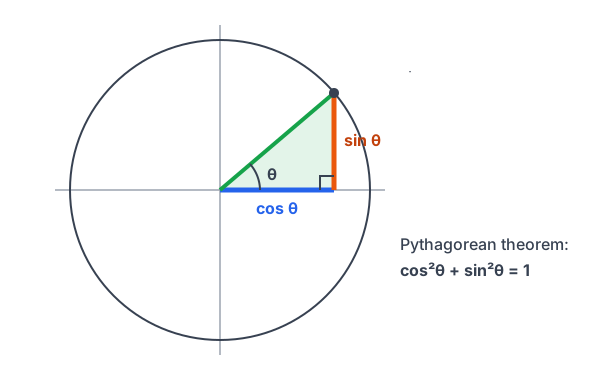
The most important one comes straight from the unit circle. The point for angle \theta is (\cos \theta, \sin \theta), and every point on the circle satisfies x^2 + y^2 = 1. So \cos^2 \theta + \sin^2 \theta = 1 for every angle. It is the Pythagorean theorem for a triangle with hypotenuse 1.
The Fundamental Identities
| Type | Identities |
|---|---|
| Reciprocal | \csc \theta = \frac{1}{\sin \theta}, \sec \theta = \frac{1}{\cos \theta}, \cot \theta = \frac{1}{\tan \theta} |
| Quotient | \tan \theta = \frac{\sin \theta}{\cos \theta}, \cot \theta = \frac{\cos \theta}{\sin \theta} |
| Pythagorean | \sin^2 \theta + \cos^2 \theta = 1, 1 + \tan^2 \theta = \sec^2 \theta, 1 + \cot^2 \theta = \csc^2 \theta |
| Even-odd | \sin(-\theta) = -\sin \theta, \cos(-\theta) = \cos \theta, \tan(-\theta) = -\tan \theta |
| Cofunction | \sin(\frac{\pi}{2} - \theta) = \cos \theta, \cos(\frac{\pi}{2} - \theta) = \sin \theta |
The other two Pythagorean identities come from the first. Divide every term of \sin^2 \theta + \cos^2 \theta = 1 by \cos^2 \theta to get \tan^2 \theta + 1 = \sec^2 \theta. Divide by \sin^2 \theta instead to get 1 + \cot^2 \theta = \csc^2 \theta.
- Rewrite everything in terms of sine and cosine.
- Look for a Pythagorean pattern, such as 1 - \cos^2 \theta, and replace it.
- Combine fractions or cancel common factors.
- Rewrite the result with the simplest function you can.
Worked Examples
Example 1: Find a value with a Pythagorean identity
If \sin \theta = \frac{3}{5} and \theta is in Quadrant II, find \cos \theta and \tan \theta.
(\frac{3}{5})^2 + \cos^2 \theta = 1Substitute into \sin^2 \theta + \cos^2 \theta = 1.
\frac{9}{25} + \cos^2 \theta = 1Square.
\cos^2 \theta = \frac{16}{25}Subtract \frac{9}{25} from both sides.
\cos \theta = \pm\frac{4}{5}Take the square root.
\cos \theta = -\frac{4}{5}Cosine is negative in Quadrant II.
\tan \theta = \frac{\frac{3}{5}}{-\frac{4}{5}} = -\frac{3}{4}Use the quotient identity.
Answer: \cos \theta = -\frac{4}{5} and \tan \theta = -\frac{3}{4}
Example 2: Simplify a product
Simplify \sin \theta \cot \theta.
\sin \theta \cdot \frac{\cos \theta}{\sin \theta}Rewrite cotangent with the quotient identity.
\cos \theta
Cancel the common factor \sin \theta.
Answer: \sin \theta \cot \theta = \cos \theta
Example 3: Use a Pythagorean identity
Simplify \frac{1 - \cos^2 \theta}{\sin \theta}.
Rearrange \sin^2 \theta + \cos^2 \theta = 1 to get 1 - \cos^2 \theta = \sin^2 \theta
\frac{\sin^2 \theta}{\sin \theta}Replace the numerator.
\sin \theta
Cancel one factor of \sin \theta.
Answer: \frac{1 - \cos^2 \theta}{\sin \theta} = \sin \theta
Example 4: Combine fractions
Simplify \sec \theta - \sin \theta \tan \theta.
\frac{1}{\cos \theta} - \sin \theta \cdot \frac{\sin \theta}{\cos \theta}Rewrite in sine and cosine.
\frac{1}{\cos \theta} - \frac{\sin^2 \theta}{\cos \theta}Multiply.
\frac{1 - \sin^2 \theta}{\cos \theta}Subtract the fractions, which share a denominator (see adding and subtracting rational expressions)
\frac{\cos^2 \theta}{\cos \theta}Use the Pythagorean identity.
\cos \theta
Cancel one factor of \cos \theta.
Answer: \sec \theta - \sin \theta \tan \theta = \cos \theta
Example 5: Word problem with a ramp
A ramp rises 1 foot for every 12 feet of horizontal run, so \tan \theta = \frac{1}{12}. The secant, \sec \theta, is the ramp length for each foot of run. Use an identity to find \sec \theta, then find the ramp length for a 24-foot run.
\sec^2 \theta = 1 + (\frac{1}{12})^2Use 1 + \tan^2 \theta = \sec^2 \theta.
\sec^2 \theta = 1 + \frac{1}{144}Square.
\sec^2 \theta = \frac{145}{144}Add.
\sec \theta = \frac{\sqrt{145}}{12} \approx 1.0035Take the square root (positive for an acute angle)
24 \cdot \frac{\sqrt{145}}{12} = 2\sqrt{145} \approx 24.08Multiply by the run.
Answer: \sec \theta = \frac{\sqrt{145}}{12}, and a 24-foot run needs a ramp about 24.08 feet long.
Common Mistakes
| Mistake | Example of the error | Fix |
|---|---|---|
| Thinking sin²θ means sin of θ² | \sin^2 \theta = \sin(\theta^2) | \sin^2 \theta means (\sin \theta)^2. |
| Writing the Pythagorean identity without squares | \sin \theta + \cos \theta = 1 | The squares matter: \sin^2 \theta + \cos^2 \theta = 1. For 45°, \sin \theta + \cos \theta = \sqrt{2}. |
| Wrong sign after a square root | \cos \theta = \frac{4}{5} in Quadrant II | Use the quadrant: cosine is negative in Quadrant II. |
| Mixing up the second identity | 1 + \tan^2 \theta = \csc^2 \theta | Tangent pairs with secant, cotangent with cosecant: 1 + \tan^2 \theta = \sec^2 \theta. |
| Canceling terms instead of factors | \frac{1 - \cos^2 \theta}{\cos \theta} = 1 - \cos \theta | Only common factors cancel. Use 1 - \cos^2 \theta = \sin^2 \theta first. |
Related Methods
Check an identity with numbers
Plug in an angle to test a simplification. For Example 4 with \theta = 60^\circ: \sec 60^\circ - \sin 60^\circ \tan 60^\circ = 2 - \frac{\sqrt{3}}{2} \cdot \sqrt{3} = 2 - \frac{3}{2} = \frac{1}{2}, which equals \cos 60^\circ. A check like this can catch mistakes, but it does not prove the identity.
Rearranged forms
Each Pythagorean identity can be solved for any term: \cos^2 \theta = 1 - \sin^2 \theta, \tan^2 \theta = \sec^2 \theta - 1, \cot^2 \theta = \csc^2 \theta - 1. Spotting these forms is the key skill for the next lesson.
Factoring
Expressions like \sin^2 \theta - \cos^2 \theta or \sin^2 \theta + 2 \sin \theta + 1 factor just like polynomials, as in factoring the difference of squares.
Practice Problems
- If \cos \theta = \frac{5}{13} and \theta is in Quadrant I, find \sin \theta.
- If \sin \theta = -\frac{1}{2} and \theta is in Quadrant III, find \cos \theta.
- If \tan \theta = 2 and \theta is in Quadrant I, find \sec \theta.
- If \cot \theta = \frac{3}{4} and \theta is in Quadrant I, find \csc \theta.
- Simplify \cos \theta \tan \theta.
- Simplify \sin^2 \theta + \cos^2 \theta + \tan^2 \theta.
- Simplify \frac{\sec^2 \theta - 1}{\tan \theta}.
- Simplify \cot \theta \sec \theta.
- Simplify (1 - \sin^2 \theta) \sec \theta.
- A roof rafter has \sec \theta = 1.25, where \theta is the roof’s angle. Use an identity to find \tan \theta, the rise per foot of run, and the rise over a 12-foot run.
Show answers
1.
\sin^2 \theta = 1 - \frac{25}{169} = \frac{144}{169}Use \sin^2 \theta + \cos^2 \theta = 1.
\sin \theta = \frac{12}{13}Take the positive root for Quadrant I.
Answer: \frac{12}{13}
2.
\cos^2 \theta = 1 - \frac{1}{4} = \frac{3}{4}Substitute.
\cos \theta = \pm\frac{\sqrt{3}}{2}Take the root.
Cosine is negative in Quadrant III
Answer: -\frac{\sqrt{3}}{2}
3.
\sec^2 \theta = 1 + 4 = 5
Use 1 + \tan^2 \theta = \sec^2 \theta.
\sec \theta = \sqrt{5}Take the positive root.
Answer: \sqrt{5}
4.
\csc^2 \theta = 1 + \frac{9}{16} = \frac{25}{16}Use 1 + \cot^2 \theta = \csc^2 \theta.
\csc \theta = \frac{5}{4}Take the positive root.
Answer: \frac{5}{4}
5.
\cos \theta \cdot \frac{\sin \theta}{\cos \theta}Rewrite tangent.
\sin \theta
Cancel \cos \theta.
Answer: \sin \theta
6.
1 + \tan^2 \theta
Replace \sin^2 \theta + \cos^2 \theta with 1.
\sec^2 \theta
Use the second Pythagorean identity.
Answer: \sec^2 \theta
7.
\frac{\tan^2 \theta}{\tan \theta}Use \sec^2 \theta - 1 = \tan^2 \theta.
\tan \theta
Cancel one factor.
Answer: \tan \theta
8.
\frac{\cos \theta}{\sin \theta} \cdot \frac{1}{\cos \theta}Rewrite.
\frac{1}{\sin \theta}Cancel \cos \theta.
\csc \theta
Use the reciprocal identity.
Answer: \csc \theta
9.
\cos^2 \theta \cdot \frac{1}{\cos \theta}Replace 1 - \sin^2 \theta with \cos^2 \theta.
\cos \theta
Cancel one factor.
Answer: \cos \theta
10.
\tan^2 \theta = 1.25^2 - 1 = 1.5625 - 1 = 0.5625
Use \tan^2 \theta = \sec^2 \theta - 1.
\tan \theta = 0.75
Take the positive root.
0.75 \cdot 12 = 9
Multiply by the run.
Answer: \tan \theta = 0.75, so the roof rises 9 feet over a 12-foot run
FAQ
What are the fundamental trig identities?
They are the reciprocal, quotient and Pythagorean identities, often listed with the even-odd and cofunction identities. Together they connect all six trig functions.
What are the three Pythagorean identities?
\sin^2 \theta + \cos^2 \theta = 1, 1 + \tan^2 \theta = \sec^2 \theta and 1 + \cot^2 \theta = \csc^2 \theta.
Why is sin²θ + cos²θ = 1?
On the unit circle, the point for \theta is (\cos \theta, \sin \theta), and every point on the circle is 1 unit from the origin. By the Pythagorean theorem, \cos^2 \theta + \sin^2 \theta = 1^2.
What is the difference between an identity and an equation?
An identity is true for every allowed value of the variable. A trig equation, like \sin \theta = \frac{1}{2}, is true only for certain angles, which you solve for.
Summary
- Reciprocal identities: \csc \theta = \frac{1}{\sin \theta}, \sec \theta = \frac{1}{\cos \theta}, \cot \theta = \frac{1}{\tan \theta}.
- Quotient identities: \tan \theta = \frac{\sin \theta}{\cos \theta} and \cot \theta = \frac{\cos \theta}{\sin \theta}.
- Pythagorean identities: \sin^2 \theta + \cos^2 \theta = 1, 1 + \tan^2 \theta = \sec^2 \theta, 1 + \cot^2 \theta = \csc^2 \theta.
- To simplify, rewrite in sine and cosine, use a Pythagorean identity, then cancel factors.
- Use the quadrant to choose the sign after a square root.
Previous lesson: Compositions of Inverse Trig Functions
Next lesson: Verifying Trig Identities
Back to the Trigonometry Index