
Simplifying Rational Expressions
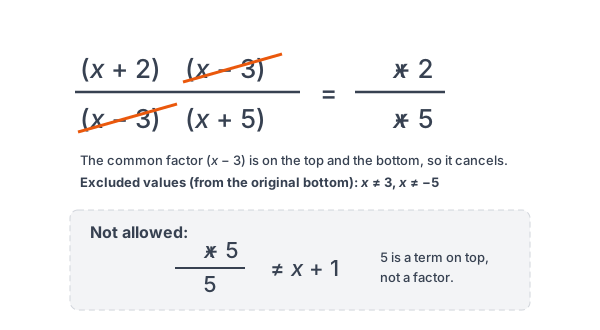
Simplifying rational expressions works like reducing a fraction: factor the numerator and the denominator, then cancel any common factors. Before you cancel, list the excluded values, the x-values that make the original denominator zero. Those values stay excluded even after the factor that caused them is gone.
Before this lesson: You should know Fractions, Factoring Trinomials, Factoring the Difference of Squares and Inverse Variation.
What a Rational Expression Is
A rational expression is a fraction with polynomials on the top and bottom, like \frac{x + 3}{x - 2}. Just like a number fraction, its denominator can never be zero.
Simplifying works the same way it does with numbers. To reduce \frac{12}{18}, you write \frac{6 \cdot 2}{6 \cdot 3} and cancel the common factor 6. With polynomials, the common factors are expressions like (x - 3).
How to Simplify
- Factor the numerator and the denominator completely.
- Find the excluded values: set each denominator factor equal to zero.
- Cancel factors that appear in both the numerator and the denominator.
- Write the simplified expression with its excluded values.
Watch for opposite factors. Since 4 - x = -(x - 4), the fraction \frac{4 - x}{x - 4} simplifies to −1, not 1.
Worked Examples
Example 1: Find excluded values
Find the excluded values of \frac{x + 4}{x^2 - 9}.
- Set the denominator equal to zero: x^2 - 9 = 0
- Factor the difference of squares (see factoring the difference of squares): (x - 3)(x + 3) = 0
- Solve each factor (see solving quadratic equations by factoring): x = 3 or x = -3
Answer: x \ne 3 and x \ne -3
Example 2: Factor and cancel
Simplify \frac{x^2 + 5x + 6}{x^2 - 4}.
- Factor the numerator (see factoring trinomials): \frac{(x + 2)(x + 3)}{x^2 - 4}
- Factor the denominator: \frac{(x + 2)(x + 3)}{(x + 2)(x - 2)}
- Excluded values from the denominator: x \ne -2 and x \ne 2
- Cancel the common factor (x + 2): \frac{x + 3}{x - 2}
Answer: \frac{x + 3}{x - 2}, with x \ne -2, 2. The −2 stays excluded even though (x + 2) was canceled.
Example 3: A monomial denominator
Simplify \frac{6x^3 - 12x^2}{3x^2}.
- Factor out the GCF on top (see factoring out the GCF): \frac{6x^2(x - 2)}{3x^2}
- Excluded value: 3x^2 = 0 when x = 0, so x \ne 0
- Divide the numbers: \frac{6}{3} = 2
- Cancel x^2 (see exponent rules): 2(x - 2)
Answer: 2(x - 2), or 2x - 4, with x \ne 0
Example 4: Opposite factors
Simplify \frac{4 - x}{x^2 - 16}.
- Factor the denominator: \frac{4 - x}{(x - 4)(x + 4)}
- Excluded values: x \ne 4 and x \ne -4
- Rewrite the top as an opposite: 4 - x = -(x - 4), so \frac{-(x - 4)}{(x - 4)(x + 4)}
- Cancel (x - 4): \frac{-1}{x + 4}
Answer: -\frac{1}{x + 4}, with x \ne 4, -4
Example 5: Word problem with a rectangle
A rectangle has an area of x^2 + 7x + 12 square meters and a length of x + 4 meters. Write and simplify an expression for its width.
- Width is area divided by length: \frac{x^2 + 7x + 12}{x + 4}
- Factor the numerator: \frac{(x + 3)(x + 4)}{x + 4}
- Cancel the common factor (x + 4): x + 3
- Check with x = 2: the area is 4 + 14 + 12 = 30, the length is 6, and 30 \div 6 = 5, which equals 2 + 3.
Answer: The width is x + 3 meters. (Lengths must be positive, so x \gt -3 in this problem.)
Common Mistakes
| Mistake | Example of the error | Fix |
|---|---|---|
| Canceling terms instead of factors | \frac{x + 5}{x + 2} = \frac{5}{2} | You can only cancel factors. \frac{x + 5}{x + 2} is already simplified. |
| Losing an excluded value | \frac{(x + 2)(x + 3)}{(x + 2)(x - 2)} = \frac{x + 3}{x - 2}, so only x \ne 2 | Find excluded values before canceling: x \ne -2 too. |
| Canceling part of a sum | \frac{x^2 + 1}{x^2} = 1 | x^2 is a term on top, not a factor. The answer stays \frac{x^2 + 1}{x^2}. |
| Missing a sign with opposites | \frac{x - 4}{4 - x} = 1 | 4 - x = -(x - 4), so the fraction is −1. |
| Canceling before factoring | Trying to cancel in \frac{x^2 - 9}{x + 3} right away | Factor first: \frac{(x - 3)(x + 3)}{x + 3} = x - 3. |
Practice Problems
- Find the excluded value of \frac{5}{x - 7}.
- Find the excluded values of \frac{x + 1}{x^2 + 3x - 10}.
- Simplify \frac{12x^4}{18x^2}.
- Simplify \frac{x^2 - 25}{x + 5}.
- Simplify \frac{x^2 - x - 12}{x^2 - 16}.
- Simplify \frac{3x + 9}{x^2 + 6x + 9}.
- Simplify \frac{2x^2 - 8x}{4x}.
- Simplify \frac{5 - x}{x^2 - 7x + 10}.
- Simplify \frac{x^3 + 8}{x^2 - 4}.
- A rectangle has an area of x^2 + 9x + 20 square feet and a width of x + 5 feet. Find its length.
Show answers
- Set the denominator to zero: x - 7 = 0
Solve: x = 7
Answer: x \ne 7 - Set the denominator to zero: x^2 + 3x - 10 = 0
Factor: (x + 5)(x - 2) = 0
Answer: x \ne -5 and x \ne 2 - Excluded value: x \ne 0
Reduce the numbers: \frac{12}{18} = \frac{2}{3}
Subtract exponents: \frac{x^4}{x^2} = x^2
Answer: \frac{2x^2}{3}, x \ne 0 - Factor: \frac{(x - 5)(x + 5)}{x + 5}
Excluded: x \ne -5
Cancel: x - 5
Answer: x - 5, x \ne -5 - Factor: \frac{(x - 4)(x + 3)}{(x - 4)(x + 4)}
Excluded: x \ne 4, -4
Cancel: \frac{x + 3}{x + 4}
Answer: \frac{x + 3}{x + 4}, x \ne \pm 4 - Factor the top: 3(x + 3)
Factor the bottom (see perfect square trinomials): (x + 3)^2
Excluded: x \ne -3
Cancel one (x + 3): \frac{3}{x + 3}
Answer: \frac{3}{x + 3}, x \ne -3 - Factor the top: \frac{2x(x - 4)}{4x}
Excluded: x \ne 0
Cancel x: \frac{2(x - 4)}{4}
Reduce \frac{2}{4} = \frac{1}{2}: \frac{x - 4}{2}
Answer: \frac{x - 4}{2}, x \ne 0 - Factor the bottom: \frac{5 - x}{(x - 5)(x - 2)}
Excluded: x \ne 5, 2
Rewrite the top: 5 - x = -(x - 5)
Cancel (x - 5): \frac{-1}{x - 2}
Answer: -\frac{1}{x - 2}, x \ne 2, 5 - Factor the top (see sum and difference of cubes): (x + 2)(x^2 - 2x + 4)
Factor the bottom: (x + 2)(x - 2)
Excluded: x \ne \pm 2
Cancel (x + 2): \frac{x^2 - 2x + 4}{x - 2}
Answer: \frac{x^2 - 2x + 4}{x - 2}, x \ne \pm 2 - Length is area divided by width: \frac{x^2 + 9x + 20}{x + 5}
Factor: \frac{(x + 4)(x + 5)}{x + 5}
Cancel: x + 4
Answer: x + 4 feet
FAQ
How do you simplify a rational expression?
Factor the numerator and denominator completely, note the excluded values, and cancel factors that appear in both. What is left is the simplified expression.
What are excluded values?
They are the values of the variable that make the denominator zero. For \frac{x + 4}{x^2 - 9}, the excluded values are 3 and −3.
Why can’t you cancel terms?
Canceling divides the top and bottom by the same factor. A term that is added or subtracted is not a factor of the whole top. For example, \frac{2 + 3}{2 + 5} = \frac{5}{7}, not \frac{3}{5}.
What does a factor of −1 mean in simplifying?
Expressions like a - b and b - a are opposites. Their quotient is −1, so factor out −1 before canceling.
Summary
- A rational expression is a ratio of two polynomials.
- Factor the top and bottom completely before you cancel anything.
- List excluded values from the original denominator.
- Cancel only common factors, never terms.
- Opposite factors like 4 - x and x - 4 cancel to −1.
Previous lesson: Inverse Variation
Next lesson: Multiplying and Dividing Rational Expressions
Back to the Algebra 2 Index