
Multiplying and Dividing Rational Expressions
Multiplying and dividing rational expressions works like multiplying and dividing fractions. To multiply, factor everything, cancel common factors from any top and any bottom, and multiply what is left. To divide, multiply by the reciprocal of the second expression. Keep track of every excluded value along the way.
Before this lesson: You should know Simplifying Rational Expressions, Multiplying and Dividing Fractions, Factoring Trinomials and Factoring the Difference of Squares.
Same Rules as Fractions
With numbers, \frac{2}{3} \cdot \frac{9}{4} = \frac{2 \cdot 9}{3 \cdot 4}. You can cancel the 3 into the 9 and the 2 into the 4 before you multiply, which gives \frac{3}{2}. Dividing means flipping the second fraction: \frac{2}{3} \div \frac{4}{9} = \frac{2}{3} \cdot \frac{9}{4}.
Rational expressions follow the same rules. The only new work is factoring, so you can see which factors cancel.
\frac{a}{b} \cdot \frac{c}{d} = \frac{ac}{bd} \qquad \frac{a}{b} \div \frac{c}{d} = \frac{a}{b} \cdot \frac{d}{c}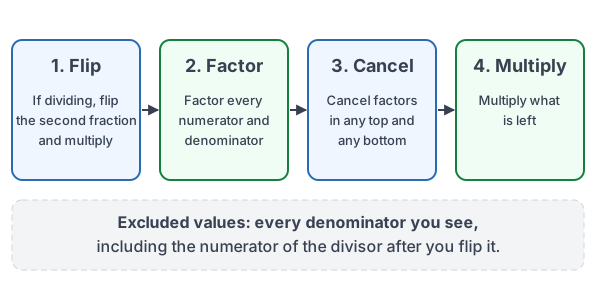
Excluded Values When Dividing
When you divide by \frac{c}{d}, the value c moves to the bottom. So the excluded values include the zeros of b, d and c. Any of them would make a denominator zero at some step.
Worked Examples
Example 1: Multiply monomial fractions
Multiply \frac{6x^2}{5y} \cdot \frac{10y^3}{3x}.
- Multiply the tops and the bottoms (see multiplying fractions): \frac{60x^2y^3}{15xy}
- Divide the numbers: \frac{60}{15} = 4
- Divide the x-powers (see exponent rules): \frac{x^2}{x} = x
- Divide the y-powers: \frac{y^3}{y} = y^2
Answer: 4xy^2, with x \ne 0 and y \ne 0
Example 2: Multiply and cancel
Multiply \frac{x^2 - 9}{x^2 + 5x + 6} \cdot \frac{x + 2}{x - 3}.
- Factor the first top (see factoring the difference of squares): x^2 - 9 = (x - 3)(x + 3)
- Factor the first bottom (see factoring trinomials): x^2 + 5x + 6 = (x + 2)(x + 3)
- Write the product: \frac{(x - 3)(x + 3)}{(x + 2)(x + 3)} \cdot \frac{x + 2}{x - 3}
- Excluded values: x \ne -2, -3, 3
- Cancel (x + 3), (x + 2) and (x - 3): every factor cancels, leaving 1.
Answer: 1, with x \ne -2, -3, 3
Example 3: Divide by flipping
Divide \frac{x^2 - 4}{3x} \div \frac{x + 2}{6x^2}.
- Multiply by the reciprocal: \frac{x^2 - 4}{3x} \cdot \frac{6x^2}{x + 2}
- Factor the top: \frac{(x - 2)(x + 2)}{3x} \cdot \frac{6x^2}{x + 2}
- Excluded values: x \ne 0 and x \ne -2
- Cancel (x + 2): \frac{x - 2}{3x} \cdot 6x^2
- Simplify \frac{6x^2}{3x} = 2x: 2x(x - 2)
Answer: 2x(x - 2), or 2x^2 - 4x, with x \ne 0, -2
Example 4: Divide with an opposite factor
Divide \frac{x^2 - 5x + 6}{x + 1} \div \frac{2 - x}{x^2 - 1}.
- Multiply by the reciprocal: \frac{x^2 - 5x + 6}{x + 1} \cdot \frac{x^2 - 1}{2 - x}
- Factor: \frac{(x - 2)(x - 3)}{x + 1} \cdot \frac{(x - 1)(x + 1)}{2 - x}
- Excluded values: x \ne -1 and x \ne 1 (from the original bottoms) and x \ne 2 (from the flipped bottom)
- Rewrite the opposite (see simplifying rational expressions): 2 - x = -(x - 2)
- Cancel (x + 1) and (x - 2), leaving −1 on the bottom: \frac{(x - 3)(x - 1)}{-1}
- Simplify: -(x - 3)(x - 1)
Answer: -(x - 3)(x - 1), with x \ne -1, 1, 2
Example 5: Word problem with area
A rectangle has length \frac{x + 3}{x - 1} feet and width \frac{x^2 - 1}{2x + 6} feet. Write its area as a simplified expression.
- Area is length times width: \frac{x + 3}{x - 1} \cdot \frac{x^2 - 1}{2x + 6}
- Factor (see factoring out the GCF): \frac{x + 3}{x - 1} \cdot \frac{(x - 1)(x + 1)}{2(x + 3)}
- Cancel (x + 3) and (x - 1): \frac{x + 1}{2}
- Check with x = 5: length \frac{8}{4} = 2, width \frac{24}{16} = 1.5, and 2 \cdot 1.5 = 3, which equals \frac{5 + 1}{2}.
Answer: The area is \frac{x + 1}{2} square feet.
Common Mistakes
| Mistake | Example of the error | Fix |
|---|---|---|
| Flipping the wrong fraction | \frac{a}{b} \div \frac{c}{d} = \frac{b}{a} \cdot \frac{c}{d} | Keep the first, flip the second: \frac{a}{b} \cdot \frac{d}{c}. |
| Canceling terms | Canceling the x in \frac{x + 2}{x} | Only cancel factors. Factor first, then cancel whole factors. |
| Missing excluded values from the divisor | Dividing by \frac{x - 2}{x + 6} and listing only x \ne -6 | After flipping, x - 2 is on the bottom, so x \ne 2 too. |
| Multiplying out first | Expanding (x - 3)(x + 3)(x + 2) before canceling | Cancel while the expressions are factored. It is much easier. |
| Dropping a −1 from an opposite | \frac{x - 2}{2 - x} = 1 | The quotient of opposites is −1. |
Practice Problems
- Multiply \frac{4a}{9b} \cdot \frac{3b^2}{8a^3}.
- Multiply \frac{x + 5}{x - 2} \cdot \frac{x^2 - 4}{x^2 + 5x}.
- Multiply \frac{x^2 + 2x - 15}{x^2 - 9} \cdot \frac{x + 3}{x + 5}.
- Divide \frac{8x^3}{15y} \div \frac{4x}{5y^2}.
- Divide \frac{x^2 - 16}{x + 1} \div \frac{x + 4}{x^2 - 1}.
- Divide \frac{2x + 6}{x^2 - 25} \div \frac{x + 3}{x - 5}.
- Multiply \frac{x^2 - 7x + 12}{x^2 - 9} \cdot \frac{x + 3}{2x - 8}.
- Divide \frac{3 - x}{x + 2} \div \frac{x^2 - 9}{x^2 + 2x}.
- List all excluded values for \frac{x + 1}{x - 4} \div \frac{x - 2}{x + 6}.
- A rectangle has length \frac{x + 2}{x - 3} meters and width \frac{x^2 - 9}{4x + 8} meters. Write its area in simplest form.
Show answers
- Multiply: \frac{12ab^2}{72a^3b}
Divide the numbers: \frac{12}{72} = \frac{1}{6}
Divide the b-powers: \frac{b^2}{b} = b
Divide the a-powers: \frac{a}{a^3} = \frac{1}{a^2}
Answer: \frac{b}{6a^2} - Factor: \frac{x + 5}{x - 2} \cdot \frac{(x - 2)(x + 2)}{x(x + 5)}
Excluded: x \ne 2, 0, -5
Cancel (x + 5) and (x - 2)
Answer: \frac{x + 2}{x} - Factor: \frac{(x + 5)(x - 3)}{(x - 3)(x + 3)} \cdot \frac{x + 3}{x + 5}
Cancel (x + 5), (x - 3) and (x + 3)
Answer: 1, with x \ne \pm 3, -5 - Flip and multiply: \frac{8x^3}{15y} \cdot \frac{5y^2}{4x}
Multiply: \frac{40x^3y^2}{60xy}
Divide the numbers: \frac{40}{60} = \frac{2}{3}
Divide the x-powers: \frac{x^3}{x} = x^2
Divide the y-powers: \frac{y^2}{y} = y
Answer: \frac{2x^2y}{3} - Flip: \frac{x^2 - 16}{x + 1} \cdot \frac{x^2 - 1}{x + 4}
Factor: \frac{(x - 4)(x + 4)}{x + 1} \cdot \frac{(x - 1)(x + 1)}{x + 4}
Cancel (x + 4) and (x + 1)
Answer: (x - 4)(x - 1), with x \ne -1, 1, -4 - Flip: \frac{2x + 6}{x^2 - 25} \cdot \frac{x - 5}{x + 3}
Factor: \frac{2(x + 3)}{(x - 5)(x + 5)} \cdot \frac{x - 5}{x + 3}
Cancel (x + 3) and (x - 5)
Answer: \frac{2}{x + 5}, with x \ne \pm 5, -3 - Factor: \frac{(x - 3)(x - 4)}{(x - 3)(x + 3)} \cdot \frac{x + 3}{2(x - 4)}
Cancel (x - 3), (x + 3) and (x - 4)
Answer: \frac{1}{2}, with x \ne \pm 3, 4 - Flip: \frac{3 - x}{x + 2} \cdot \frac{x^2 + 2x}{x^2 - 9}
Factor: \frac{3 - x}{x + 2} \cdot \frac{x(x + 2)}{(x - 3)(x + 3)}
Rewrite: 3 - x = -(x - 3)
Cancel (x + 2) and (x - 3)
Answer: -\frac{x}{x + 3}, with x \ne -2, 0, \pm 3 - Original bottoms: x \ne 4 and x \ne -6
Flipped bottom: x - 2 \ne 0, so x \ne 2
Answer: x \ne 4, -6, 2 - Area: \frac{x + 2}{x - 3} \cdot \frac{x^2 - 9}{4x + 8}
Factor: \frac{x + 2}{x - 3} \cdot \frac{(x - 3)(x + 3)}{4(x + 2)}
Cancel (x + 2) and (x - 3)
Answer: \frac{x + 3}{4} square meters
FAQ
How do you multiply rational expressions?
Factor every numerator and denominator, cancel common factors, then multiply the remaining tops and the remaining bottoms.
How do you divide rational expressions?
Keep the first expression, flip the second, and multiply. Then factor and cancel as usual.
Do you have to factor before multiplying?
It is the best way. Factoring first shows which factors cancel and keeps the expressions small. Multiplying out first works but makes the canceling much harder to see.
Why are there extra excluded values when dividing?
The numerator of the divisor ends up on the bottom after you flip it. Any value that makes it zero would mean dividing by zero, so it is excluded too.
Summary
- Multiply rational expressions like fractions: tops times tops, bottoms times bottoms.
- To divide, keep the first, flip the second and multiply.
- Factor everything, then cancel common factors across any top and bottom.
- Excluded values come from every denominator, including the flipped divisor.
- Opposite factors cancel to −1.
Previous lesson: Simplifying Rational Expressions
Next lesson: Adding and Subtracting Rational Expressions
Back to the Algebra 2 Index