
Adding and Subtracting Rational Expressions
Adding and subtracting rational expressions works like adding fractions: you need a common denominator. If the denominators already match, combine the numerators. If not, factor each denominator, build the least common denominator (LCD), rewrite each fraction over it, combine the numerators, and simplify.
Before this lesson: You should know Adding and Subtracting Fractions, Least Common Multiple, Simplifying Rational Expressions and Multiplying and Dividing Rational Expressions.
Common Denominators, Again
To add \frac{1}{4} + \frac{1}{6}, you rewrite both over 12: \frac{3}{12} + \frac{2}{12} = \frac{5}{12}. The 12 is the least common multiple of 4 and 6.
Rational expressions work the same way. The least common denominator is the smallest expression that every denominator divides into. You build it from the factors of the denominators, using each factor the greatest number of times it appears in any one denominator.
Steps
- Factor every denominator.
- Build the LCD from all the different factors.
- Rewrite each fraction over the LCD: multiply its top and bottom by the factors it is missing.
- Add or subtract the numerators. Put parentheses around a numerator you subtract.
- Simplify: combine like terms, factor and cancel if you can, and note excluded values.
Worked Examples
Example 1: Same denominator, then simplify
Add \frac{5x}{x + 2} + \frac{10}{x + 2}.
- The denominators match, so add the numerators: \frac{5x + 10}{x + 2}
- Factor the top (see factoring out the GCF): \frac{5(x + 2)}{x + 2}
- Cancel (x + 2): 5
Answer: 5, with x \ne -2
Example 2: Subtract with the same denominator
Subtract \frac{3x + 1}{x - 4} - \frac{x + 9}{x - 4}.
- Subtract the whole second numerator: \frac{(3x + 1) - (x + 9)}{x - 4}
- Distribute the minus sign (see distributive property): \frac{3x + 1 - x - 9}{x - 4}
- Combine like terms (see combining like terms): \frac{2x - 8}{x - 4}
- Factor the top: \frac{2(x - 4)}{x - 4}
- Cancel (x - 4): 2
Answer: 2, with x \ne 4
Example 3: Monomial denominators
Add \frac{3}{4x} + \frac{5}{6x^2}.
- The LCD of 4 and 6 is 12, and the highest power of x is x^2. So the LCD is 12x^2 (see least common multiple).
- First fraction is missing 3x: \frac{3 \cdot 3x}{4x \cdot 3x} = \frac{9x}{12x^2}
- Second fraction is missing 2: \frac{5 \cdot 2}{6x^2 \cdot 2} = \frac{10}{12x^2}
- Add the numerators: \frac{9x + 10}{12x^2}
Answer: \frac{9x + 10}{12x^2}, with x \ne 0
Example 4: Factor to find the LCD
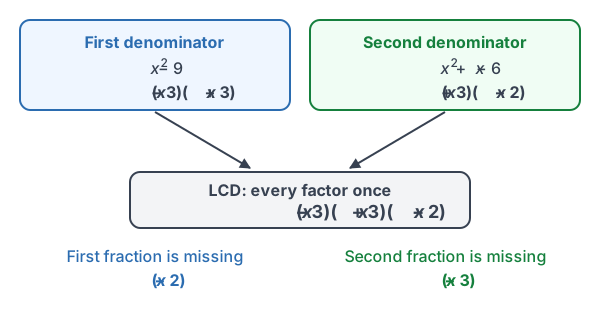
Subtract \frac{x}{x^2 - 9} - \frac{2}{x^2 + x - 6}. This is the diagram above.
- Factor the first denominator (see factoring the difference of squares): x^2 - 9 = (x - 3)(x + 3)
- Factor the second (see factoring trinomials): x^2 + x - 6 = (x + 3)(x - 2)
- LCD: (x - 3)(x + 3)(x - 2)
- Build the first fraction with (x - 2): \frac{x(x - 2)}{(x - 3)(x + 3)(x - 2)}
- Build the second with (x - 3): \frac{2(x - 3)}{(x - 3)(x + 3)(x - 2)}
- Subtract the numerators: \frac{x(x - 2) - 2(x - 3)}{(x - 3)(x + 3)(x - 2)}
- Distribute: \frac{x^2 - 2x - 2x + 6}{(x - 3)(x + 3)(x - 2)}
- Combine like terms: \frac{x^2 - 4x + 6}{(x - 3)(x + 3)(x - 2)}
Answer: \frac{x^2 - 4x + 6}{(x - 3)(x + 3)(x - 2)}, with x \ne 3, -3, 2. The top doesn’t factor, so this is simplified.
Example 5: Word problem with two pipes
Pipe A can fill a tank in x hours, and pipe B can fill it in x + 2 hours. Together they fill \frac{1}{x} + \frac{1}{x + 2} of the tank per hour. Write this as one fraction, then find the combined rate when x = 4.
- LCD: x(x + 2)
- Build the first fraction: \frac{x + 2}{x(x + 2)}
- Build the second fraction: \frac{x}{x(x + 2)}
- Add the numerators: \frac{x + 2 + x}{x(x + 2)}
- Combine like terms: \frac{2x + 2}{x(x + 2)}
- Substitute x = 4: \frac{2(4) + 2}{4(4 + 2)}
- Evaluate: \frac{10}{24}
- Simplify: \frac{5}{12}
Answer: \frac{2x + 2}{x(x + 2)} of the tank per hour; when x = 4, that is \frac{5}{12} of the tank per hour. Check: \frac{1}{4} + \frac{1}{6} = \frac{3}{12} + \frac{2}{12} = \frac{5}{12}.
Common Mistakes
| Mistake | Example of the error | Fix |
|---|---|---|
| Adding the denominators | \frac{1}{x} + \frac{1}{y} = \frac{2}{x + y} | Use a common denominator: \frac{y + x}{xy}. |
| Not distributing the minus | \frac{3x + 1 - x + 9}{x - 4} | Subtract every term: -(x + 9) = -x - 9. |
| Building only the bottom | \frac{x}{(x - 3)(x + 3)(x - 2)} for the first fraction | Multiply the top by the same missing factor: x(x - 2). |
| Canceling terms at the end | Canceling x in \frac{x^2 - 4x + 6}{x(x - 2)} | Only whole factors cancel. Factor the top first, if it factors. |
| Forgetting to simplify | Leaving \frac{2x - 8}{x - 4} | Factor and cancel: \frac{2(x - 4)}{x - 4} = 2. |
Practice Problems
- Add \frac{4}{x + 1} + \frac{3x}{x + 1}.
- Subtract \frac{2x + 5}{x - 3} - \frac{x + 8}{x - 3}.
- Add \frac{2}{3x} + \frac{1}{6x}.
- Subtract \frac{5}{2x^2} - \frac{3}{4x}.
- Add \frac{3}{x - 2} + \frac{4}{x + 5}.
- Subtract \frac{x}{x + 4} - \frac{2}{x - 1}.
- Add \frac{1}{x^2 - 4} + \frac{1}{x + 2}.
- Subtract \frac{2x}{x^2 - 1} - \frac{1}{x - 1}.
- Add \frac{3}{x - 5} + \frac{2}{5 - x}.
- A cyclist rides 12 miles at x miles per hour and returns at x + 2 miles per hour. The total time is \frac{12}{x} + \frac{12}{x + 2} hours. Write it as one fraction and find the time when x = 10.
Show answers
- Same denominator: \frac{4 + 3x}{x + 1}
Answer: \frac{3x + 4}{x + 1} - Subtract: \frac{(2x + 5) - (x + 8)}{x - 3}
Distribute: \frac{2x + 5 - x - 8}{x - 3}
Combine: \frac{x - 3}{x - 3}
Answer: 1, x \ne 3 - LCD: 6x
Build: \frac{4}{6x} + \frac{1}{6x}
Answer: \frac{5}{6x} - LCD: 4x^2
Build: \frac{10}{4x^2} - \frac{3x}{4x^2}
Answer: \frac{10 - 3x}{4x^2} - LCD: (x - 2)(x + 5)
Numerator: 3(x + 5) + 4(x - 2)
Distribute: 3x + 15 + 4x - 8
Combine: 7x + 7
Answer: \frac{7(x + 1)}{(x - 2)(x + 5)} - LCD: (x + 4)(x - 1)
Numerator: x(x - 1) - 2(x + 4)
Distribute: x^2 - x - 2x - 8
Combine: x^2 - 3x - 8
Answer: \frac{x^2 - 3x - 8}{(x + 4)(x - 1)} - Factor: x^2 - 4 = (x - 2)(x + 2), so the LCD is (x - 2)(x + 2)
Numerator: 1 + (x - 2)
Combine: x - 1
Answer: \frac{x - 1}{(x - 2)(x + 2)} - Factor: x^2 - 1 = (x - 1)(x + 1), the LCD
Numerator: 2x - (x + 1)
Distribute: 2x - x - 1
Combine: x - 1
Fraction: \frac{x - 1}{(x - 1)(x + 1)}
Cancel: \frac{1}{x + 1}, x \ne \pm 1 - Rewrite 5 - x = -(x - 5): \frac{3}{x - 5} - \frac{2}{x - 5}
Subtract: \frac{1}{x - 5}
Answer: \frac{1}{x - 5} - LCD: x(x + 2)
Numerator: 12(x + 2) + 12x
Distribute: 12x + 24 + 12x
Combine: 24x + 24
One fraction: \frac{24x + 24}{x(x + 2)}
Substitute x = 10: \frac{24(10) + 24}{10(12)}
Evaluate: \frac{264}{120}
Divide: 2.2
Answer: 2.2 hours
FAQ
How do you add rational expressions?
Find a common denominator, rewrite each fraction over it, add the numerators and keep the denominator. Then simplify.
How do you find the LCD of rational expressions?
Factor each denominator completely. The LCD uses every different factor, each raised to the highest power that appears in any one denominator.
Why do you put parentheses around the second numerator when subtracting?
The minus sign applies to the whole numerator, not just its first term. Parentheses remind you to distribute the minus to every term.
Can I just multiply the denominators together?
Yes, that always gives a common denominator, but it may not be the least one. You will then have more canceling to do at the end.
Summary
- Same denominator: combine the numerators and keep the denominator.
- Different denominators: factor them and build the LCD.
- Multiply each numerator by the same factors you added to its denominator.
- Put parentheses around a numerator you subtract, then distribute the minus.
- Simplify at the end and list excluded values.
Previous lesson: Multiplying and Dividing Rational Expressions
Next lesson: Complex Rational Expressions
Back to the Algebra 2 Index