
Complex Rational Expressions
Complex rational expressions are fractions that have fractions in their numerator, denominator or both, like \frac{1 + \frac{1}{x}}{1 - \frac{1}{x^2}}. To simplify one, either combine the top and bottom into single fractions and divide, or multiply the top and bottom by the LCD of all the small fractions. Both methods give the same answer.
Before this lesson: You should know Nested Fractions, Multiplying and Dividing Rational Expressions and Adding and Subtracting Rational Expressions.
A Fraction Inside a Fraction
A complex rational expression (also called a complex fraction) has a main fraction bar with smaller fractions above or below it. You met the number version in nested fractions. The same two methods work when the small fractions contain variables.
The main fraction bar means division. So \frac{A}{B} with fractions in A and B is just A \div B.
Two Methods
| Method | Steps | Best when |
|---|---|---|
| 1. Combine, then divide | Write the top as one fraction and the bottom as one fraction. Then multiply the top by the reciprocal of the bottom. | The top and bottom are already single fractions |
| 2. Multiply by the LCD | Find the LCD of every small fraction. Multiply the whole top and the whole bottom by it, then simplify. | The top or bottom has sums like 1 + \frac{1}{x} |
Write down the excluded values first: any value that makes a small denominator zero, or makes the whole bottom zero.
Worked Examples
Example 1: Single fractions on top and bottom
Simplify \frac{\frac{x}{3}}{\frac{x^2}{6}}.
- Rewrite the main bar as division: \frac{x}{3} \div \frac{x^2}{6}
- Multiply by the reciprocal (see multiplying and dividing rational expressions): \frac{x}{3} \cdot \frac{6}{x^2}
- Multiply: \frac{6x}{3x^2}
- Simplify: \frac{2}{x}
Answer: \frac{2}{x}, with x \ne 0
Example 2: Method 1, combine then divide
Simplify \frac{1 + \frac{1}{x}}{1 - \frac{1}{x^2}}.
- Combine the top over x (see adding rational expressions): 1 + \frac{1}{x} = \frac{x + 1}{x}
- Combine the bottom over x^2: 1 - \frac{1}{x^2} = \frac{x^2 - 1}{x^2}
- Divide by multiplying by the reciprocal: \frac{x + 1}{x} \cdot \frac{x^2}{x^2 - 1}
- Factor (see factoring the difference of squares): \frac{x + 1}{x} \cdot \frac{x^2}{(x - 1)(x + 1)}
- Cancel (x + 1) and one x: \frac{x}{x - 1}
Answer: \frac{x}{x - 1}, with x \ne 0, 1, -1
Example 3: Method 2, multiply by the LCD
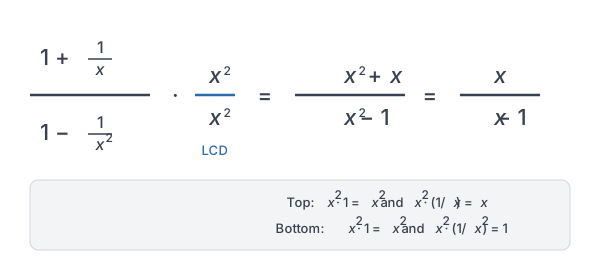
Simplify the same expression, \frac{1 + \frac{1}{x}}{1 - \frac{1}{x^2}}, using the LCD. This is the diagram above.
- The small denominators are x and x^2, so the LCD is x^2.
- Multiply the top and bottom by x^2: \frac{x^2\left(1 + \frac{1}{x}\right)}{x^2\left(1 - \frac{1}{x^2}\right)}
- Distribute on top (see distributive property): x^2 + x
- Distribute on the bottom: x^2 - 1
- Write the new fraction: \frac{x^2 + x}{x^2 - 1}
- Factor: \frac{x(x + 1)}{(x - 1)(x + 1)}
- Cancel (x + 1): \frac{x}{x - 1}
Answer: \frac{x}{x - 1}. Same answer, fewer steps.
Example 4: Two variables
Simplify \frac{\frac{1}{a} - \frac{1}{b}}{\frac{1}{a} + \frac{1}{b}}.
- The LCD of a and b is ab.
- Multiply the top by ab: ab \cdot \frac{1}{a} - ab \cdot \frac{1}{b} = b - a
- Multiply the bottom by ab: ab \cdot \frac{1}{a} + ab \cdot \frac{1}{b} = b + a
- Write the new fraction: \frac{b - a}{b + a}
Answer: \frac{b - a}{a + b}, with a \ne 0, b \ne 0 and a \ne -b
Example 5: Word problem with average speed
You drive d miles to a lake at 30 miles per hour and come back the same d miles at 20 miles per hour. Your average speed is total distance over total time: \frac{2d}{\frac{d}{30} + \frac{d}{20}}. Simplify it.
- The LCD of 30 and 20 is 60 (see least common multiple).
- Multiply the top by 60: 60 \cdot 2d = 120d
- Multiply the bottom by 60: 60 \cdot \frac{d}{30} + 60 \cdot \frac{d}{20} = 2d + 3d
- Combine: 5d
- Write the new fraction: \frac{120d}{5d}
- Cancel d: \frac{120}{5}
- Divide: 24
Answer: 24 miles per hour. It is not 25, the average of 30 and 20, because you spend more time at the slower speed.
Common Mistakes
| Mistake | Example of the error | Fix |
|---|---|---|
| Multiplying only the top by the LCD | \frac{x^2 + x}{1 - \frac{1}{x^2}} | Multiply the top and the bottom by the same LCD. |
| Flipping the wrong part | \frac{x}{3} \div \frac{x^2}{6} = \frac{3}{x} \cdot \frac{x^2}{6} | Keep the top fraction, flip the bottom one: \frac{x}{3} \cdot \frac{6}{x^2}. |
| Canceling terms | Canceling the 1s in \frac{1 + \frac{1}{x}}{1 - \frac{1}{x}} | The 1s are terms, not factors. Clear the small fractions first. |
| Averaging the speeds | Average speed is \frac{30 + 20}{2} = 25 | Use total distance over total time: 24 mph. |
| Missing a distributed term | x^2\left(1 + \frac{1}{x}\right) = x^2 + 1 | Multiply every term: x^2 \cdot \frac{1}{x} = x, so it is x^2 + x. |
Practice Problems
- Simplify \frac{\frac{x}{4}}{\frac{x^3}{8}}.
- Simplify \frac{\frac{2}{x}}{\frac{6}{x^2}}.
- Simplify \frac{1 + \frac{2}{x}}{1 - \frac{4}{x^2}}.
- Simplify \frac{3 - \frac{1}{x}}{9 - \frac{1}{x^2}}.
- Simplify \frac{\frac{1}{x} + \frac{1}{y}}{\frac{1}{xy}}.
- Simplify \frac{\frac{1}{x + 1}}{\frac{x}{x + 1} + 1}.
- Simplify \frac{\frac{2}{x - 1} - 1}{\frac{1}{x - 1}}.
- Simplify \frac{\frac{a}{b} - \frac{b}{a}}{\frac{1}{a} + \frac{1}{b}}.
- Simplify \frac{\frac{x}{x + 2}}{\frac{x^2}{x^2 - 4}}.
- A runner jogs d miles at 6 mph and walks back at 4 mph. Simplify the average speed \frac{2d}{\frac{d}{6} + \frac{d}{4}}.
Show answers
- Flip and multiply: \frac{x}{4} \cdot \frac{8}{x^3}
Multiply: \frac{8x}{4x^3}
Simplify: \frac{2}{x^2} - Flip and multiply: \frac{2}{x} \cdot \frac{x^2}{6}
Multiply: \frac{2x^2}{6x}
Simplify: \frac{x}{3} - Multiply top and bottom by x^2: \frac{x^2 + 2x}{x^2 - 4}
Factor: \frac{x(x + 2)}{(x - 2)(x + 2)}
Cancel: \frac{x}{x - 2} - Multiply top and bottom by x^2: \frac{3x^2 - x}{9x^2 - 1}
Factor: \frac{x(3x - 1)}{(3x - 1)(3x + 1)}
Cancel: \frac{x}{3x + 1} - Multiply top and bottom by xy: top y + x, bottom 1
Answer: x + y - Multiply top and bottom by x + 1: top 1, bottom x + (x + 1)
Combine: 2x + 1
Answer: \frac{1}{2x + 1} - Multiply top and bottom by x - 1: top 2 - (x - 1), bottom 1
Distribute: 2 - x + 1
Combine: 3 - x
Answer: 3 - x - Multiply top and bottom by ab: top a^2 - b^2, bottom b + a
Factor: \frac{(a - b)(a + b)}{a + b}
Cancel: a - b - Flip and multiply: \frac{x}{x + 2} \cdot \frac{x^2 - 4}{x^2}
Factor: \frac{x}{x + 2} \cdot \frac{(x - 2)(x + 2)}{x^2}
Cancel (x + 2) and one x: \frac{x - 2}{x} - LCD of 6 and 4: 12
Top: 12 \cdot 2d = 24d
Bottom: 12 \cdot \frac{d}{6} + 12 \cdot \frac{d}{4} = 2d + 3d
Combine: 5d
Write the fraction: \frac{24d}{5d}
Cancel d: \frac{24}{5}
Divide: 4.8
Answer: 4.8 mph
FAQ
What is a complex rational expression?
It is a rational expression with a fraction in its numerator, its denominator or both. It is also called a complex fraction.
What is the fastest way to simplify a complex fraction?
Usually, multiply the top and bottom by the LCD of all the small fractions. That clears every small fraction in one step.
Does the method change the answer?
No. Combining and dividing, or multiplying by the LCD, always gives the same simplified expression. Pick the one that looks shorter.
How do you find excluded values for a complex fraction?
Exclude any value that makes a small denominator zero, and any value that makes the whole bottom of the main fraction zero.
Summary
- A complex rational expression has fractions inside its top or bottom.
- The main fraction bar means division.
- Method 1: combine the top and bottom into single fractions, then multiply by the reciprocal.
- Method 2: multiply the top and bottom by the LCD of all the small fractions.
- Factor and cancel at the end, and list excluded values.
Previous lesson: Adding and Subtracting Rational Expressions
Next lesson: Solving Rational Equations
Back to the Algebra 2 Index