
Solving Rational Equations
Solving rational equations means solving equations with variables in a denominator, like \frac{2}{x} + \frac{1}{3} = 1. Multiply both sides by the least common denominator to clear the fractions, then solve the equation that is left. Finally, check each answer: any value that makes an original denominator zero is extraneous and must be thrown out.
Before this lesson: You should know Adding and Subtracting Rational Expressions, Equations with Variables on Both Sides, Solving Quadratic Equations by Factoring and Solving Radical Equations.
Clear the Fractions First
Fractions make equations harder to solve. If every term is multiplied by the LCD, each denominator divides out, and you get a polynomial equation you already know how to solve.
That multiplication can add answers that don’t really work, just like squaring did in solving radical equations. A value that makes a denominator zero can never be a solution, so list the excluded values before you start.
Steps
- Find the excluded values (zeros of every denominator).
- Find the LCD of all the denominators.
- Multiply every term on both sides by the LCD.
- Solve the resulting equation.
- Throw out any answer that is an excluded value, and check the rest.
If the equation is a single fraction equal to a single fraction, you can cross multiply instead, as with proportions.
Worked Examples
Example 1: Cross multiply a proportion
Solve \frac{3}{x + 1} = \frac{5}{x - 3}.
- Excluded values: x \ne -1 and x \ne 3
- Cross multiply: 3(x - 3) = 5(x + 1)
- Distribute (see distributive property): 3x - 9 = 5x + 5
- Subtract 5x from both sides (see variables on both sides): -2x - 9 = 5
- Add 9 to both sides: -2x = 14
- Divide both sides by −2: x = -7
- Check: \frac{3}{-6} = -\frac{1}{2} and \frac{5}{-10} = -\frac{1}{2}. It works.
Answer: x = -7
Example 2: Multiply by the LCD
Solve \frac{2}{x} + \frac{1}{3} = 1.
- Excluded value: x \ne 0. The LCD is 3x (see least common multiple).
- Multiply every term by 3x: 3x \cdot \frac{2}{x} + 3x \cdot \frac{1}{3} = 3x \cdot 1
- Simplify each term: 6 + x = 3x
- Subtract x from both sides: 6 = 2x
- Divide both sides by 2: x = 3
- Check: \frac{2}{3} + \frac{1}{3} = 1. It works.
Answer: x = 3
Example 3: A quadratic appears
Solve x + \frac{6}{x} = 5.
- Excluded value: x \ne 0. Multiply every term by x: x^2 + 6 = 5x
- Subtract 5x from both sides: x^2 - 5x + 6 = 0
- Factor (see factoring trinomials): (x - 2)(x - 3) = 0
- Solve each factor (see solving quadratic equations by factoring): x = 2 or x = 3
- Check 2: 2 + \frac{6}{2} = 2 + 3 = 5. Check 3: 3 + \frac{6}{3} = 3 + 2 = 5. Both work.
Answer: x = 2 or x = 3
Example 4: An extraneous solution
Solve \frac{x}{x - 2} + \frac{1}{x + 2} = \frac{8}{x^2 - 4}.
- Factor the last denominator (see factoring the difference of squares): x^2 - 4 = (x - 2)(x + 2)
- Excluded values: x \ne 2 and x \ne -2. The LCD is (x - 2)(x + 2).
- Multiply every term by the LCD: x(x + 2) + (x - 2) = 8
- Distribute: x^2 + 2x + x - 2 = 8
- Combine like terms: x^2 + 3x - 2 = 8
- Subtract 8: x^2 + 3x - 10 = 0
- Factor: (x + 5)(x - 2) = 0
- Solve: x = -5 or x = 2
- x = 2 is an excluded value, so it is extraneous.
- Check −5: \frac{-5}{-7} + \frac{1}{-3} = \frac{15}{21} - \frac{7}{21} = \frac{8}{21}, and \frac{8}{25 - 4} = \frac{8}{21}. It works.
Answer: x = -5 only
Example 5: Work problem
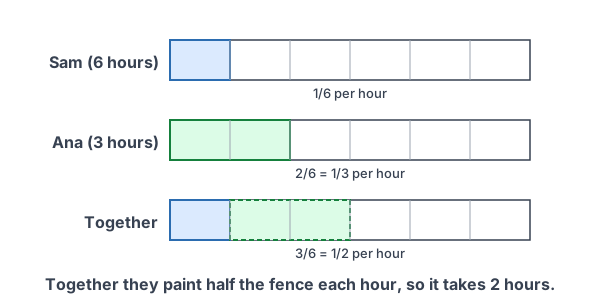
Sam can paint a fence in 6 hours. Ana can paint it in 3 hours. How long does it take if they work together? This is the diagram above.
- Each person’s rate is 1 fence divided by their time. Together the rates add up to \frac{1}{t}: \frac{1}{6} + \frac{1}{3} = \frac{1}{t}
- Multiply every term by the LCD, 6t: t + 2t = 6
- Combine like terms: 3t = 6
- Divide both sides by 3: t = 2
- Check: \frac{1}{6} + \frac{1}{3} = \frac{1}{6} + \frac{2}{6} = \frac{3}{6} = \frac{1}{2}. It works.
Answer: 2 hours. Together they are faster than either one alone.
Common Mistakes
| Mistake | Example of the error | Fix |
|---|---|---|
| Multiplying only some terms by the LCD | \frac{2}{x} + \frac{1}{3} = 1 becomes 6 + x = 1 | Multiply every term, including the 1: 6 + x = 3x. |
| Keeping an excluded value | Giving x = 2 as an answer in Example 4 | x = 2 makes a denominator zero. It is extraneous. |
| Adding the times in a work problem | Together they take 6 + 3 = 9 hours | Add the rates, not the times: \frac{1}{6} + \frac{1}{3} = \frac{1}{2}. |
| Cross multiplying with more than two fractions | Cross multiplying \frac{2}{x} + \frac{1}{3} = 1 | Cross multiply only when one fraction equals one fraction. Otherwise use the LCD. |
| Forgetting to distribute | 3(x - 3) = 3x - 3 | Multiply every term: 3x - 9. |
Practice Problems
- Solve \frac{4}{x} = \frac{2}{5}.
- Solve \frac{2}{x - 1} = \frac{6}{x + 3}.
- Solve \frac{3}{x} + \frac{1}{2} = 2.
- Solve x - \frac{8}{x} = 2.
- Solve \frac{5}{x + 2} = \frac{3}{x}.
- Solve \frac{x}{x - 4} = \frac{4}{x - 4} + 3.
- Solve \frac{1}{x - 1} + \frac{2}{x + 1} = \frac{4}{x^2 - 1}.
- Solve \frac{x}{x + 1} + \frac{2}{x} = 1.
- Pipe A fills a pool in 4 hours, and pipe B fills it in 12 hours. How long do they take together?
- A boat goes 24 miles downstream in the same time it goes 16 miles upstream. The current is 2 mph. Find the boat’s speed b in still water, using \frac{24}{b + 2} = \frac{16}{b - 2}.
Show answers
- Cross multiply: 2x = 20
Divide by 2: x = 10
Check: \frac{4}{10} = \frac{2}{5} - Cross multiply: 2(x + 3) = 6(x - 1)
Distribute: 2x + 6 = 6x - 6
Subtract 2x: 6 = 4x - 6
Add 6: 12 = 4x
Divide by 4: x = 3
Check: \frac{2}{2} = \frac{6}{6} - Multiply by 2x: 6 + x = 4x
Subtract x: 6 = 3x
Divide by 3: x = 2
Check: \frac{3}{2} + \frac{1}{2} = 2 - Multiply by x: x^2 - 8 = 2x
Subtract 2x: x^2 - 2x - 8 = 0
Factor: (x - 4)(x + 2) = 0
Solve: x = 4 or x = -2
Check: 4 - 2 = 2 and -2 + 4 = 2
Answer: x = 4 or x = -2 - Cross multiply: 5x = 3(x + 2)
Distribute: 5x = 3x + 6
Subtract 3x: 2x = 6
Divide by 2: x = 3
Check: \frac{5}{5} = \frac{3}{3} - Excluded: x \ne 4
Multiply by x - 4: x = 4 + 3(x - 4)
Distribute: x = 4 + 3x - 12
Combine: x = 3x - 8
Subtract 3x: -2x = -8
Divide by −2: x = 4, which is excluded
Answer: no solution - Excluded: x \ne \pm 1; LCD (x - 1)(x + 1)
Multiply: (x + 1) + 2(x - 1) = 4
Distribute: x + 1 + 2x - 2 = 4
Combine: 3x - 1 = 4
Add 1: 3x = 5
Divide by 3: x = \frac{5}{3} - Excluded: x \ne 0, -1; LCD x(x + 1)
Multiply: x^2 + 2(x + 1) = x(x + 1)
Distribute: x^2 + 2x + 2 = x^2 + x
Subtract x^2: 2x + 2 = x
Subtract x: x + 2 = 0
Answer: x = -2 (check: \frac{-2}{-1} + \frac{2}{-2} = 2 - 1 = 1) - Equation: \frac{1}{4} + \frac{1}{12} = \frac{1}{t}
Multiply by 12t: 3t + t = 12
Combine: 4t = 12
Divide by 4: t = 3
Answer: 3 hours - Cross multiply: 24(b - 2) = 16(b + 2)
Distribute: 24b - 48 = 16b + 32
Subtract 16b: 8b - 48 = 32
Add 48: 8b = 80
Divide by 8: b = 10
Answer: 10 mph
FAQ
How do you solve a rational equation?
Multiply every term by the LCD to clear the fractions, solve the equation that is left, and check each answer. Throw out any answer that makes an original denominator zero.
What is an extraneous solution in a rational equation?
It is an answer from the algebra that makes a denominator in the original equation zero. It can’t be a solution, because division by zero is undefined.
When can you cross multiply?
Only when the equation is one fraction equal to one fraction, like \frac{a}{b} = \frac{c}{d}. Then ad = bc.
How do you set up a work problem?
Write each worker’s rate as 1 job over their time. Add the rates and set the sum equal to \frac{1}{t}, where t is the time working together.
Summary
- List the excluded values first.
- Multiply every term on both sides by the LCD to clear the fractions.
- Solve the resulting linear or quadratic equation.
- Throw out excluded values and check the rest.
- In work problems, add the rates, not the times.
Previous lesson: Complex Rational Expressions
Next lesson: Graphing Rational Functions
Back to the Algebra 2 Index