
Inverse Variation
Inverse variation is a relationship where one quantity gets smaller as the other gets bigger, so that their product stays the same. It is written y = \frac{k}{x}, or xy = k, where k is a nonzero constant called the constant of variation. If x doubles, y is cut in half.
Before this lesson: You should know Direct Variation, Proportions, One-Step Equations and Function Notation.
What Inverse Variation Looks Like
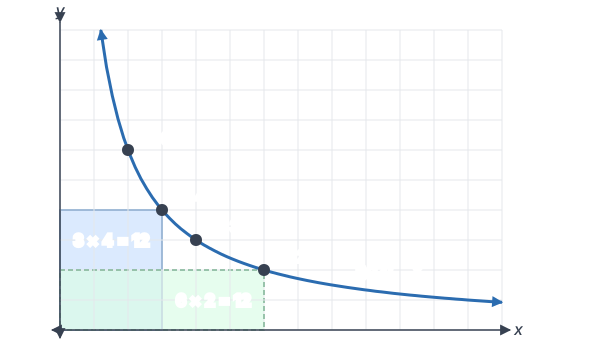
Think of a 12-mile trip. At 2 miles per hour it takes 6 hours. At 3 miles per hour it takes 4 hours. At 6 miles per hour it takes 2 hours. Speed goes up, time goes down, and speed times time is always 12.
That is the key test. In direct variation, the ratio \frac{y}{x} stays the same. In inverse variation, the product xy stays the same.
| Direct variation | Inverse variation | |
|---|---|---|
| Equation | y = kx | y = \frac{k}{x} |
| What stays the same | \frac{y}{x} = k | xy = k |
| When x doubles | y doubles | y is cut in half |
| Graph | A line through the origin | A curve with two branches that never touch the axes |
Worked Examples
Example 1: Use a table to decide
Does this table show inverse variation? x: 1, 2, 3, 6 and y: 12, 6, 4, 2.
- Multiply each pair: 1 \cdot 12 = 12
- Next pair: 2 \cdot 6 = 12
- Next pair: 3 \cdot 4 = 12
- Last pair: 6 \cdot 2 = 12
- Every product is 12, so xy = 12.
Answer: Yes. It is inverse variation with k = 12, so y = \frac{12}{x}.
Example 2: Find k, then find y
y varies inversely with x, and y = 8 when x = 3. Find y when x = 6.
- Write the inverse variation equation: y = \frac{k}{x}
- Substitute the known pair: 8 = \frac{k}{3}
- Multiply both sides by 3 (see one-step equations): k = 24
- Write the equation: y = \frac{24}{x}
- Substitute x = 6: y = \frac{24}{6}
- Divide: y = 4
Answer: y = 4. Doubling x from 3 to 6 cut y in half, from 8 to 4.
Example 3: Recognize the equation
Which equations show inverse variation? (a) xy = 5 (b) y = 5x (c) y = \frac{3}{x} + 1
- (a) The product xy is the constant 5. This is inverse variation with k = 5.
- (b) This has the form y = kx, which is direct variation (see direct variation).
- (c) Test the product: at x = 1, y = 4 and xy = 4; at x = 3, y = 2 and xy = 6. The product changes, so this is not inverse variation.
Answer: Only (a).
Example 4: Inverse square variation
The brightness I of a light varies inversely with the square of the distance d: I = \frac{k}{d^2}. A light measures 40 units at 3 meters. How bright is it at 6 meters?
- Substitute the known values: 40 = \frac{k}{3^2}
- Square: 40 = \frac{k}{9}
- Multiply both sides by 9: k = 360
- Write the equation: I = \frac{360}{d^2}
- Substitute d = 6: I = \frac{360}{6^2}
- Square: I = \frac{360}{36}
- Divide: I = 10
Answer: 10 units. Doubling the distance made the light one fourth as bright, because 2^2 = 4.
Example 5: Word problem with speed and time
A drive takes 4 hours at 60 miles per hour. The time varies inversely with the speed. How long does the same drive take at 48 miles per hour?
- Write the equation: t = \frac{k}{s}
- Substitute the known values: 4 = \frac{k}{60}
- Multiply both sides by 60: k = 240. This is the distance in miles.
- Substitute s = 48: t = \frac{240}{48}
- Divide: t = 5
Answer: 5 hours.
Common Mistakes
| Mistake | Example of the error | Fix |
|---|---|---|
| Using the direct variation formula | y = kx, so 8 = 3k | Inverse variation is y = \frac{k}{x}, so 8 = \frac{k}{3} and k = 24. |
| Finding k as a ratio | k = \frac{y}{x} = \frac{8}{3} | For inverse variation, k = xy = 3 \cdot 8 = 24. |
| Thinking “inverse” means subtracting | y goes down by the same amount each time | y goes down by a factor: double x, halve y. |
| Forgetting the square | I = \frac{360}{6} = 60 | Inverse square means divide by d^2: \frac{360}{36} = 10. |
| Letting x = 0 | Plotting a point on the y-axis | \frac{k}{0} is undefined, so the graph never touches the axes. |
Practice Problems
- Does this table show inverse variation? x: 2, 4, 5, 10 and y: 10, 5, 4, 2. If so, find k.
- y varies inversely with x, and y = 9 when x = 4. Find y when x = 12.
- y varies inversely with x, and y = 2.5 when x = 8. Find x when y = 5.
- y varies inversely with x, and y = -3 when x = 6. Write the equation.
- Is y = \frac{7}{x} inverse variation? Is y = \frac{x}{7}?
- Six painters can paint a building in 10 hours. The time varies inversely with the number of painters. How long would 4 painters take?
- At a fixed temperature, gas pressure P varies inversely with volume V. If P = 30 psi when V = 4 liters, find P when V = 6 liters.
- I varies inversely with the square of d, and I = 18 when d = 2. Find I when d = 6.
- A guitar string’s pitch varies inversely with its length. A 60 cm string plays at 440 Hz. What pitch does a 66 cm string play?
- In an inverse variation, what happens to y when x doubles? Explain using y = \frac{k}{x}.
Show answers
- Multiply each pair: 2 \cdot 10 = 20, 4 \cdot 5 = 20, 5 \cdot 4 = 20, 10 \cdot 2 = 20
Every product is 20
Answer: yes, k = 20 - Find k: k = xy = 4 \cdot 9 = 36
Equation: y = \frac{36}{x}
Substitute: y = \frac{36}{12}
Divide: y = 3 - Find k: k = 8 \cdot 2.5 = 20
Equation: y = \frac{20}{x}
Substitute y = 5: 5 = \frac{20}{x}
Multiply by x: 5x = 20
Divide by 5: x = 4 - Find k: k = 6 \cdot (-3) = -18
Answer: y = -\frac{18}{x} - y = \frac{7}{x} means xy = 7, so yes, with k = 7
y = \frac{x}{7} means y = \frac{1}{7}x, which is direct variation
Answer: the first yes, the second no - Find k: k = 6 \cdot 10 = 60
Equation: t = \frac{60}{n}
Substitute: t = \frac{60}{4}
Divide: 15 hours - Find k: k = 30 \cdot 4 = 120
Equation: P = \frac{120}{V}
Substitute: P = \frac{120}{6}
Divide: 20 psi - Substitute: 18 = \frac{k}{2^2}
Square: 18 = \frac{k}{4}
Multiply by 4: k = 72
Substitute: I = \frac{72}{6^2}
Square: I = \frac{72}{36}
Divide: I = 2 - Find k: k = 60 \cdot 440 = 26{,}400
Substitute: f = \frac{26{,}400}{66}
Divide: 400 Hz - Replace x with 2x: y = \frac{k}{2x}
Rewrite: y = \frac{1}{2} \cdot \frac{k}{x}
Answer: y is cut in half
FAQ
What is inverse variation?
It is a relationship y = \frac{k}{x} where the product xy always equals the same nonzero number k. As one quantity increases, the other decreases by the same factor.
How do you find the constant of variation?
Multiply a known pair of values: k = xy. For example, if y = 8 when x = 3, then k = 24.
What is the difference between direct and inverse variation?
In direct variation, y = kx and the ratio \frac{y}{x} stays the same. In inverse variation, y = \frac{k}{x} and the product xy stays the same.
What does the graph of inverse variation look like?
It is a hyperbola with two branches. When k is positive, the branches are in quadrants I and III. The graph gets closer and closer to both axes but never touches them.
Summary
- Inverse variation: y = \frac{k}{x}, or xy = k, with k \ne 0.
- Find k by multiplying a known pair: k = xy.
- When x is multiplied by a number, y is divided by that number.
- Inverse square variation uses y = \frac{k}{x^2}.
- The graph never touches the axes, because x and y can’t be 0.
Previous lesson: Solving Radical Equations
Next lesson: Simplifying Rational Expressions
Back to the Algebra 2 Index