
Solving Trig Equations with Identities
Solving trig equations with identities means rewriting an equation so it has only one trig function of one angle, then solving it. For \sin 2x = \cos x, replace \sin 2x with 2 \sin x \cos x, factor, and set each factor equal to 0. Use Pythagorean, double-angle and reciprocal identities to make the swap.
Before this lesson: You should know Solving Trig Equations, Fundamental Trig Identities and Double-Angle Formulas.
Why Use Identities to Solve Trig Equations?
An equation like 2 \cos^2 x + 3 \sin x - 3 = 0 mixes sine and cosine. You can’t solve for one function while the other is still there. An identity lets you trade one for the other.
Here, \cos^2 x = 1 - \sin^2 x turns the whole equation into sine only. Then it is a quadratic in \sin x, and you already know how to solve those.
The same idea works for different angles. In \sin 2x = \cos x, the angles 2x and x don’t match. The double-angle formula rewrites \sin 2x with angle x, so both sides use the same angle.
How to Solve Trig Equations with Identities
- Look for mixed functions (like sine and cosine) or mixed angles (like 2x and x).
- Pick an identity that leaves one function of one angle. Common choices are in the table below.
- Move every term to one side so the other side is 0.
- Factor, then set each factor equal to 0.
- Solve each simpler equation on [0, 2\pi).
- If you squared both sides, check every answer in the original equation.
| If the equation has… | Try this identity | Result |
|---|---|---|
| \sin^2 x and \cos x | \sin^2 x = 1 - \cos^2 x | Only cosine |
| \cos^2 x and \sin x | \cos^2 x = 1 - \sin^2 x | Only sine |
| \sin 2x with \sin x or \cos x | \sin 2x = 2 \sin x \cos x | Only angle x |
| \cos 2x and \cos x | \cos 2x = 2\cos^2 x - 1 | Only cosine |
| \cos 2x and \sin x | \cos 2x = 1 - 2\sin^2 x | Only sine |
| \sec^2 x and \tan x | \sec^2 x = 1 + \tan^2 x | Only tangent |
Worked Examples
Example 1: Use a Pythagorean identity
Solve 2 \cos^2 x + 3 \sin x - 3 = 0 on [0, 2\pi).
2(1 - \sin^2 x) + 3 \sin x - 3 = 0
Replace \cos^2 x with 1 - \sin^2 x (see Pythagorean identities)
2 - 2\sin^2 x + 3 \sin x - 3 = 0
Distribute the 2.
-2\sin^2 x + 3 \sin x - 1 = 0
Combine the constants, 2 - 3 = -1.
2\sin^2 x - 3 \sin x + 1 = 0
Multiply both sides by −1.
(2 \sin x - 1)(\sin x - 1) = 0
Factor the trinomial (see factoring trinomials when a is not 1)
2 \sin x - 1 = 0
Set the first factor equal to 0.
\sin x = \frac{1}{2}Add 1 and divide by 2.
Solve it on the unit circle: x = \frac{\pi}{6} or x = \frac{5\pi}{6}
\sin x - 1 = 0
Set the second factor equal to 0.
\sin x = 1
Add 1 to both sides.
x = \frac{\pi}{2}Solve it on the unit circle.
Answer: x = \frac{\pi}{6}, \frac{\pi}{2}, \frac{5\pi}{6}
Example 2: Use the double-angle formula for sine
Solve \sin 2x = \cos x on [0, 2\pi).
2 \sin x \cos x = \cos x
Replace \sin 2x with 2 \sin x \cos x.
2 \sin x \cos x - \cos x = 0
Subtract \cos x from both sides.
\cos x (2 \sin x - 1) = 0
Factor out the GCF \cos x (see factoring out the GCF)
Set the first factor equal to 0: \cos x = 0, so x = \frac{\pi}{2} or x = \frac{3\pi}{2}
2 \sin x - 1 = 0
Set the second factor equal to 0.
\sin x = \frac{1}{2}Add 1 and divide by 2.
Solve it: x = \frac{\pi}{6} or x = \frac{5\pi}{6}
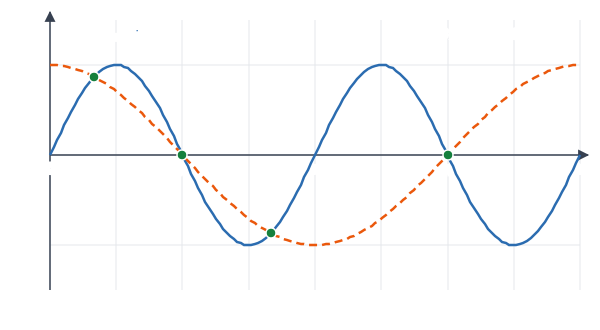
Answer: x = \frac{\pi}{6}, \frac{\pi}{2}, \frac{5\pi}{6}, \frac{3\pi}{2}. These are the four crossing points in the graph above. Don’t divide both sides by \cos x; that would lose \frac{\pi}{2} and \frac{3\pi}{2}.
Example 3: Use the double-angle formula for cosine
Solve \cos 2x + 3 \cos x + 2 = 0 on [0, 2\pi).
2\cos^2 x - 1 + 3 \cos x + 2 = 0
The other terms use \cos x, so replace \cos 2x with 2\cos^2 x - 1.
2\cos^2 x + 3 \cos x + 1 = 0
Combine the constants, -1 + 2 = 1.
(2 \cos x + 1)(\cos x + 1) = 0
Factor the trinomial.
2 \cos x + 1 = 0
Set the first factor equal to 0.
\cos x = -\frac{1}{2}Subtract 1 and divide by 2.
Cosine is negative in Quadrants II and III: x = \frac{2\pi}{3} or x = \frac{4\pi}{3}
\cos x + 1 = 0
Set the second factor equal to 0.
\cos x = -1
Subtract 1 from both sides.
x = \pi
Solve it on the unit circle.
Answer: x = \frac{2\pi}{3}, \pi, \frac{4\pi}{3}
Example 4: Square both sides, then check
Solve \sin x + \cos x = 1 on [0, 2\pi).
(\sin x + \cos x)^2 = 1
Square both sides.
\sin^2 x + 2 \sin x \cos x + \cos^2 x = 1
Expand the square (see special products of binomials)
1 + 2 \sin x \cos x = 1
Replace \sin^2 x + \cos^2 x with 1.
2 \sin x \cos x = 0
Subtract 1 from both sides.
\sin x \cos x = 0
Divide both sides by 2.
Set each factor equal to 0: \sin x = 0 gives x = 0, \pi, and \cos x = 0 gives x = \frac{\pi}{2}, \frac{3\pi}{2}
Squaring can add false answers (see extraneous solutions), so check each one in the original: x = 0 gives 0 + 1 = 1, which works
Check x = \frac{\pi}{2}: 1 + 0 = 1, which works
Check x = \pi: 0 + (-1) = -1, which is not 1, so reject it
Check x = \frac{3\pi}{2}: -1 + 0 = -1, which is not 1, so reject it
Answer: x = 0, \frac{\pi}{2}
Example 5: Word problem with a kicked ball
A ball is kicked at 64 feet per second at an angle \theta above the ground. It lands R = 256 \sin \theta \cos \theta feet away. For 0^\circ \lt \theta \lt 90^\circ, at what angles does it land 64\sqrt{3} feet away (about 111 feet)?
256 \sin \theta \cos \theta = 64\sqrt{3}Set the distance equal to 64\sqrt{3}.
128 (2 \sin \theta \cos \theta) = 64\sqrt{3}Write 256 as 128 \cdot 2.
128 \sin 2\theta = 64\sqrt{3}Replace 2 \sin \theta \cos \theta with \sin 2\theta.
\sin 2\theta = \frac{\sqrt{3}}{2}Divide both sides by 128.
Since 0^\circ \lt \theta \lt 90^\circ, the double angle is in 0^\circ \lt 2\theta \lt 180^\circ. Sine is \frac{\sqrt{3}}{2} at 2\theta = 60^\circ and 2\theta = 120^\circ
Divide each by 2: \theta = 30^\circ or \theta = 60^\circ
Answer: 30^\circ or 60^\circ. A low kick and a high kick land in the same spot, because \sin 60^\circ = \sin 120^\circ.
Common Mistakes
| Mistake | Example of the error | Fix |
|---|---|---|
| Dividing by a trig function | Dividing 2 \sin x \cos x = \cos x by \cos x | Move all terms to one side and factor out \cos x, so you keep \cos x = 0. |
| Picking the wrong \cos 2x formula | Using \cos^2 x - \sin^2 x when the rest is in \cos x | Choose the form that matches: 2\cos^2 x - 1 for cosine, 1 - 2\sin^2 x for sine. |
| Sign error in the Pythagorean swap | \cos^2 x = \sin^2 x - 1 | It is \cos^2 x = 1 - \sin^2 x. |
| Not checking after squaring | Keeping x = \pi for \sin x + \cos x = 1 | Plug every answer into the original equation. |
| Forgetting one factor | Solving only \sin x = \frac{1}{2} from (2\sin x - 1)(\sin x - 1) = 0 | Set every factor equal to 0. |
Related Methods
Sum and difference formulas
Some equations have angles like x + \frac{\pi}{6}. Expand them with the sum and difference formulas first. For example, \sin(x + \frac{\pi}{6}) + \sin(x - \frac{\pi}{6}) simplifies to \sqrt{3} \sin x.
Use a multiple angle instead
Sometimes it is faster to go the other way. In \sin x \cos x = \frac{1}{4}, multiply by 2 to get \sin 2x = \frac{1}{2}. Then solve it as in trig equations with multiple angles.
Check with a graph
Graph each side as its own function, as in the picture above. The number of crossing points on [0, 2\pi) tells you how many answers to expect. This is also how you spot an extraneous answer.
Practice Problems
- Solve 2\cos^2 x - \sin x - 1 = 0 on [0, 2\pi).
- Solve \sec^2 x - \tan x - 1 = 0 on [0, 2\pi).
- Solve \sin 2x = \sin x on [0, 2\pi).
- Solve \cos 2x = \cos x on [0, 2\pi).
- Solve \cos 2x + \sin x = 0 on [0, 2\pi).
- Solve \tan x + \cot x = 2 on [0, 2\pi).
- Solve \sin^2 x - \cos^2 x = \frac{1}{2} on [0, 2\pi) with a Pythagorean identity.
- Solve \cos x - \sin x = 1 on [0, 2\pi).
- Solve \sin(x + \frac{\pi}{6}) + \sin(x - \frac{\pi}{6}) = \frac{\sqrt{3}}{2} on [0, 2\pi).
- A ball kicked at 48 feet per second lands R = 144 \sin \theta \cos \theta feet away. For 0^\circ \lt \theta \lt 90^\circ, at what angles does it land 36 feet away?
Show answers
1.
2(1 - \sin^2 x) - \sin x - 1 = 0
Replace \cos^2 x with 1 - \sin^2 x.
2 - 2\sin^2 x - \sin x - 1 = 0
Distribute the 2.
-2\sin^2 x - \sin x + 1 = 0
Combine the constants.
2\sin^2 x + \sin x - 1 = 0
Multiply both sides by −1.
(2 \sin x - 1)(\sin x + 1) = 0
Factor.
2 \sin x - 1 = 0 gives \sin x = \frac{1}{2}, so x = \frac{\pi}{6}, \frac{5\pi}{6}
\sin x + 1 = 0 gives \sin x = -1, so x = \frac{3\pi}{2}
Answer: x = \frac{\pi}{6}, \frac{5\pi}{6}, \frac{3\pi}{2}
2.
1 + \tan^2 x - \tan x - 1 = 0
Replace \sec^2 x with 1 + \tan^2 x.
\tan^2 x - \tan x = 0
Combine the constants.
\tan x (\tan x - 1) = 0
Factor out \tan x.
\tan x = 0 gives x = 0, \pi
\tan x - 1 = 0 gives \tan x = 1, so x = \frac{\pi}{4}, \frac{5\pi}{4}
Answer: x = 0, \frac{\pi}{4}, \pi, \frac{5\pi}{4}
3.
2 \sin x \cos x = \sin x
Replace \sin 2x with 2 \sin x \cos x.
2 \sin x \cos x - \sin x = 0
Subtract \sin x from both sides.
\sin x (2 \cos x - 1) = 0
Factor out \sin x.
\sin x = 0 gives x = 0, \pi
2 \cos x - 1 = 0 gives \cos x = \frac{1}{2}, so x = \frac{\pi}{3}, \frac{5\pi}{3}
Answer: x = 0, \frac{\pi}{3}, \pi, \frac{5\pi}{3}
4.
2\cos^2 x - 1 = \cos x
Replace \cos 2x with 2\cos^2 x - 1.
2\cos^2 x - \cos x - 1 = 0
Subtract \cos x from both sides.
(2 \cos x + 1)(\cos x - 1) = 0
Factor.
2 \cos x + 1 = 0 gives \cos x = -\frac{1}{2}, so x = \frac{2\pi}{3}, \frac{4\pi}{3}
\cos x - 1 = 0 gives \cos x = 1, so x = 0
Answer: x = 0, \frac{2\pi}{3}, \frac{4\pi}{3}
5.
1 - 2\sin^2 x + \sin x = 0
Replace \cos 2x with 1 - 2\sin^2 x.
2\sin^2 x - \sin x - 1 = 0
Multiply both sides by −1.
(2 \sin x + 1)(\sin x - 1) = 0
Factor.
2 \sin x + 1 = 0 gives \sin x = -\frac{1}{2}, so x = \frac{7\pi}{6}, \frac{11\pi}{6}
\sin x - 1 = 0 gives \sin x = 1, so x = \frac{\pi}{2}
Answer: x = \frac{\pi}{2}, \frac{7\pi}{6}, \frac{11\pi}{6}
6.
\tan x + \frac{1}{\tan x} = 2Replace \cot x with \frac{1}{\tan x}.
\tan^2 x + 1 = 2 \tan x
Multiply both sides by \tan x.
\tan^2 x - 2 \tan x + 1 = 0
Subtract 2 \tan x from both sides.
(\tan x - 1)^2 = 0
Factor the perfect square.
\tan x = 1
Set the factor equal to 0.
Answer: x = \frac{\pi}{4}, \frac{5\pi}{4}
7.
\sin^2 x - (1 - \sin^2 x) = \frac{1}{2}Replace \cos^2 x with 1 - \sin^2 x.
2\sin^2 x - 1 = \frac{1}{2}Remove the parentheses.
2\sin^2 x = \frac{3}{2}Add 1 to both sides.
\sin^2 x = \frac{3}{4}Divide both sides by 2.
\sin x = \pm\frac{\sqrt{3}}{2}Take the square root of both sides.
\sin x = \frac{\sqrt{3}}{2} gives x = \frac{\pi}{3}, \frac{2\pi}{3}; \sin x = -\frac{\sqrt{3}}{2} gives x = \frac{4\pi}{3}, \frac{5\pi}{3}
Answer: x = \frac{\pi}{3}, \frac{2\pi}{3}, \frac{4\pi}{3}, \frac{5\pi}{3}
8.
\cos^2 x - 2 \sin x \cos x + \sin^2 x = 1
Square both sides.
1 - 2 \sin x \cos x = 1
Replace \sin^2 x + \cos^2 x with 1.
-2 \sin x \cos x = 0
Subtract 1 from both sides.
\sin x \cos x = 0
Divide both sides by −2.
x = 0, \frac{\pi}{2}, \pi, \frac{3\pi}{2}List the angles where sine or cosine is 0.
Check: x = 0 gives 1 - 0 = 1 (works); \frac{\pi}{2} gives 0 - 1 = -1 (reject); \pi gives -1 - 0 = -1 (reject); \frac{3\pi}{2} gives 0 - (-1) = 1 (works)
Answer: x = 0, \frac{3\pi}{2}
9.
\sin x \cos \frac{\pi}{6} + \cos x \sin \frac{\pi}{6} + \sin x \cos \frac{\pi}{6} - \cos x \sin \frac{\pi}{6}Expand with the sum and difference formulas.
2 \sin x \cos \frac{\pi}{6}The \cos x terms cancel.
2 \sin x \cdot \frac{\sqrt{3}}{2} = \sqrt{3} \sin xUse \cos \frac{\pi}{6} = \frac{\sqrt{3}}{2}.
\sqrt{3} \sin x = \frac{\sqrt{3}}{2}Set it equal.
\sin x = \frac{1}{2}Divide both sides by \sqrt{3}.
Answer: x = \frac{\pi}{6}, \frac{5\pi}{6}
10.
144 \sin \theta \cos \theta = 36
Set the distance to 36.
72 (2 \sin \theta \cos \theta) = 36
Write 144 as 72 \cdot 2.
72 \sin 2\theta = 36
Replace 2 \sin \theta \cos \theta with \sin 2\theta.
\sin 2\theta = \frac{1}{2}Divide both sides by 72.
For 0^\circ \lt 2\theta \lt 180^\circ: 2\theta = 30^\circ or 2\theta = 150^\circ
Divide each by 2: \theta = 15^\circ or \theta = 75^\circ
Answer: 15^\circ or 75^\circ
FAQ
How do you solve trig equations using identities?
Use an identity to rewrite the equation with one trig function of one angle. Then move everything to one side, factor and solve each factor on the interval.
Which identity should I use first?
Look at what doesn’t match. Mixed functions call for a Pythagorean or reciprocal identity. Mixed angles, like 2x and x, call for a double-angle formula.
Why do I need to check answers after squaring?
Squaring makes negative and positive values look the same, so it can add answers that don’t work. Plug each one into the original equation and drop any that fail.
Can I divide both sides by sin x or cos x?
No. Dividing throws away the answers where that function equals 0. Factor it out instead and set each factor equal to 0.
Summary
- Use an identity to get one trig function of one angle.
- Pythagorean identities fix mixed functions; double-angle formulas fix mixed angles.
- Move every term to one side, factor, and set each factor equal to 0.
- Never divide by a trig function, because you lose answers.
- If you square both sides, check every answer in the original equation.
Previous lesson: Trig Equations with Multiple Angles
Next lesson: Law of Sines
Back to the Trigonometry Index