
Solving Trig Equations
Solving trig equations means finding the angles that make an equation like 2 \sin x - 1 = 0 true. Isolate the trig function, find the reference angle from the unit circle or an inverse trig function, and list every solution in [0, 2\pi). For all solutions, add multiples of the period: x = \frac{\pi}{6} + 2\pi n.
Before this lesson: You should know Inverse Trig Functions, The Unit Circle and Reference Angles.
Why Trig Equations Have Many Solutions
A linear equation like 2x - 1 = 0 has one solution. A trig equation usually has many, because trig functions repeat. In one turn of the unit circle, \sin x = \frac{1}{2} at two angles, \frac{\pi}{6} and \frac{5\pi}{6}. Every full turn after that gives two more.
On a graph, the solutions are the x-values where y = \sin x crosses the line y = \frac{1}{2}. An inverse trig function gives only one of them, so you must find the rest with reference angles and the period.
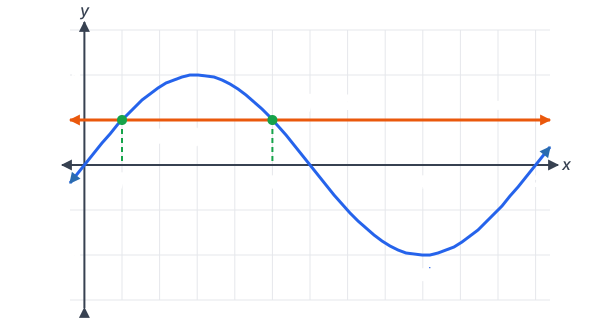
Steps for Solving a Trig Equation
- Isolate the trig function, using the same steps as in two-step equations.
- Find the reference angle from the unit circle, or with an inverse trig function on a calculator.
- Use the sign of the value to find every quadrant where the function has that sign.
- Write each solution in [0, 2\pi).
- For the general solution, add 2\pi n for sine and cosine, or \pi n for tangent, where n is any integer.
If the equation has a squared trig function or two trig terms, try factoring first. Set each factor equal to 0 and solve each one.
Worked Examples
Example 1: A sine equation
Solve 2 \sin x - 1 = 0 on [0, 2\pi), and give the general solution.
2 \sin x = 1
Add 1 to both sides.
\sin x = \frac{1}{2}Divide both sides by 2.
The reference angle is \frac{\pi}{6}, because \sin \frac{\pi}{6} = \frac{1}{2}
Sine is positive in Quadrants I and II: x = \frac{\pi}{6} and x = \pi - \frac{\pi}{6} = \frac{5\pi}{6}
Add full turns for the general solution: x = \frac{\pi}{6} + 2\pi n or x = \frac{5\pi}{6} + 2\pi n
Answer: x = \frac{\pi}{6}, \frac{5\pi}{6} on [0, 2\pi)
Example 2: A cosine equation with a negative value
Solve \sqrt{2} \cos x + 1 = 0 on [0, 2\pi).
\sqrt{2} \cos x = -1Subtract 1 from both sides.
\cos x = -\frac{1}{\sqrt{2}} = -\frac{\sqrt{2}}{2}Divide both sides by \sqrt{2}.
The reference angle is \frac{\pi}{4}
Cosine is negative in Quadrants II and III: x = \pi - \frac{\pi}{4} = \frac{3\pi}{4} and x = \pi + \frac{\pi}{4} = \frac{5\pi}{4}
Answer: x = \frac{3\pi}{4}, \frac{5\pi}{4}
Example 3: A tangent equation
Solve \tan x = \sqrt{3} on [0, 2\pi), and give the general solution.
\tan \frac{\pi}{3} = \sqrt{3}The reference angle is \frac{\pi}{3}.
x = \frac{\pi}{3}Tangent is positive in Quadrant I. Use the reference angle.
x = \pi + \frac{\pi}{3} = \frac{4\pi}{3}Tangent is also positive in Quadrant III. Add π.
x = \frac{\pi}{3} + \pi nTangent has period \pi. Add multiples of π for the general solution.
Answer: x = \frac{\pi}{3}, \frac{4\pi}{3} on [0, 2\pi). The two answers are \pi apart, which matches the period of tangent.
Example 4: Solve by factoring
Solve 2 \sin^2 x - \sin x = 0 on [0, 2\pi).
\sin x (2 \sin x - 1) = 0
Factor out the GCF \sin x (see factoring out the GCF)
Set the first factor equal to 0: \sin x = 0, so x = 0 or x = \pi
2 \sin x - 1 = 0
Set the second factor equal to 0.
Solve it: \sin x = \frac{1}{2}, so x = \frac{\pi}{6} or x = \frac{5\pi}{6}
Answer: x = 0, \frac{\pi}{6}, \frac{5\pi}{6}, \pi. Do not divide both sides by \sin x; that would lose the solutions where \sin x = 0.
Example 5: Word problem with a Ferris wheel
A rider’s height on a Ferris wheel is h(t) = -20 \cos(\frac{\pi}{4} t) + 25 meters, t minutes after boarding. During the first turn, 0 \le t \lt 8, when is the rider 35 meters up?
-20 \cos(\frac{\pi}{4} t) + 25 = 35Set the height to 35.
-20 \cos(\frac{\pi}{4} t) = 10Subtract 25 from both sides.
\cos(\frac{\pi}{4} t) = -\frac{1}{2}Divide both sides by −20.
Let u = \frac{\pi}{4} t, with 0 \le u \lt 2\pi. Cosine is -\frac{1}{2} at u = \frac{2\pi}{3} and u = \frac{4\pi}{3}
Solve \frac{\pi}{4} t = \frac{2\pi}{3}: multiply both sides by \frac{4}{\pi} to get t = \frac{8}{3} \approx 2.67
Solve \frac{\pi}{4} t = \frac{4\pi}{3}: multiply both sides by \frac{4}{\pi} to get t = \frac{16}{3} \approx 5.33
Answer: about 2.67 minutes (going up) and 5.33 minutes (coming down). This model comes from sinusoidal models.
Common Mistakes
| Mistake | Example of the error | Fix |
|---|---|---|
| Giving only the calculator answer | \sin x = \frac{1}{2}, so x = \frac{\pi}{6} only | Sine is also positive in Quadrant II: add \frac{5\pi}{6}. |
| Dividing by a trig function | Dividing 2 \sin^2 x = \sin x by \sin x | Factor instead, so you keep \sin x = 0. |
| Using 2π n for tangent | x = \frac{\pi}{3} + 2\pi n for \tan x = \sqrt{3} | Tangent repeats every \pi: x = \frac{\pi}{3} + \pi n. |
| Wrong quadrants for a negative value | \cos x = -\frac{\sqrt{2}}{2} in Quadrants I and IV | Cosine is negative in Quadrants II and III. |
| Including 2π in [0, 2π) | Listing both 0 and 2\pi | The interval [0, 2\pi) includes 0 but not 2\pi. |
Related Methods
Non-special values
If the value is not on the unit circle, use an inverse trig function for the reference angle. For 3 \cos x = 2, \cos x = \frac{2}{3}, and \cos^{-1}(\frac{2}{3}) \approx 0.8411. Cosine is also positive in Quadrant IV, so the second answer is 2\pi - 0.8411 \approx 5.4421.
Solve by graphing
Graph each side as its own function and find where they cross, as in the picture above. This is a good check, and it shows how many solutions to expect.
Quadratic trig equations
An equation like 2\cos^2 x - \cos x - 1 = 0 is a quadratic in \cos x. Factor it like a trinomial (see factoring trinomials when a is not 1), then solve each factor.
Practice Problems
- Solve \sin x = \frac{\sqrt{3}}{2} on [0, 2\pi).
- Solve 2 \cos x = 1 on [0, 2\pi).
- Solve \tan x + 1 = 0 on [0, 2\pi).
- Solve 2 \sin x + \sqrt{3} = 0 on [0, 2\pi).
- Solve \cos^2 x = \frac{1}{4} on [0, 2\pi).
- Solve \sin x \cos x - \sin x = 0 on [0, 2\pi).
- Solve 2\cos^2 x - \cos x - 1 = 0 on [0, 2\pi).
- Solve 3 \cos x = 2 on [0, 2\pi), to the nearest hundredth.
- Write the general solution of \sin x = 0.
- The water depth at a harbor is y = 3 \cos(\frac{\pi}{6}(t - 2)) + 5 feet, t hours after midnight. Between t = 2 and t = 8, when is the depth 6.5 feet?
Show answers
1.
Reference angle: \frac{\pi}{3}; sine is positive in Quadrants I and II
\pi - \frac{\pi}{3} = \frac{2\pi}{3}Find the second angle: subtract the reference angle from π.
Answer: x = \frac{\pi}{3}, \frac{2\pi}{3}
2.
\cos x = \frac{1}{2}Divide both sides by 2.
Reference angle \frac{\pi}{3}; cosine is positive in Quadrants I and IV
2\pi - \frac{\pi}{3} = \frac{5\pi}{3}Find the second angle: subtract the reference angle from 2π.
Answer: x = \frac{\pi}{3}, \frac{5\pi}{3}
3.
\tan x = -1
Subtract 1 from both sides.
Reference angle \frac{\pi}{4}; tangent is negative in Quadrants II and IV
Angles: \pi - \frac{\pi}{4} = \frac{3\pi}{4} and 2\pi - \frac{\pi}{4} = \frac{7\pi}{4}
Answer: x = \frac{3\pi}{4}, \frac{7\pi}{4}
4.
\sin x = -\frac{\sqrt{3}}{2}Subtract \sqrt{3} and divide by 2.
Reference angle \frac{\pi}{3}; sine is negative in Quadrants III and IV
Angles: \pi + \frac{\pi}{3} = \frac{4\pi}{3} and 2\pi - \frac{\pi}{3} = \frac{5\pi}{3}
Answer: x = \frac{4\pi}{3}, \frac{5\pi}{3}
5.
\cos x = \pm\frac{1}{2}Take the square root of both sides.
x = \frac{\pi}{3}, \frac{5\pi}{3}For \cos x = \frac{1}{2}.
x = \frac{2\pi}{3}, \frac{4\pi}{3}For \cos x = -\frac{1}{2}.
Answer: x = \frac{\pi}{3}, \frac{2\pi}{3}, \frac{4\pi}{3}, \frac{5\pi}{3}
6.
\sin x (\cos x - 1) = 0
Factor out \sin x.
\sin x = 0 gives x = 0, \pi
\cos x - 1 = 0 gives \cos x = 1, so x = 0
Answer: x = 0, \pi
7.
(2\cos x + 1)(\cos x - 1) = 0
Factor.
2\cos x + 1 = 0 gives \cos x = -\frac{1}{2}, so x = \frac{2\pi}{3}, \frac{4\pi}{3}
\cos x - 1 = 0 gives \cos x = 1, so x = 0
Answer: x = 0, \frac{2\pi}{3}, \frac{4\pi}{3}
8.
\cos x = \frac{2}{3}Divide both sides by 3.
x = \cos^{-1}(\frac{2}{3}) \approx 0.8411Use the inverse in radian mode.
2\pi - 0.8411 \approx 5.4421
Quadrant IV angle.
Answer: x \approx 0.84, 5.44
9.
Sine is 0 at 0, \pi, 2\pi, \ldots, which are all multiples of \pi
Answer: x = \pi n, where n is any integer
10.
3 \cos(\frac{\pi}{6}(t - 2)) + 5 = 6.5Set the depth to 6.5.
\cos(\frac{\pi}{6}(t - 2)) = \frac{1}{2}Subtract 5 and divide by 3.
For 2 \le t \le 8, the inside goes from 0 to \pi, so use \frac{\pi}{6}(t - 2) = \frac{\pi}{3}
t - 2 = 2
Multiply both sides by \frac{6}{\pi}.
t = 4
Add 2 to both sides.
Answer: at 4 a.m.
FAQ
How do you solve a trig equation?
Isolate the trig function, find the reference angle, use the sign to find all the quadrants that work, and list the solutions in the interval. Add multiples of the period for all solutions.
Why do trig equations have more than one answer?
Trig functions repeat, so the same value appears at many angles. In one full turn, sine and cosine usually reach each value twice.
What is the general solution of a trig equation?
It is a formula for every solution, made by adding whole periods. For sine and cosine, add 2\pi n; for tangent, add \pi n.
Can I divide both sides by sin x?
Avoid it. Dividing by \sin x throws away the solutions where \sin x = 0. Factor out \sin x instead.
Summary
- Isolate the trig function first.
- Find the reference angle, then use signs to find every quadrant that works.
- List solutions in [0, 2\pi), which includes 0 but not 2\pi.
- General solutions add 2\pi n for sine and cosine and \pi n for tangent.
- Factor instead of dividing by a trig function.
Previous lesson: Half-Angle Formulas
Next lesson: Trig Equations with Multiple Angles
Back to the Trigonometry Index