
Sinusoidal Models
Sinusoidal models use sine or cosine functions to describe things that repeat, like tides, Ferris wheels and seasonal temperatures. From the highest value, the lowest value and the time for one cycle, you can write y = A \cos(B(t - h)) + k: the amplitude is A = \frac{\max - \min}{2}, the midline is k = \frac{\max + \min}{2} and B = \frac{2\pi}{\text{period}}.
Before this lesson: You should know Phase Shift, Amplitude and Period and Graphs of Sine and Cosine.
Turning a Pattern Into an Equation
A seat on a Ferris wheel goes up and down in the same pattern every turn. Its height over time looks like a wave, so a sine or cosine function can describe it. Once you have the equation, you can find the height at any time.
Every sinusoid has four numbers to find: how far it swings (amplitude), its middle level (midline), how long a cycle lasts (period) and where the cycle starts (phase shift). Cosine is usually easiest, because a cosine cycle starts at a maximum, and a negative cosine starts at a minimum.
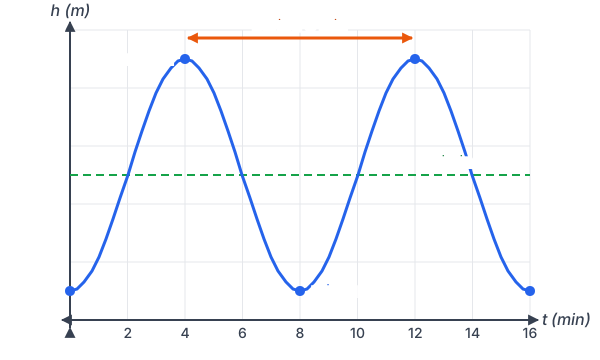
Steps for Writing a Sinusoidal Model
y = A \cos(B(t - h)) + k
- Find the amplitude: A = \frac{\max - \min}{2}
- Find the midline: k = \frac{\max + \min}{2}
- Find B from the period: B = \frac{2\pi}{\text{period}}. The time from a maximum to the next minimum is half a period.
- Choose the start: if the cycle starts at a maximum, use +A \cos; if it starts at a minimum, use -A \cos. Set h to the time of that starting point.
- Check your equation at one or two known times.
| Clue in the problem | What it gives you |
|---|---|
| Highest and lowest values | Amplitude and midline |
| Time for one full cycle | Period, so B = \frac{2\pi}{\text{period}} |
| Time from high to low | Half the period |
| Time of the first maximum or minimum | The phase shift h |
Worked Examples
Example 1: A Ferris wheel
A Ferris wheel has a diameter of 40 meters, and its center is 25 meters above the ground. It turns once every 8 minutes. A rider gets on at the bottom at t = 0. Write a model for the rider’s height h(t) in meters, and find the height at 2 and 4 minutes.
A = \frac{40}{2} = 20Amplitude is the radius.
k = 25
Midline is the height of the center.
B = \frac{2\pi}{8} = \frac{\pi}{4}Find B.
h(t) = -20 \cos(\frac{\pi}{4} t) + 25The rider starts at the bottom, a minimum, so use negative cosine with h = 0.
Check t = 0: -20 \cos 0 + 25 = -20 + 25 = 5, the bottom of the wheel
-20 \cos \frac{\pi}{2} + 25 = -20 \cdot 0 + 25 = 25At t = 2.
-20 \cos \pi + 25 = -20 \cdot (-1) + 25 = 45
At t = 4.
Answer: h(t) = -20 \cos(\frac{\pi}{4} t) + 25. The rider is 25 m up at 2 minutes and at the top, 45 m, at 4 minutes.
Example 2: Tides
At a harbor, high tide is 8 feet at 2 a.m., and the next low tide is 2 feet at 8 a.m. Write a model for the water depth y in feet, t hours after midnight.
A = \frac{8 - 2}{2} = 3Find the amplitude: half the distance from max to min.
k = \frac{8 + 2}{2} = 5Find the midline: the average of max and min.
High to low takes 8 - 2 = 6 hours, which is half a period, so the period is 12 hours
B = \frac{2\pi}{12} = \frac{\pi}{6}Find B.
y = 3 \cos(\frac{\pi}{6}(t - 2)) + 5The first maximum is at t = 2, so use positive cosine with h = 2.
Check t = 8: 3 \cos(\frac{\pi}{6} \cdot 6) + 5 = 3 \cos \pi + 5 = -3 + 5 = 2
Answer: y = 3 \cos(\frac{\pi}{6}(t - 2)) + 5
Example 3: Monthly temperatures
In a city, the average high temperature peaks at 86°F in July (month 7) and drops to 30°F in January (month 1). Write a model for the temperature T in month t, and predict April (month 4).
A = \frac{86 - 30}{2} = \frac{56}{2} = 28Find the amplitude: half the distance from max to min.
k = \frac{86 + 30}{2} = \frac{116}{2} = 58Find the midline: the average of max and min.
B = \frac{2\pi}{12} = \frac{\pi}{6}The pattern repeats every 12 months.
T = 28 \cos(\frac{\pi}{6}(t - 7)) + 58The maximum is at t = 7.
28 \cos(\frac{\pi}{6}(4 - 7)) + 58 = 28 \cos(-\frac{\pi}{2}) + 58Substitute t = 4.
28 \cdot 0 + 58 = 58
Evaluate.
Answer: T = 28 \cos(\frac{\pi}{6}(t - 7)) + 58. April is predicted at 58°F, right on the midline, halfway between the coldest and warmest months.
Example 4: A spring
A weight on a spring bobs up and down. Its lowest height is 3 cm at t = 0, and its next highest height is 11 cm at t = 1.5 seconds. Write a model for its height y.
A = \frac{11 - 3}{2} = 4Find the amplitude: half the distance from max to min.
k = \frac{11 + 3}{2} = 7Find the midline: the average of max and min.
Low to high takes 1.5 seconds, half a period, so the period is 3 seconds
B = \frac{2\pi}{3}Find B.
y = -4 \cos(\frac{2\pi}{3} t) + 7It starts at a minimum, so use negative cosine.
Check t = 1.5: -4 \cos(\frac{2\pi}{3} \cdot 1.5) + 7 = -4 \cos \pi + 7 = 4 + 7 = 11
Answer: y = -4 \cos(\frac{2\pi}{3} t) + 7
Example 5: Hours of daylight
A town gets the most daylight, 15 hours, on day 172 of the year and the least, 9 hours, half a year later. Write a model for the hours of daylight D on day t, using a period of 365 days.
A = \frac{15 - 9}{2} = 3Find the amplitude: half the distance from max to min.
k = \frac{15 + 9}{2} = 12Find the midline: the average of max and min.
B = \frac{2\pi}{365}Find B.
D = 3 \cos(\frac{2\pi}{365}(t - 172)) + 12The maximum is at t = 172.
Check day 172: 3 \cos 0 + 12 = 3 + 12 = 15
Answer: D = 3 \cos(\frac{2\pi}{365}(t - 172)) + 12. A quarter year from day 172, the model gives the midline, 12 hours of daylight.
Common Mistakes
| Mistake | Example of the error | Fix |
|---|---|---|
| Using the full height as the amplitude | A = 8 - 2 = 6 for tides between 2 and 8 feet | Divide by 2: A = 3. |
| Using half a period as the period | High to low takes 6 hours, so B = \frac{2\pi}{6} | High to low is half a cycle, so the period is 12 and B = \frac{\pi}{6}. |
| Using the period as B | y = 3 \cos(12t) + 5 for a 12-hour period | B = \frac{2\pi}{12} = \frac{\pi}{6}. |
| Starting at the wrong point | Using +20 \cos for a rider who starts at the bottom | A cycle that starts at a minimum needs -A \cos. |
| Calculator in degree mode | Getting the wrong height for \cos(\frac{\pi}{4} \cdot 3) | These models use radians. Switch to radian mode. |
Related Methods
Using sine instead of cosine
Any model can also use sine, which starts on the midline going up. The Ferris wheel in Example 1 is also h(t) = 20 \sin(\frac{\pi}{4}(t - 2)) + 25, because the rider passes the midline going up at t = 2.
Fitting a curve to data
With real data, graphing calculators and Desmos can find a best-fit sine model. The steps in this lesson give a good first guess to compare with.
Solving for a time
To find when a model reaches a value, such as when the tide is 6.5 feet, set the model equal to that value and solve. That takes inverse trig functions, which come next in this course.
Practice Problems
- A wave rises to 10 and falls to 2. Find its amplitude and midline.
- A pattern repeats every 24 hours. Find B.
- Write a model with a maximum of 12 at t = 0, a minimum of 4 and a period of 10.
- A Ferris wheel has a diameter of 30 m, its center is 18 m above the ground, and it turns once every 6 minutes. A rider starts at the bottom at t = 0. Write a model for the height.
- Use your model from problem 4 to find the height at t = 1.5 minutes.
- Use your model from problem 4 to find the height at t = 3 minutes.
- A pendulum swings 12 cm to each side of center, with a period of 2 seconds. It starts at its farthest right point at t = 0. Write a model for its position x, with right as positive.
- The depth of water is y = 2.5 \sin(\frac{\pi}{6}(t - 1)) + 4 feet. Find the greatest depth, the least depth and the period.
- A buoy is lowest, at 1 m, at t = 0 and highest, at 3 m, at t = 4 seconds. Write a model for its height.
- The temperature is T = 15 \sin(\frac{\pi}{12}(t - 8)) + 60 degrees, t hours after midnight. Find the temperature at noon to the nearest tenth.
Show answers
1.
\frac{10 - 2}{2} = 4Find the amplitude: half the distance from max to min.
\frac{10 + 2}{2} = 6Find the midline: the average of max and min.
Answer: amplitude 4, midline y = 6
2.
B = \frac{2\pi}{24}Use the formula.
B = \frac{\pi}{12}Simplify.
Answer: \frac{\pi}{12}
3.
Amplitude: \frac{12 - 4}{2} = 4; midline: \frac{12 + 4}{2} = 8
\frac{2\pi}{10} = \frac{\pi}{5}Find B.
It starts at a maximum, so use positive cosine
Answer: y = 4 \cos(\frac{\pi}{5} t) + 8
4.
Amplitude is the radius: \frac{30}{2} = 15; midline: 18
\frac{2\pi}{6} = \frac{\pi}{3}Find B.
It starts at the bottom, so use negative cosine
Answer: h(t) = -15 \cos(\frac{\pi}{3} t) + 18
5.
-15 \cos(\frac{\pi}{3} \cdot 1.5) + 18 = -15 \cos \frac{\pi}{2} + 18Substitute.
-15 \cdot 0 + 18 = 18
Evaluate.
Answer: 18 meters
6.
-15 \cos(\frac{\pi}{3} \cdot 3) + 18 = -15 \cos \pi + 18Substitute.
-15 \cdot (-1) + 18 = 15 + 18 = 33
Evaluate.
Answer: 33 meters, the top of the wheel
7.
Amplitude 12; midline 0
\frac{2\pi}{2} = \piFind B.
It starts at a maximum, so use positive cosine
Answer: x = 12 \cos(\pi t)
8.
Greatest: 4 + 2.5 = 6.5; least: 4 - 2.5 = 1.5
\frac{2\pi}{\frac{\pi}{6}} = 12Find the period: divide 2π by B.
Answer: 6.5 feet, 1.5 feet, 12 hours
9.
Amplitude: \frac{3 - 1}{2} = 1; midline: \frac{3 + 1}{2} = 2
Low to high is half a period, so the period is 8
\frac{2\pi}{8} = \frac{\pi}{4}Find B.
It starts at a minimum, so use negative cosine
Answer: y = -\cos(\frac{\pi}{4} t) + 2
10.
15 \sin(\frac{\pi}{12} \cdot 4) + 60 = 15 \sin \frac{\pi}{3} + 60Substitute t = 12.
15 \cdot \frac{\sqrt{3}}{2} + 60Use the special value.
\approx 12.99 + 60 = 72.99
Evaluate.
Answer: about 73.0 degrees
FAQ
What is a sinusoidal model?
It is a sine or cosine function, such as y = A \cos(B(t - h)) + k, that describes something that repeats in a smooth wave, like tides or seasons.
How do you find the amplitude from a word problem?
Subtract the lowest value from the highest value, then divide by 2. For a Ferris wheel, the amplitude is the radius.
Should I use sine or cosine?
Either works. Cosine is easier when you know when the maximum or minimum happens, and sine is easier when you know when the wave crosses its midline going up.
How do you find B from the period?
Divide 2\pi by the period. For a period of 12 hours, B = \frac{2\pi}{12} = \frac{\pi}{6}.
Summary
- Amplitude: A = \frac{\max - \min}{2}; midline: k = \frac{\max + \min}{2}.
- B = \frac{2\pi}{\text{period}}; the time from high to low is half a period.
- Start at a maximum with +A \cos, or at a minimum with -A \cos.
- The phase shift h is the time of that starting high or low point.
- Always check the model at a known time, in radian mode.
Previous lesson: Graphs of Secant, Cosecant and Cotangent
Next lesson: Inverse Trig Functions
Back to the Trigonometry Index