
Phase Shift
A phase shift moves a sine or cosine graph left or right. In y = a \sin(b(x - h)) + k, the graph shifts right h units (left if h is negative), and k shifts it up or down so the middle line is y = k. For y = a \sin(bx - c) + d, the phase shift is \frac{c}{b}.
Before this lesson: You should know Amplitude and Period, Graphs of Sine and Cosine and Transformations of Functions.
Sliding the Wave
Changing x to x - h moves any graph right h units, as you saw in transformations of functions. For a sine wave, this horizontal slide is called the phase shift. The wave keeps its shape; it just starts its cycle at x = h instead of x = 0.
Adding k outside moves the graph up k units. The wave then rises and falls around the line y = k, called the midline, instead of around the x-axis.
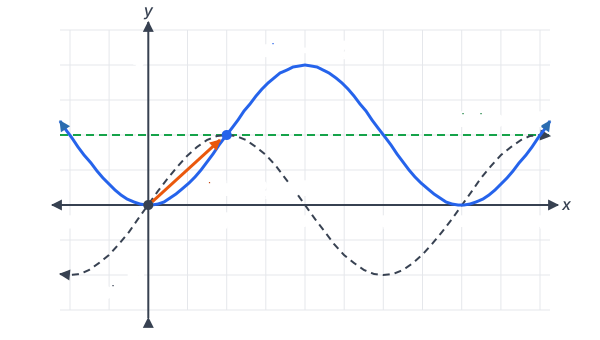
The General Sine and Cosine Equations
y = a \sin(b(x - h)) + k \qquad y = a \cos(b(x - h)) + k
| Number | Effect | Formula |
|---|---|---|
| a | Amplitude (and a flip if negative) | Amplitude = |a| |
| b | Period | Period = \frac{2\pi}{|b|} |
| h | Phase shift (right if positive, left if negative) | Phase shift = h |
| k | Vertical shift and midline | Midline: y = k |
If the equation is written as y = a \sin(bx - c) + d, factor out b first: bx - c = b(x - \frac{c}{b}). So the phase shift is \frac{c}{b}, not c.
- Factor b out of the inside so it looks like b(x - h).
- Find the amplitude |a|, the period \frac{2\pi}{|b|}, the phase shift h and the midline y = k.
- The cycle starts at x = h. Add a quarter period four times to get five key x-values.
- Use the parent pattern for y, multiply by a, then add k.
- Plot the points and draw the wave.
Worked Examples
Example 1: A phase shift only
Find the phase shift and key points of y = \sin(x - \frac{\pi}{4}).
Match the form: h = \frac{\pi}{4}, so shift right \frac{\pi}{4}
The period is 2\pi, so the spacing is \frac{\pi}{2}
\frac{\pi}{4}, \frac{3\pi}{4}, \frac{5\pi}{4}, \frac{7\pi}{4}, \frac{9\pi}{4}Start at \frac{\pi}{4} and add \frac{\pi}{2} each time.
0, 1, 0, -1, 0
Use the sine pattern.
Answer: right \frac{\pi}{4}; key points (\frac{\pi}{4}, 0), (\frac{3\pi}{4}, 1), (\frac{5\pi}{4}, 0), (\frac{7\pi}{4}, -1), (\frac{9\pi}{4}, 0)
Example 2: A left shift and a vertical shift
Describe the graph of y = \cos(x + \frac{\pi}{3}) + 2.
x + \frac{\pi}{3} = x - (-\frac{\pi}{3})Rewrite the inside as x - h.
h = -\frac{\pi}{3}Read h from the inside.
The phase shift is left \frac{\pi}{3}
The vertical shift is up 2, so the midline is y = 2
The amplitude is 1, so the maximum is 2 + 1 = 3 and the minimum is 2 - 1 = 1
Answer: the cosine wave moved left \frac{\pi}{3} and up 2. It has midline y = 2 and range [1, 3], and its first maximum is at x = -\frac{\pi}{3}.
Example 3: Factor out b first
Find the amplitude, period, phase shift and key points of y = 3 \sin(2x - \pi).
2x - \pi = 2(x - \frac{\pi}{2})Factor 2 out of the inside.
|3| = 3
Find the amplitude.
\frac{2\pi}{2} = \piFind the period: divide 2π by b.
Phase shift: right \frac{\pi}{2}
Spacing: \frac{\pi}{4}; x-values: \frac{\pi}{2}, \frac{3\pi}{4}, \pi, \frac{5\pi}{4}, \frac{3\pi}{2}
0, 3, 0, -3, 0
Multiply the sine pattern by 3.
Answer: amplitude 3, period \pi, phase shift right \frac{\pi}{2}; key points (\frac{\pi}{2}, 0), (\frac{3\pi}{4}, 3), (\pi, 0), (\frac{5\pi}{4}, -3), (\frac{3\pi}{2}, 0)
Example 4: Write the equation
A sine wave has amplitude 2, period 2\pi and midline y = -1. It rises through its midline at x = \frac{\pi}{6}. Write its equation.
h = \frac{\pi}{6}A plain sine wave rises through its midline at the start of its cycle.
a = 2
Amplitude 2, and the wave rises.
b = \frac{2\pi}{2\pi} = 1Divide 2π by the period, 2\pi.
k = -1
The midline is y = -1.
Answer: y = 2 \sin(x - \frac{\pi}{6}) - 1
Example 5: Word problem with daily temperature
The temperature in a city, in degrees Celsius, is modeled by T(t) = 10 \sin(\frac{\pi}{12}(t - 9)) + 15, where t is hours after midnight. What is the highest temperature, and at what time does it happen?
Read the parts: amplitude 10, midline T = 15
15 + 10 = 25
Find the highest temperature: midline plus amplitude.
\frac{\pi}{12}(t - 9) = \frac{\pi}{2}Sine reaches its maximum when its input is \frac{\pi}{2}.
t - 9 = 6
Multiply both sides by \frac{12}{\pi}.
t = 15
Add 9 to both sides.
Answer: The high is 25°C at t = 15, which is 3:00 p.m. The period is \frac{2\pi}{\frac{\pi}{12}} = 24 hours, so the pattern repeats each day.
Common Mistakes
| Mistake | Example of the error | Fix |
|---|---|---|
| Shifting the wrong direction | y = \sin(x - \frac{\pi}{4}) moves left | A minus inside moves the graph right: right \frac{\pi}{4}. |
| Not factoring out b | Phase shift of y = 3 \sin(2x - \pi) is \pi | Factor: 2(x - \frac{\pi}{2}), so the shift is \frac{\pi}{2}. |
| Mixing up the vertical shift and amplitude | Saying y = \sin x + 4 has amplitude 4 | The 4 outside moves the midline to y = 4. The amplitude is still 1. |
| Using the old range | Range of y = \cos x + 2 is [-1, 1] | Add the shift: the range is [1, 3]. |
| Starting key points at 0 | Key points of y = \sin(x - \frac{\pi}{4}) start at x = 0 | The cycle starts at the phase shift, x = \frac{\pi}{4}. |
Related Methods
Find the shift from the start of the cycle
Set the inside of the function equal to 0 and solve. For y = 3 \sin(2x - \pi), 2x - \pi = 0 gives x = \frac{\pi}{2}, which is where the cycle starts.
Sine and cosine are shifts of each other
A cosine wave is a sine wave shifted left \frac{\pi}{2}: \cos x = \sin(x + \frac{\pi}{2}). So any sinusoid can be written with either function, using a different phase shift.
Midline from the maximum and minimum
The midline is halfway between the highest and lowest values: k = \frac{\text{max} + \text{min}}{2}. For a range of [1, 3], k = \frac{1 + 3}{2} = 2.
Practice Problems
- Find the phase shift of y = \sin(x - \frac{\pi}{2}).
- Find the phase shift of y = \cos(x + \pi).
- Find the midline and range of y = \sin x + 4.
- Find the amplitude, phase shift, midline and range of y = 2 \cos(x - \frac{\pi}{6}) - 3.
- Find the period and phase shift of y = \sin(3x - \pi).
- Find the period and phase shift of y = -\cos(2x + \frac{\pi}{2}).
- Find the amplitude, period, phase shift and midline of y = 4 \sin(\frac{1}{2}(x - \pi)) + 1.
- List the key points of y = \sin(x + \frac{\pi}{2}) for one cycle. What do you notice?
- Write a cosine function with amplitude 3, period 2\pi, midline y = 0 and a maximum at x = \frac{\pi}{4}.
- A Ferris wheel seat’s height in meters after t minutes is h(t) = 20 \sin(\frac{\pi}{5}(t - 2.5)) + 22. Find the greatest and least heights and the first time the seat is at the top.
Show answers
1.
h = \frac{\pi}{2}Match the form.
Answer: right \frac{\pi}{2}
2.
x + \pi = x - (-\pi)
Rewrite.
h = -\pi
Read h from the inside.
Answer: left \pi
3.
y = 4
The 4 outside moves the midline up.
[4 - 1, 4 + 1] = [3, 5]
Find the range: midline minus and plus the amplitude.
Answer: midline y = 4, range [3, 5]
4.
|2| = 2
Find the amplitude.
Phase shift: right \frac{\pi}{6}
y = -3
Find the midline.
[-3 - 2, -3 + 2] = [-5, -1]
Find the range: midline minus and plus the amplitude.
Answer: amplitude 2, right \frac{\pi}{6}, midline y = -3, range [-5, -1]
5.
3x - \pi = 3(x - \frac{\pi}{3})Factor.
\frac{2\pi}{3}Find the period: divide 2π by b.
Answer: period \frac{2\pi}{3}, right \frac{\pi}{3}
6.
2x + \frac{\pi}{2} = 2(x + \frac{\pi}{4})Factor.
\frac{2\pi}{2} = \piFind the period: divide 2π by b.
Answer: period \pi, left \frac{\pi}{4}, and the negative sign flips the graph
7.
|4| = 4
Find the amplitude.
\frac{2\pi}{\frac{1}{2}} = 4\piFind the period: divide 2π by b.
y = 1
Phase shift: right \pi; midline.
Answer: amplitude 4, period 4\pi, right \pi, midline y = 1
8.
Phase shift: left \frac{\pi}{2}, so start at -\frac{\pi}{2}
-\frac{\pi}{2}, 0, \frac{\pi}{2}, \pi, \frac{3\pi}{2}List the x-values of the key points.
0, 1, 0, -1, 0
List the y-values of the key points.
Answer: these are the points of y = \cos x, so \sin(x + \frac{\pi}{2}) = \cos x
9.
Cosine starts its cycle at a maximum, so h = \frac{\pi}{4}
Amplitude 3 means a = 3; period 2\pi means b = 1; midline 0 means k = 0
Answer: y = 3 \cos(x - \frac{\pi}{4})
10.
Greatest height: 22 + 20 = 42; least height: 22 - 20 = 2
\frac{\pi}{5}(t - 2.5) = \frac{\pi}{2}The top is where the sine input is \frac{\pi}{2}.
t - 2.5 = 2.5
Multiply both sides by \frac{5}{\pi}.
t = 5
Add 2.5 to both sides.
Answer: 42 meters and 2 meters; the seat first reaches the top at 5 minutes
FAQ
What is a phase shift?
It is a horizontal shift of a sine or cosine graph. In y = a \sin(b(x - h)) + k, the phase shift is h: right if positive, left if negative.
How do you find the phase shift of y = a sin(bx − c)?
Factor out b to get a \sin(b(x - \frac{c}{b})). The phase shift is \frac{c}{b}. You can also set bx - c = 0 and solve for x.
What is the midline of a trig graph?
It is the horizontal line halfway between the maximum and minimum. For y = a \sin(b(x - h)) + k, the midline is y = k.
Does a phase shift change the period?
No. A phase shift slides the graph sideways but does not stretch it. Only b changes the period.
Summary
- The general form is y = a \sin(b(x - h)) + k (or cosine).
- h is the phase shift: right for positive h, left for negative h.
- k is the vertical shift; the midline is y = k.
- Factor out b first: for bx - c, the phase shift is \frac{c}{b}.
- Key points start at x = h and are a quarter period apart.
Previous lesson: Amplitude and Period
Next lesson: Graph of Tangent
Back to the Trigonometry Index