
Graphs of Sine and Cosine
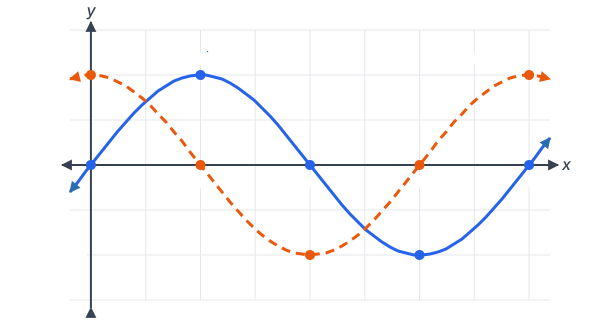
The graphs of sine and cosine are smooth waves that repeat every 2\pi radians (360°). The graph of y = \sin x starts at 0, rises to 1 at \frac{\pi}{2}, returns to 0 at \pi, falls to −1 at \frac{3\pi}{2} and is back to 0 at 2\pi. The graph of y = \cos x is the same wave shifted left \frac{\pi}{2}, so it starts at 1.
Before this lesson: You should know The Unit Circle, Parent Functions and Radians.
Unwrapping the Unit Circle
Picture a point moving counterclockwise around the unit circle. Its height is \sin x, where x is the angle in radians. As the point goes around once, the height climbs from 0 to 1, drops to −1 and returns to 0. Plotting the height against the angle gives the sine wave.
The point’s left-right position is \cos x. It starts at 1, moves to −1 halfway around and returns to 1. Plotting that gives the cosine wave. Because the point repeats its path every full turn, both graphs repeat every 2\pi.
Key Points and Features
One period is split into four equal parts by five key points. Plot them and connect them with a smooth curve.
| x | 0 | \frac{\pi}{2} | \pi | \frac{3\pi}{2} | 2\pi |
|---|---|---|---|---|---|
| \sin x | 0 | 1 | 0 | -1 | 0 |
| \cos x | 1 | 0 | -1 | 0 | 1 |
| Feature | y = \sin x | y = \cos x |
|---|---|---|
| Domain | All real numbers | All real numbers |
| Range | [-1, 1] | [-1, 1] |
| Period | 2\pi | 2\pi |
| Amplitude | 1 | 1 |
| y-intercept | (0, 0) | (0, 1) |
| Zeros on [0, 2\pi] | 0, \pi, 2\pi | \frac{\pi}{2}, \frac{3\pi}{2} |
| Symmetry | Odd: \sin(-x) = -\sin x | Even: \cos(-x) = \cos x |
The period is the length of one full cycle. The amplitude is half the distance from the lowest point to the highest point, which is 1 for both parent graphs. The domain and range show the graphs go on forever left and right but stay between −1 and 1.
Worked Examples
Example 1: Sine values between the key points
Make a table of values for y = \sin x from 0 to \pi, using steps of \frac{\pi}{6}, and describe the graph.
\sin 0 = 0
Use the unit circle values.
\sin \frac{\pi}{6} = \frac{1}{2} = 0.5Find the sine at this angle from the unit circle.
\sin \frac{\pi}{3} = \frac{\sqrt{3}}{2} \approx 0.87Find the sine at this angle from the unit circle.
\sin \frac{\pi}{2} = 1Find the sine at this angle from the unit circle.
\sin \frac{2\pi}{3} = \frac{\sqrt{3}}{2} \approx 0.87Find the sine at this angle from the unit circle.
\sin \frac{5\pi}{6} = \frac{1}{2} = 0.5Find the sine at this angle from the unit circle.
\sin \pi = 0
Find the sine at this angle from the unit circle.
Answer: The graph rises from 0 to a peak of 1 at \frac{\pi}{2}, then falls back to 0 at \pi. The values are symmetric around \frac{\pi}{2}, so the hump is symmetric too.
Example 2: Key points of cosine over two periods
List the key points of y = \cos x from -2\pi to 2\pi.
(0, 1),\ (\frac{\pi}{2}, 0),\ (\pi, -1),\ (\frac{3\pi}{2}, 0),\ (2\pi, 1)Start with one period from 0 to 2\pi.
\cos(-x) = \cos x
Cosine is even. Reflect each point across the y-axis.
(-\frac{\pi}{2}, 0),\ (-\pi, -1),\ (-\frac{3\pi}{2}, 0),\ (-2\pi, 1)Write the reflected points.
Answer: (-2\pi, 1), (-\frac{3\pi}{2}, 0), (-\pi, -1), (-\frac{\pi}{2}, 0), (0, 1), (\frac{\pi}{2}, 0), (\pi, -1), (\frac{3\pi}{2}, 0), (2\pi, 1)
Example 3: Use the period
Find every x with 0 \le x \le 4\pi where \sin x = 1.
x = \frac{\pi}{2}In one period, \sin x = 1 only at the peak.
\frac{\pi}{2} + 2\pi = \frac{\pi}{2} + \frac{4\pi}{2} = \frac{5\pi}{2}The graph repeats every 2\pi, so add one period.
Adding another period gives \frac{9\pi}{2}, which is more than 4\pi = \frac{8\pi}{2}, so stop.
Answer: x = \frac{\pi}{2} and x = \frac{5\pi}{2}
Example 4: Where the graph rises and falls
On the interval [0, 2\pi], where is y = \cos x increasing, and where is it decreasing?
x = 0
Read the key points. Cosine starts at its maximum, 1, here.
x = \pi
It falls to its minimum, −1, here.
x = 2\pi
It rises back to 1 here.
Answer: decreasing on (0, \pi) and increasing on (\pi, 2\pi). This uses the ideas from key features of functions.
Example 5: Word problem with a buoy
A buoy bobs on waves. Its height above calm water, in meters, is h(t) = \sin t, where t is time in seconds. During the first 7 seconds, when is the buoy highest, and when is it lowest?
The highest value of sine is 1, at t = \frac{\pi}{2}
\frac{\pi}{2} \approx 1.57Evaluate. The answer is in seconds.
The next peak is at \frac{5\pi}{2} \approx 7.85, which is after 7 seconds.
The lowest value of sine is −1, at t = \frac{3\pi}{2}
\frac{3\pi}{2} \approx 4.71Evaluate. The answer is in seconds.
Answer: The buoy is highest (1 meter above calm water) at about 1.57 seconds and lowest (1 meter below) at about 4.71 seconds.
Common Mistakes
| Mistake | Example of the error | Fix |
|---|---|---|
| Starting sine at its peak | Graphing y = \sin x through (0, 1) | Sine starts at 0, like the height of the starting point on the unit circle. Cosine starts at 1. |
| Using degrees on a radian axis | Plotting the peak of sine at x = 90 | On a radian axis, the peak is at \frac{\pi}{2} \approx 1.57. |
| Thinking the range goes past 1 | Plotting \sin x = 2 somewhere | Sine and cosine always stay between −1 and 1. |
| Forgetting the graph repeats | Listing only \frac{\pi}{2} for \sin x = 1 on [0, 4\pi] | Add the period 2\pi to find more solutions. |
| Drawing sharp corners | Making the wave look like a zigzag | The graph is smooth and rounded at every peak and valley. |
Related Methods
Cosine is a shifted sine
Shift the sine graph left by \frac{\pi}{2} and it lands exactly on the cosine graph: \cos x = \sin (x + \frac{\pi}{2}). This is one reason the two graphs share every feature except their starting point.
Degrees on the x-axis
You can also label the x-axis in degrees: 0°, 90°, 180°, 270° and 360°. The shape is the same; only the labels change. Calculus uses radians, so practice both.
Changing the shape
In the next lessons, numbers in y = a \sin (bx - c) + d stretch and shift the parent graph, just like the transformations of functions from Algebra 2.
Practice Problems
- Find \sin \frac{\pi}{2}.
- Find \cos \pi.
- List the zeros of y = \sin x on [0, 2\pi].
- List the zeros of y = \cos x on [0, 2\pi].
- Where on [0, 2\pi] does y = \cos x reach its maximum?
- What is the range of y = \sin x?
- Find \sin(-\frac{\pi}{2}) and explain what it shows about the sine graph.
- Find \cos(-\frac{\pi}{3}).
- Find every x on [0, 2\pi] where \cos x = -1.
- A mass on a spring moves up and down. Its position is y = \cos t centimeters at time t seconds. Find the first time after 0 when the mass is at y = 0, and the first time it is at its lowest point.
Show answers
1.
Read the key point: the peak of sine is at \frac{\pi}{2}
Answer: \sin \frac{\pi}{2} = 1
2.
Read the key point: cosine is at its minimum at \pi
Answer: \cos \pi = -1
3.
Sine is 0 at the start, middle and end of a period
Answer: 0, \pi, 2\pi
4.
Cosine is 0 a quarter and three quarters of the way through
Answer: \frac{\pi}{2}, \frac{3\pi}{2}
5.
Cosine equals 1 at the start and end of the period
Answer: x = 0 and x = 2\pi, where y = 1
6.
Sine stays between its minimum and maximum
Answer: [-1, 1]
7.
Use the unit circle point for -\frac{\pi}{2}, which is (0, -1)
So \sin(-\frac{\pi}{2}) = -1 = -\sin \frac{\pi}{2}
Answer: −1; it shows \sin(-x) = -\sin x, so the graph is symmetric about the origin
8.
\cos(-\frac{\pi}{3}) = \cos \frac{\pi}{3}Cosine is even.
\cos \frac{\pi}{3} = \frac{1}{2}Use the special value.
Answer: \frac{1}{2}
9.
Cosine reaches −1 only at its minimum
Answer: x = \pi
10.
Cosine first equals 0 at t = \frac{\pi}{2} \approx 1.57
Cosine first equals −1 at t = \pi \approx 3.14
Answer: at about 1.57 seconds and about 3.14 seconds
FAQ
What do the graphs of sine and cosine look like?
Both are smooth waves that go up and down between −1 and 1 forever. Sine starts at 0 and rises; cosine starts at its peak of 1 and falls.
What is the period of sine and cosine?
The period of both y = \sin x and y = \cos x is 2\pi radians, or 360°. After that, the graphs repeat.
What is the difference between the sine and cosine graphs?
They have the same shape, but cosine is shifted \frac{\pi}{2} to the left. So sine passes through (0, 0) and cosine passes through (0, 1).
What are the 5 key points of a sine graph?
For one period of y = \sin x, they are (0, 0), (\frac{\pi}{2}, 1), (\pi, 0), (\frac{3\pi}{2}, -1) and (2\pi, 0).
Summary
- y = \sin x and y = \cos x are waves with period 2\pi and range [-1, 1].
- Sine key points: 0, 1, 0, −1, 0 at 0, \frac{\pi}{2}, \pi, \frac{3\pi}{2}, 2\pi.
- Cosine key points: 1, 0, −1, 0, 1 at the same x-values.
- Sine is odd (symmetric about the origin); cosine is even (symmetric about the y-axis).
- Add or subtract 2\pi to find repeats of any point.
Previous lesson: The Unit Circle
Next lesson: Amplitude and Period
Back to the Trigonometry Index