
Radians
A radian is the angle at the center of a circle that cuts off an arc exactly as long as the radius. One full turn is 2\pi radians, so 180^\circ = \pi radians. To convert degrees to radians, multiply by \frac{\pi}{180^\circ}. To convert radians to degrees, multiply by \frac{180^\circ}{\pi}.
Before this lesson: You should know Coterminal Angles, Angles in Standard Position and Arc Length.
Measuring an Angle With the Radius
Degrees split a full turn into 360 equal parts. That number was chosen long ago, and it has nothing to do with the circle itself. Radians measure an angle with the circle’s own radius instead.
Take a circle with radius r. Lay a piece of string as long as r along the edge of the circle. The angle at the center that spans that arc is 1 radian. It is a little less than 60°.
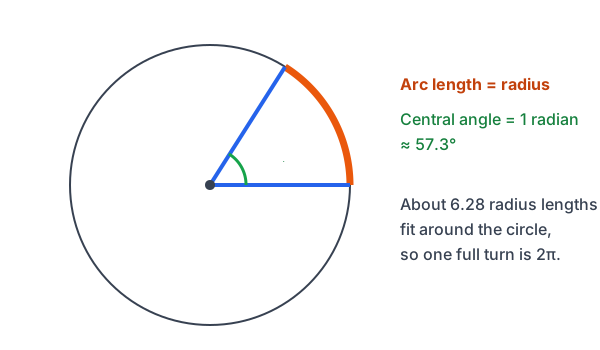
How many radii fit around the whole circle? The circumference is 2\pi r, so it holds 2\pi radius lengths, a little more than 6. That means one full turn is 2\pi radians:
360^\circ = 2\pi \text{ radians}, \qquad 180^\circ = \pi \text{ radians}Converting Between Degrees and Radians
\text{radians} = \text{degrees} \cdot \frac{\pi}{180^\circ} \qquad \text{degrees} = \text{radians} \cdot \frac{180^\circ}{\pi}Both conversion factors equal 1, because \pi radians and 180° are the same angle. Multiplying by them changes the units but not the angle. When no unit is written, an angle is in radians.
| Degrees | Radians |
|---|---|
| 0° | 0 |
| 30° | \frac{\pi}{6} |
| 45° | \frac{\pi}{4} |
| 60° | \frac{\pi}{3} |
| 90° | \frac{\pi}{2} |
| 180° | \pi |
| 270° | \frac{3\pi}{2} |
| 360° | 2\pi |
Worked Examples
Example 1: Degrees to radians
Convert 60^\circ to radians.
60^\circ \cdot \frac{\pi}{180^\circ} = \frac{60\pi}{180}Multiply by \frac{\pi}{180^\circ}.
\frac{60\pi}{180} = \frac{\pi}{3}Simplify the fraction by dividing the top and bottom by 60 (see greatest common factor)
Answer: 60^\circ = \frac{\pi}{3} radians
Example 2: A larger angle in degrees
Convert 225^\circ to radians.
225^\circ \cdot \frac{\pi}{180^\circ} = \frac{225\pi}{180}Multiply by \frac{\pi}{180^\circ}.
Find the GCF of 225 and 180: 45
\frac{225\pi}{180} = \frac{5\pi}{4}Divide the top and bottom by 45.
Answer: 225^\circ = \frac{5\pi}{4} radians. Leave \pi in the answer so it stays exact.
Example 3: Radians to degrees
Convert \frac{7\pi}{6} to degrees.
\frac{7\pi}{6} \cdot \frac{180^\circ}{\pi}Multiply by \frac{180^\circ}{\pi}.
\frac{7 \cdot 180^\circ}{6}Cancel \pi from the top and bottom.
7 \cdot 30^\circ
Divide 180 by 6.
7 \cdot 30^\circ = 210^\circ
Multiply.
Answer: \frac{7\pi}{6} = 210^\circ
Example 4: Radians without pi
Convert 2.5 radians to degrees. Round to the nearest hundredth.
2.5 \cdot \frac{180^\circ}{\pi}Multiply by \frac{180^\circ}{\pi}.
\frac{450^\circ}{\pi}Multiply the numbers on top.
\frac{450^\circ}{\pi} \approx 143.239^\circDivide with a calculator.
143.24^\circ
Round to the nearest hundredth.
Answer: about 143.24^\circ. Calculator note: type 450 ÷ π (on a TI-84, press 2nd, then ^ for π), then ENTER.
Example 5: Word problem with a sprinkler
A lawn sprinkler sprays water out to 15 feet and turns through 120°. How long is the curved outer edge of the wet area? Use the arc length formula s = r\theta, where \theta is in radians.
120^\circ \cdot \frac{\pi}{180^\circ} = \frac{120\pi}{180}Convert the angle to radians.
\frac{120\pi}{180} = \frac{2\pi}{3}Simplify by dividing the top and bottom by 60.
s = 15 \cdot \frac{2\pi}{3}Substitute into s = r\theta.
s = \frac{30\pi}{3} = 10\piMultiply.
10\pi \approx 31.42
Evaluate with a calculator.
Answer: The edge is 10\pi \approx 31.42 feet long. This matches the degree formula from arc length in Geometry, \frac{120}{360} \cdot 2\pi \cdot 15 = 10\pi.
Common Mistakes
| Mistake | Example of the error | Fix |
|---|---|---|
| Using the wrong conversion factor | 60^\circ \cdot \frac{180^\circ}{\pi} \approx 3438 | To get radians, put \pi on top: 60^\circ \cdot \frac{\pi}{180^\circ} = \frac{\pi}{3}. |
| Not simplifying the fraction | Leaving \frac{225\pi}{180} as the answer | Divide by the GCF, 45, to get \frac{5\pi}{4}. |
| Thinking every radian angle has pi in it | Saying 2.5 radians is not an angle | Any number can be a radian measure. 2.5 radians is about 143.24°. |
| Writing pi equals 180 | \pi = 180 | \pi is a number, about 3.14. It is \pi radians that equals 180°. |
| Using degrees in s = rθ | s = 15 \cdot 120 = 1800 feet | Convert to radians first: s = 15 \cdot \frac{2\pi}{3} = 10\pi. |
Related Methods
Count by special angles
Many radian angles are multiples of \frac{\pi}{6} (30°) or \frac{\pi}{4} (45°). For example, \frac{5\pi}{6} is 5 steps of 30°, or 150°. This is faster than using the formula.
Coterminal angles in radians
One full turn is 2\pi, so add or subtract 2\pi to find a coterminal angle. For example, \frac{\pi}{3} + 2\pi = \frac{7\pi}{3}.
Radians in calculus
Calculus uses radians almost all the time. The derivative rules for sine and cosine only come out simple when angles are in radians.
Practice Problems
- Convert 45^\circ to radians.
- Convert 150^\circ to radians.
- Convert -90^\circ to radians.
- Convert 330^\circ to radians.
- Convert \frac{\pi}{9} to degrees.
- Convert \frac{3\pi}{4} to degrees.
- Convert -\frac{5\pi}{3} to degrees.
- Convert 4 radians to degrees. Round to the nearest hundredth.
- Convert 72^\circ to radians.
- A wheel with a radius of 30 centimeters turns through 5 radians as it rolls. How far does it roll?
Show answers
1.
45^\circ \cdot \frac{\pi}{180^\circ} = \frac{45\pi}{180}Multiply.
\frac{\pi}{4}Divide the top and bottom by 45.
Answer: \frac{\pi}{4}
2.
150^\circ \cdot \frac{\pi}{180^\circ} = \frac{150\pi}{180}Multiply.
\frac{5\pi}{6}Divide the top and bottom by 30.
Answer: \frac{5\pi}{6}
3.
-90^\circ \cdot \frac{\pi}{180^\circ} = -\frac{90\pi}{180}Multiply.
-\frac{\pi}{2}Divide the top and bottom by 90.
Answer: -\frac{\pi}{2}
4.
330^\circ \cdot \frac{\pi}{180^\circ} = \frac{330\pi}{180}Multiply.
\frac{11\pi}{6}Divide the top and bottom by 30.
Answer: \frac{11\pi}{6}
5.
\frac{\pi}{9} \cdot \frac{180^\circ}{\pi}Multiply.
\frac{180^\circ}{9}Cancel \pi.
20^\circ
Divide.
Answer: 20^\circ
6.
\frac{3\pi}{4} \cdot \frac{180^\circ}{\pi}Multiply.
\frac{3 \cdot 180^\circ}{4}Cancel \pi.
3 \cdot 45^\circ
Divide 180 by 4.
135^\circ
Multiply.
Answer: 135^\circ
7.
-\frac{5\pi}{3} \cdot \frac{180^\circ}{\pi}Multiply.
-\frac{5 \cdot 180^\circ}{3}Cancel \pi.
-5 \cdot 60^\circ
Divide 180 by 3.
-300^\circ
Multiply.
Answer: -300^\circ
8.
4 \cdot \frac{180^\circ}{\pi} = \frac{720^\circ}{\pi}Multiply.
\frac{720^\circ}{\pi} \approx 229.183^\circDivide with a calculator.
Answer: about 229.18^\circ
9.
72^\circ \cdot \frac{\pi}{180^\circ} = \frac{72\pi}{180}Multiply.
\frac{2\pi}{5}Divide the top and bottom by 36.
Answer: \frac{2\pi}{5}
10.
s = 30 \cdot 5
Use s = r\theta with the angle in radians.
s = 150
Multiply.
Answer: 150 centimeters
FAQ
What is a radian?
A radian is the central angle that cuts off an arc equal in length to the radius of the circle. One full turn is 2\pi radians, about 6.28 radians.
How many degrees are in one radian?
One radian is \frac{180^\circ}{\pi}, which is about 57.3°.
How do you convert degrees to radians?
Multiply the degree measure by \frac{\pi}{180^\circ} and simplify. For example, 90^\circ \cdot \frac{\pi}{180^\circ} = \frac{\pi}{2}.
Why do we use radians instead of degrees?
Radians come from the circle itself, so formulas like arc length, s = r\theta, become simpler. They also make the formulas of calculus work cleanly.
Summary
- One radian is the central angle whose arc is as long as the radius.
- 180^\circ = \pi radians, and one full turn is 2\pi radians.
- Degrees to radians: multiply by \frac{\pi}{180^\circ}.
- Radians to degrees: multiply by \frac{180^\circ}{\pi}.
- With radians, arc length is s = r\theta.
Previous lesson: Coterminal Angles
Next lesson: Linear and Angular Speed
Back to the Trigonometry Index