
Arc Length
Arc length is the distance along a curved part of a circle. To find it, take the fraction of the circle the arc covers and multiply by the circumference. With the central angle \theta in degrees and radius r, the arc length is \frac{\theta}{360^\circ} \cdot 2\pi r.
Before this lesson: You should know Circumference and Area of Circles, Arcs and Central Angles and Proportions.
Arc Measure vs. Arc Length
An arc has two different numbers. Its arc measure is in degrees, and it equals the central angle. Its arc length is a distance, in units like centimeters or feet.
Two arcs can have the same measure but different lengths. A 60° arc on a pizza is much longer than a 60° arc on a coin. Arc length depends on both the angle and the radius.
The Arc Length Formula
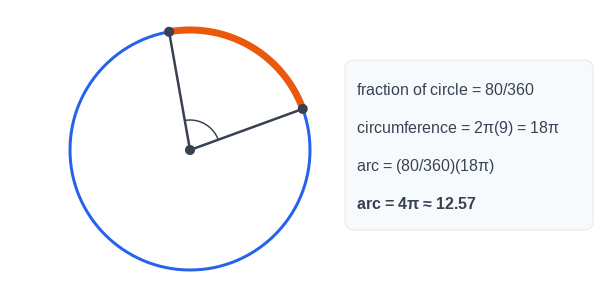
The whole circle is 360°, and its length is the circumference, 2\pi r. An arc with central angle \theta is the fraction \frac{\theta}{360^\circ} of the circle. So it is that same fraction of the circumference.
\text{arc length} = \frac{\theta}{360^\circ} \cdot 2\pi rYou can also set up a proportion. The arc is to the whole circle as the angle is to 360°:
\frac{\text{arc length}}{2\pi r} = \frac{\theta}{360^\circ}Give an exact answer in terms of \pi, like 4\pi. Then use a calculator for a decimal, like 12.57. In Trigonometry you will meet radians, which give a shorter formula, s = r\theta.
How to Find Arc Length
- Find the radius. If you know the diameter, divide it by 2.
- Find the central angle \theta of the arc. For a major arc, use 360° minus the minor arc.
- Write the fraction \frac{\theta}{360^\circ} and simplify it.
- Multiply by the circumference, 2\pi r.
- Give the exact answer in terms of \pi, then round if asked.
Worked Examples
Example 1: Find an arc length
A circle has a radius of 9 cm. Find the length of an arc with a central angle of 80°. Give the exact answer and the answer rounded to the nearest hundredth.
L = \frac{80}{360} \cdot 2\pi(9)Write the formula.
L = \frac{2}{9} \cdot 2\pi(9)Simplify the fraction (see fractions)
L = \frac{2}{9} \cdot 18\piMultiply 2 and 9 in the circumference.
L = 4\pi
Multiply (see multiplying and dividing fractions)
L \approx 12.57
Use a calculator.
Answer: 4\pi cm, or about 12.57 cm
Example 2: Start with the diameter
A circle has a diameter of 20 in. Find the length of a 135° arc.
r = \frac{20}{2} = 10Find the radius.
L = \frac{135}{360} \cdot 2\pi(10)Write the formula.
L = \frac{3}{8} \cdot 20\piSimplify the fraction.
L = \frac{60\pi}{8}Multiply.
L = 7.5\pi
Simplify.
L \approx 23.56
Use a calculator.
Answer: 7.5\pi in, or about 23.56 in
Example 3: Find the central angle
An arc in a circle of radius 12 m has length 10\pi m. Find its central angle.
10\pi = \frac{\theta}{360} \cdot 2\pi(12)Write the formula.
10\pi = \frac{\theta}{360} \cdot 24\piMultiply 2 and 12.
\frac{10}{24} = \frac{\theta}{360}Divide both sides by 24\pi.
\theta = \frac{10}{24} \cdot 360Multiply both sides by 360.
\theta = 150
Multiply.
Answer: The central angle is 150°.
Example 4: Find the radius
A 60° arc has length 6\pi ft. Find the radius of the circle.
6\pi = \frac{60}{360} \cdot 2\pi rWrite the formula.
6\pi = \frac{1}{6} \cdot 2\pi rSimplify the fraction.
6\pi = \frac{\pi r}{3}Multiply.
18\pi = \pi r
Multiply both sides by 3.
r = 18
Divide both sides by \pi.
Answer: The radius is 18 ft.
Example 5: Word problem with a pendulum
A pendulum is 90 cm long. Its tip swings through an angle of 24°. How far does the tip travel in one swing? Round to the nearest hundredth.

L = \frac{24}{360} \cdot 2\pi(90)The tip moves along an arc. The radius is the pendulum length, 90 cm. Write the formula.
L = \frac{1}{15} \cdot 2\pi(90)Simplify the fraction.
L = \frac{1}{15} \cdot 180\piMultiply 2 and 90.
L = 12\pi
Multiply.
L \approx 37.70
Use a calculator.
Answer: The tip travels about 37.70 cm.
Common Mistakes
| Mistake | Example of the error | Fix |
|---|---|---|
| Using the diameter as the radius | \frac{135}{360} \cdot 2\pi(20) when the diameter is 20 | Halve the diameter first: r = 10. |
| Giving the arc measure as the length | Arc length = 80° | Length is a distance: \frac{80}{360} \cdot 2\pi(9) = 4\pi cm. |
| Using the area formula | \frac{80}{360} \cdot \pi(9)^2 | Arc length uses the circumference, 2\pi r, not the area. |
| Using the minor arc angle for a major arc | Using 100° for the major arc | Major arc angle = 360^\circ - 100^\circ = 260^\circ. |
| Rounding \pi too early | Using 3 for \pi | Keep \pi until the end, then use the calculator’s \pi key. |
Related Idea: Rolling Wheels
Arc length also describes motion. A point moving around a circle covers arc length s = r\theta (with \theta in radians), which leads to linear and angular speed in Trigonometry.
When a wheel rolls one full turn without slipping, it moves forward one circumference, 2\pi r. A part of a turn moves it forward the matching arc length. That is how a bike’s odometer turns wheel turns into distance.
Practice Problems
Give each answer exactly in terms of \pi, then round to the nearest hundredth.
- Find the length of a 120° arc in a circle with radius 6 cm.
- Find the length of a 45° arc in a circle with radius 10 m.
- Find the length of a 270° arc in a circle with diameter 16 in.
- An arc of length 5\pi is in a circle of radius 15. Find its central angle.
- A 144° arc has length 8\pi. Find the radius.
- In a circle of radius 9, a minor arc has a central angle of 100°. Find the length of the major arc.
- The minute hand of a clock is 12 cm long. How far does its tip move in 25 minutes?
- A bike wheel has a radius of 35 cm. How far does the bike move when the wheel makes 3 full turns?
- Find the length of a semicircle with radius 7 ft.
- Two circles have radii 5 and 10. Each has a 60° arc. Find both arc lengths. How do they compare?
Show answers
1.
L = \frac{120}{360} \cdot 2\pi(6)Write the formula.
L = \frac{1}{3} \cdot 12\piSimplify the fraction.
L = 4\pi
Multiply.
L \approx 12.57
Use a calculator. The answer is in centimeters.
2.
L = \frac{45}{360} \cdot 2\pi(10)Write the formula.
L = \frac{1}{8} \cdot 20\piSimplify the fraction.
L = 2.5\pi
Multiply.
L \approx 7.85
Use a calculator. The answer is in meters.
3.
r = \frac{16}{2} = 8Find the radius.
L = \frac{270}{360} \cdot 2\pi(8)Write the formula.
L = \frac{3}{4} \cdot 16\piSimplify the fraction.
L = 12\pi
Multiply.
L \approx 37.70
Use a calculator. The answer is in inches.
4.
5\pi = \frac{\theta}{360} \cdot 2\pi(15)Write the formula.
5\pi = \frac{\theta}{360} \cdot 30\piMultiply 2 and 15.
\frac{5}{30} = \frac{\theta}{360}Divide both sides by 30\pi.
\theta = \frac{5}{30} \cdot 360Multiply both sides by 360.
\theta = 60^\circ
Multiply.
5.
8\pi = \frac{144}{360} \cdot 2\pi rWrite the formula.
8\pi = \frac{2}{5} \cdot 2\pi rSimplify the fraction.
8\pi = \frac{4\pi r}{5}Multiply.
40\pi = 4\pi r
Multiply both sides by 5.
r = 10
Divide both sides by 4\pi.
6.
360^\circ - 100^\circ = 260^\circ
Find the major arc angle.
L = \frac{260}{360} \cdot 2\pi(9)Write the formula.
L = \frac{13}{18} \cdot 18\piSimplify the fraction.
L = 13\pi
Multiply.
L \approx 40.84
Use a calculator.
7.
The minute hand turns 360° in 60 minutes, so in 25 minutes it turns \frac{25}{60} \cdot 360^\circ = 150^\circ
L = \frac{150}{360} \cdot 2\pi(12)Write the formula.
L = \frac{5}{12} \cdot 24\piSimplify the fraction.
L = 10\pi
Multiply.
L \approx 31.42
Use a calculator. The answer is in centimeters.
8.
2\pi(35) = 70\pi
One turn moves the bike one circumference.
3 \cdot 70\pi = 210\pi
Multiply by 3 turns.
210\pi \approx 659.73
Use a calculator. The answer is in centimeters.
9.
L = \frac{180}{360} \cdot 2\pi(7)A semicircle is 180°.
L = \frac{1}{2} \cdot 14\piSimplify the fraction.
L = 7\pi
Multiply.
L \approx 21.99
Use a calculator. The answer is in feet.
10.
L = \frac{60}{360} \cdot 2\pi(5) = \frac{1}{6} \cdot 10\pi = \frac{5\pi}{3} \approx 5.24Find the arc length for radius 5.
L = \frac{60}{360} \cdot 2\pi(10) = \frac{1}{6} \cdot 20\pi = \frac{10\pi}{3} \approx 10.47Find the arc length for radius 10.
The arcs have the same measure, but doubling the radius doubles the arc length.
Want more practice? The Geometry Unit 10 Practice Pack (Part 2) has 32 pages of problems on this and the other lessons in the unit, with step-by-step answers and a cheat sheet.
FAQ
What is the formula for arc length in degrees?
Arc length = \frac{\theta}{360^\circ} \cdot 2\pi r, where \theta is the central angle and r is the radius.
What is the difference between arc length and arc measure?
Arc measure is an angle in degrees and equals the central angle. Arc length is a distance, like 12.57 cm, and depends on the radius too.
How do you find arc length without the angle?
You need some way to get the angle. For example, if you know the arc is a fraction of the circle, multiply that fraction by the circumference. If you know the arc’s inscribed angle, double it to get the central angle.
Is arc length the same as circumference?
No. Circumference is the length of the whole circle. Arc length is the length of part of it, so it is a fraction of the circumference.
Summary
- Arc measure is in degrees. Arc length is a distance.
- Arc length = \frac{\theta}{360^\circ} \cdot 2\pi r: the fraction of the circle times the circumference.
- Use the radius, not the diameter, and 360° minus the minor arc for a major arc.
- Give exact answers in terms of \pi, then round.
- Arcs with the same measure get longer as the radius grows.
Previous lesson: Segment Relationships in Circles
Next lesson: Area of a Sector
Back to the Geometry Index